Recipe for a storm: The ingredients for more powerful Atlantic hurricanes
November 29, 2007 Recipe for a storm: The ingredients for more powerful Atlantic hurricanes

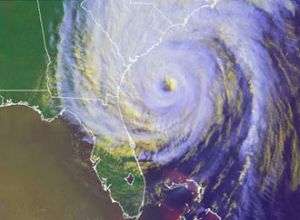
This satellite image composite shows Hurricane Floyd off the Atlantic coast in 1999. UW-Madison researchers Jim Kossin and Dan Vimont have established a connection between an atmospheric circulation pattern known as the Atlantic Meridional Mode and the strength of Atlantic hurricanes. Image: courtesy Cooperative Institute of Meteorological Satellite Studies

As the world warms, the interaction between the Atlantic Ocean and atmosphere may be the recipe for stronger, more frequent hurricanes.

UW-Madison scientists have found that the Atlantic organizes the ingredients for a powerful hurricane season to create a situation where either everything is conducive to hurricane activity or nothing is — potentially making the Atlantic more vulnerable to climate change than the world's other hurricane hot spots.

After the 2004 and 2005 hurricane seasons, many worry what Atlantic hurricane seasons will look like in a warmer world. Evidence indicates that higher ocean temperatures add a lot of fuel to these devastating storms.

In a paper published today, Nov. 29, in the "Bulletin of the American Meteorological Society," co-authors Jim Kossin and Dan Vimont caution against only looking at one piece of the puzzle. "Sea surface temperature is a bit overrated," says Kossin, an atmospheric scientist at UW-Madison's Cooperative Institute of Meteorological Satellite Studies. "It's part of a larger pattern."

Kossin and Vimont, a professor in the Department of Atmospheric and Oceanic Sciences, noticed that warmer water is just one part of a larger pattern indicating that the conditions are right for more frequent, stronger hurricanes in the Atlantic.

The atmosphere reacts to ocean conditions and the ocean reacts to the atmospheric situation, creating a distinct circulation pattern known as the Atlantic Meridional Mode (AMM). The AMM unifies the connections among the factors that influence hurricanes such as ocean temperature, characteristics of the wind and moisture in the atmosphere.

Finding that a basin-wide circulation pattern drives Atlantic hurricane activity helps explain evidence of significant differences in long-term hurricane trends among the world's basins.

In a study published last February, Kossin and his co-authors created a more consistent record of hurricane data that accounted for the significant improvement in storm detection that followed the advent of weather satellites. An analysis of this recalibrated data showed that hurricanes have become stronger and more frequent in the Atlantic Ocean over the last two decades. The increasing trend, however, is harder to identify in the world's other oceans.

Kossin and Vimont wanted to determine why long-term trends in the Atlantic looked different from those in other basins, particularly in the Pacific, where the majority of the world's hurricane activity occurs. "The AMM helps us understand why hurricanes in the Atlantic react differently to climate changes than those in the Pacific," Vimont says.

According to Vimont, the other oceanic basins have their own modes of variability. Understanding how factors vary together provides a new framework from which to consider climate change and hurricanes. "Our study broadens the interpretation of the hurricane-climate relationship," Vimont says.

Looking at the larger set of varying conditions provides a more coherent understanding of how climate change affects hurricane activity. In the Atlantic, warmer water indicates that other conditions are also ideal for hurricane development.

However, in the Pacific, a hurricane-friendly environment goes along with cooler ocean temperatures in the area where the storms spend their lives. The inconsistent relationship with sea surface temperature leads Vimont and Kossin to conclude that the connection between hurricane activity and climate variability hinges on more than just changes in ocean temperatures.

"You can never isolate one factor on this planet," Kossin says. "Everything is interrelated."

Depending on the other conditions hurricanes care about, warmer oceans can mean different outcomes. Concentrating on how the atmosphere and the ocean work together helps hurricane researchers see the bigger picture. Because higher sea surface temperatures in the Atlantic act in concert with the AMM, Vimont and Kossin suggest that Atlantic hurricanes will be more sensitive to climate changes than storms in other ocean basins.

In addition to helping researchers understand and predict the effects of climate change on hurricane activity, Vimont and Kossin can forecast the AMM up to a year in advance.

If the AMM is positive, all the conditions are right for hurricane development. If it is negative, those living on the coasts can generally expect a quieter hurricane season. Vimont and Kossin plan to further develop their AMM forecasts for use during the hurricane season.

The duo also hopes to continue to research the physical relationships that constitute the AMM as well as how future climate change will affect these modes of climate variability.

Source: UW-Madison, by Jennifer O'Leary


print this article email this article download pdf blog this article bookmark this article     Stumble it Digg this share on Facebook retweet share on Reddit add to delicious
Rate this story - 3.3 /5 (28 votes)

Rank Filter

Move the slider to adjust rank threshold, so that you can hide some of the comments.


Display comments: newest first

  • out7x - Nov 30, 2007
    • Rank: 1 / 5 (1)
    I will be happy if the 5 day forecast can be in the ballpark. Hurricane prediction is still more an art than a science.
  • wesgeorge - Nov 30, 2007
    • Rank: 1 / 5 (1)
    Forecasters predicted many more hurricanes in the Atlantic this year than what actually occurred. Then in a lame attempt to make up the difference they began to count storms that reached hurricane strength for only a few minutes well offshore before dissipating, a trick that earlier hurricane counters without the aid of sophisticated satellites or the ideological motivation lacked. So when they pull out a graph showing a hockey stick hike in hurricanes in the last few years, know that it is polluted with recent overcounts due to new technologies combined with an ideological fervor to prove the end is nigh.

    So far there is no real evidence that the number or strength of hurricanes is on the increase, however there is much evidence that some so-called scientists and politicians have a vested interest in seeing more and deadlier storms. Go figure.

November 29, 2007 all stories

Comments: 2

3.3 /5 (28 votes)
  • Stumble this up

  • Digg this

  • share this

  • hide
  • Related Stories

  • NASA's GOES Project offers real-time hurricane alley movies
    created 6 hours ago | popularity not rated yet | comments 0
  • Pacific El Nino equals Atlantic hurricane calm: experts
    created Oct 18, 2009 | popularity not rated yet | comments 0
  • Earth from Space: Typhoon Melor
    created Oct 09, 2009 | popularity not rated yet | comments 0
  • NASA satellite reveals a depressed and disorganized Henri
    created Oct 08, 2009 | popularity not rated yet | comments 0
  • Henri born in Eastern Atlantic... could be short-lived
    created Oct 07, 2009 | popularity not rated yet | comments 0


  • hide
  • Relevant PhysicsForums posts

  • cycles
    created Nov 08, 2009
  • The Origin of the term 'fossil' fuels
    created Nov 05, 2009
  • co2
    created Nov 03, 2009
  • Early Earths Sulfidic Ocean Conditions
    created Oct 30, 2009
  • vegetation
    created Oct 29, 2009
  • climate change
    created Oct 29, 2009
  • More from Physics Forums - Earth

Other News

Planetary Society plans new 'solar sail'

Space & Earth / Space Exploration

created 1hour ago | popularity not rated yet | comments 0

(AP) -- Four years after its first solar sail ended up in the ocean instead of orbit, The Planetary Society announced Monday that by the end of 2010 it will try again to launch a spacecraft that will be propelled by the ...


L-R: Chiwetel Ejiofor, Amanda Peet and John Cusack at the premiere of "2012"

NASA on crusade to debunk 2012 apocalypse myths

Space & Earth / Space Exploration

created 6 hours ago | popularity not rated yet | comments 0

The world is not coming to an end on December 21, 2012, the US space agency insisted Monday in a rare campaign to dispel widespread rumors fueled by the Internet and a new Hollywood movie.


Antarctica glacier retreat creates new carbon dioxide store

Antarctica glacier retreat creates new carbon dioxide store

Space & Earth / Earth Sciences

created 11 hours ago | popularity 3.5 / 5 (4) | comments 0

Large blooms of tiny marine plants called phytoplankton are flourishing in areas of open water left exposed by the recent and rapid melting of ice shelves and glaciers around the Antarctic Peninsula. This ...


NASA satellites make a movie and get rainfall, wind info on Ida

NASA satellites make a movie and get rainfall, wind info on Ida (w/ Video)

Space & Earth / Earth Sciences

created 6 hours ago | popularity not rated yet | comments 0

NASA satellites are amazing examples of technology. The TRMM satellite peers into tropical cyclones and can tell how much rain is falling per hour and where. QuikScat uses microwave technology to measure Ida's ...


Australian scientists call for urgent 'global cooling' to save coral reefs

Space & Earth / Environment

created 1hour ago | popularity 3 / 5 (2) | comments 0

(PhysOrg.com) -- Australian marine scientists have issued an urgent call for massive and rapid worldwide cuts in carbon emissions, deep enough to prevent atmospheric CO2 levels rising to 450 parts per million (ppm).