Scientists solve cosmological puzzle
November 29th, 2007 Scientists solve cosmological puzzle

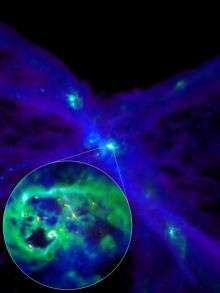
It is a picture of a dwarf galaxy forming one billion years after the Big Bang. The background image shows the large-scale cosmic context (the panel is approximately 100,000 light years across); the inset shows the central 2,000 light years of the dwarf galaxy where powerful feedback from newly born star clusters drives bulk motions in the gas. Stars are shown in yellow; colours from violet to blue to green to white correspond to gas of increasing density. Credit: S. Mashchenko, J. Wadsley, and H. M. P. Couchman

Researchers using supercomputer simulations have exposed a very violent and critical relationship between interstellar gas and dark matter when galaxies are born – one that has been largely ignored by the current model of how the universe evolved.

The findings, published today in Science, solve a longstanding problem of the widely accepted model – Cold Dark Matter cosmology – which suggests there is much more dark matter in the central regions of galaxies than actual scientific observations suggest.

“This standard model has been hugely successful on the largest of scales—those above a few million light-years—but suffers from several persistent difficulties in predicting the internal properties of galaxies,” says Sergey Mashchenko, research associate in the Department of Physics & Astronomy at McMaster University. “One of the most troublesome issues concerns the mysterious dark matter that dominates the mass of most galaxies.”

Supercomputer cosmological simulations prove that indeed, this problem can be resolved. Researchers modeled the formation of a dwarf galaxy to illustrate the very violent processes galaxies suffer at their births, a process in which dense gas clouds in the galaxy form massive stars, which, at the ends of their lives, blow up as supernovae.

“These huge explosions push the interstellar gas clouds back and forth in the centre of the galaxy,” says Mashchenko, the lead author of the study. “Our high-resolution model did extremely accurate simulations, showing that this ‘sloshing’ effect – similar to water in a bathtub— kicks most of the dark matter out of the centre of the galaxy.”

Cosmologists have largely discounted the role interstellar gas has played in the formation of galaxies and this new research, says Mashchenko, will force scientists to think in new terms and could lead to a better understanding of dark matter.

The simulations reported in the research paper were carried out on the Shared Hierarchical Academic Research Computing Network (SHARCNET).

Source: McMaster University


print this article email this article download pdf blog this article bookmark this article     Digg this Stumble it share on Facebook share on Reddit add to delicious save to Yahoo! bookmarks
4.1/5 after 54 votes

Rank Filter

Move the slider to adjust rank threshold, so that you can hide some of the comments.


Display comments: newest first

  • seanpu - Nov 30, 2007
    • Rank: not rated yet
    gas gas gas, all they see is gas! Where's all the plasma gone?
  • quantum_flux - Nov 30, 2007
    • Rank: not rated yet
    plasma and gas are sometimes used interchangeably in astronomy. This is exciting.

November 29th, 2007 all stories
Physics / General Physics

Comments: 2
Rank: 4.1/5 after 54 votes

  • Stumble this up

  • Digg this

  • Share it:
  • share on Facebook
  • share on MySpace
  • share on Slashdot
  • rss-newsfeed
  • share on Google
  • share on Reddit
  • add to delicious
  • save to Yahoo! bookmarks
  • share on Windows Live
  • Add to Mixx!
Rating: 4.1/5 after 54 votes

  • Related Stories

  • Intense heat killed the Universe's would-be galaxies, researchers say
    created Jul 01, 2009 | popularity not rated yet | comments 0
  • Computer Finds Massive Black Hole in Nearby Galaxy
    created Jun 09, 2009 | popularity not rated yet | comments 0
  • Is Everything Made of Mini Black Holes?
    created May 18, 2009 | popularity not rated yet | comments 0
  • Planck Satellite ready to measure the Big Bang
    created May 11, 2009 | popularity not rated yet | comments 0
  • The day the universe froze: New dark energy model includes cosmological phase transition
    created May 08, 2009 | popularity not rated yet | comments 0

Tags


  • Physicists Demonstrate Quantum Memory with Matter Qubits
    Physicists Demonstrate Quantum Memory with Matter Qubits
    Physics / General Physics
    created Jul 03, 2009 | popularity 4.4 / 5 (17) | comments 1
  • 'Holey' Nanosheets for Wastewater Dye Removal
    Nanotechnology / Nanomaterials
    created Jul 01, 2009 | popularity 5 / 5 (5) | comments 1
  • Jellyfish Robot Swims Like its Biological Counterpart
    Jellyfish Robot Swims Like its Biological Counterpart
    Electronics / Robotics
    created Jun 26, 2009 | popularity 4.4 / 5 (8) | comments 1
  • Could Maxwell's Demon Exist in Nanoscale Systems?
    Could Maxwell's Demon Exist in Nanoscale Systems?
    Physics / General Physics
    created Jun 24, 2009 | popularity 4.4 / 5 (18) | comments 29
  • Living Safely with Robots, Beyond Asimov's Laws
    Living Safely with Robots, Beyond Asimov's Laws
    Electronics / Robotics
    created Jun 22, 2009 | popularity 4.6 / 5 (52) | comments 40
  • Other News

    Scientists create first electronic quantum processor

    Scientists create first electronic quantum processor

    Physics / General Physics

    created Jun 28, 2009 | popularity 4.8 / 5 (52) | comments 39

    A team led by Yale University researchers has created the first rudimentary solid-state quantum processor, taking another step toward the ultimate dream of building a quantum computer.


    Science journals

    How to Spot an Influential Paper Based on its Citations

    Physics / General Physics

    created Jul 04, 2009 | popularity 4 / 5 (9) | comments 5

    (PhysOrg.com) -- At first it may seem that the number of citations received by a published scientific paper is directly related to that paper's quality of content. The higher the quality, the more people read ...


    Fermilab's CDF observes Omega-sub-b baryon

    Fermilab's CDF observes Omega-sub-b baryon

    Physics / General Physics

    created Jun 29, 2009 | popularity 4.7 / 5 (16) | comments 7

    (PhysOrg.com) -- At a recent physics seminar at the Department of Energy’s Fermi National Accelerator Laboratory, Fermilab physicist Pat Lukens of the CDF experiment announced the observation of a new particle, ...


    New insights, and a new angle, on high-temperature superconductivity

    New insights, and a new angle, on high-temperature superconductivity

    Physics / Superconductivity

    created Jun 29, 2009 | popularity 4.8 / 5 (13) | comments 6

    (PhysOrg.com) -- A Princeton-led research team has revealed surprising information about how electron behavior influences the conduction of electricity in a class of high-temperature superconductors. An increased ...


    The art of invisibility and the perfect cat's eye

    The art of invisibility and the perfect cat's eye

    Physics / Optics & Photonics

    created Jun 30, 2009 | popularity 4 / 5 (8) | comments 6

    (PhysOrg.com) -- In recent years scientists have explored the impossible by developing invisibility or 'cloaking' devices, but can the same technology also help make things more visible?