There's more than meets the eye in judging the size of an object
March 8th, 2006 There's more than meets the eye in judging the size of an object

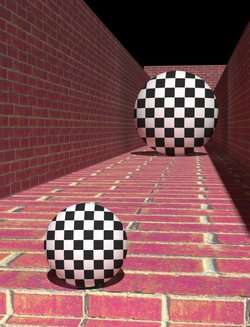
A visual illusion of two identical spheres makes the rear, or more distant one, appear to be larger. Image by Huseyin Boyaci

You can't always trust your eyes. Neuroscientists from the University of Washington and the University of Minnesota have found that the first area in the cortex of the human brain that receives information from the eyes processes the perceived size, rather than the actual size, of an object.

"Our eyes only tell us part of what we need to be able to see. The other part is done by the brain, taking the input from the eyes and making guesses or inferences about what's out there in the environment. Usually these inferences are very accurate, but sometimes they lead us astray in the form of visual illusions," said Scott Murray, a UW assistant psychology professor and lead author of a study published in the current issue of Nature Neuroscience.

Murray and his Minnesota colleagues, Huseyin Boyaci and Daniel Kersten, used functional magnetic resonance imaging (fMRI) to see how the brain processes the size of objects when faced with an illusion such as the long-known moon illusion. For centuries it has been known that the moon, while rising, looks huge when it is near the horizon and smaller when high in the sky. It is in reality always the same size.

The researchers used a similar illusion, one that looked at the perceived difference in the size of an object at different distances. For their experiment they placed two identical spheres decorated with a checkerboard pattern in the front and rear of a receding brick hallway. In this kind of illusion, the more distant object appears to occupy a larger portion of the visual field.

Using fMRI, the researchers examined how the brains of five people with normal vision registered this difference in perceived size. They found that the brain region known as the primary visual cortex, which is the first area in the cortex to receive input from the retina, showed a difference. Even though both spheres occupied exactly the same size on the retina, the rear sphere activated an approximately 20 percent larger area in the primary visual cortex than the front sphere. This difference closely matched a perceptual difference in size made by the subjects. Asked about the size of the two spheres, the people estimated the back sphere to be about 20 percent larger than the front one.

Murray said the simplicity of the results can belie its importance to anyone not involved in vision research.

"It almost seems like a first grader could have predicted the result. But virtually no vision or neuroscientist would have. The very dominant view is that the image of an object in the primary visual cortex is just a precise reflection of the image on the retina. I'm sure if one were to poll scientists, 99 percent of them would say the 'large' moon and the 'small' moon occupy the same amount of space in the primary visual cortex , assuming they haven't read our paper!"

Murray said such illusions are more than simple curiosities because they can help identify how the visual system works.

"Our finding is important because it demonstrates that the process of making inferences about visual properties in our environment is occurring in the earliest stages of the visual system," he said. "Researchers have long believed that the visual system is organized hierarchically, with early visual areas such as the primary visual cortex simply registering the physical input from the eyes and 'higher' visual areas attempting to put all the information together. This work challenges these theories of the organization of the visual system."

Source: University of Washington


print this article email this article download pdf blog this article bookmark this article     Digg this Stumble it share on Facebook share on Reddit add to delicious save to Yahoo! bookmarks
4.3/5 after 23 votes


March 8th, 2006 all stories
Other Sciences /

Comments: 0
Rank: 4.3/5 after 23 votes

  • Stumble this up

  • Digg this

  • Share it:
  • share on Facebook
  • share on MySpace
  • share on Slashdot
  • rss-newsfeed
  • share on Google
  • share on Reddit
  • add to delicious
  • save to Yahoo! bookmarks
  • share on Windows Live
  • Add to Mixx!
Rating: 4.3/5 after 23 votes

  • Related Stories

  • People who wear rose-colored glasses see more, study shows
    created Jun 03, 2009 | popularity not rated yet | comments 0
  • A glimpse at vision: First impressions count
    created Apr 29, 2009 | popularity not rated yet | comments 0
  • New Features Found in Einstein's Brain
    created Apr 21, 2009 | popularity not rated yet | comments 0
  • Researcher discovers brain cells have 'memory'
    created Apr 02, 2009 | popularity not rated yet | comments 0
  • Distinguishing between 2 birds of a feather
    created Aug 08, 2008 | popularity not rated yet | comments 0

Tags


  • Physicists Demonstrate Quantum Memory with Matter Qubits
    Physicists Demonstrate Quantum Memory with Matter Qubits
    Physics / General Physics
    created Jul 03, 2009 | popularity 4.4 / 5 (17) | comments 1
  • 'Holey' Nanosheets for Wastewater Dye Removal
    Nanotechnology / Nanomaterials
    created Jul 01, 2009 | popularity 5 / 5 (5) | comments 1
  • Jellyfish Robot Swims Like its Biological Counterpart
    Jellyfish Robot Swims Like its Biological Counterpart
    Electronics / Robotics
    created Jun 26, 2009 | popularity 4.4 / 5 (8) | comments 1
  • Could Maxwell's Demon Exist in Nanoscale Systems?
    Could Maxwell's Demon Exist in Nanoscale Systems?
    Physics / General Physics
    created Jun 24, 2009 | popularity 4.4 / 5 (18) | comments 29
  • Living Safely with Robots, Beyond Asimov's Laws
    Living Safely with Robots, Beyond Asimov's Laws
    Electronics / Robotics
    created Jun 22, 2009 | popularity 4.6 / 5 (52) | comments 40
  • Other News

    Creation Museum president Ken A. Ham

    Paleontologists brought to tears, laughter by Creation Museum

    Other Sciences / Other

    created Jun 30, 2009 | popularity 4.3 / 5 (44) | comments 124

    For a group of paleontologists, a tour of the Creation Museum seemed like a great tongue-in-cheek way to cap off a serious conference.


    Mummified dinosaur skin yields up new secrets

    Mummified dinosaur skin yields up new secrets

    Other Sciences / Archaeology & Fossils

    created Jul 01, 2009 | popularity 4.7 / 5 (15) | comments 10

    (PhysOrg.com) -- Scientists from The University of Manchester have identified preserved organic molecules in the skin of a dinosaur that died around 66-million years ago.


    Liberal? Conservative? Stanford study says mental nudge can make voters flip-flop

    Liberal? Conservative? Stanford study says mental nudge can make voters flip-flop

    Other Sciences / Social Sciences

    created Jul 02, 2009 | popularity 3.8 / 5 (5) | comments 4

    (PhysOrg.com) -- No doubt you’ve worked hard for your success. But chances are you’ve also had some help and lucky breaks along the way.


    Probing Question: How do Ponzi Schemes work?

    Other Sciences / Economics

    created Jul 02, 2009 | popularity 5 / 5 (2) | comments 2

    Imagine the shock, the horror, and the sheer panic that would come with learning that the financial plan you’d sunk your life savings into was a sham, the financial experts you trusted were crooks, and all your money was ...


    Tourists enjoy a "Pineapple Tour" in Costa Rica

    Costa Rica tops happiness, 'green living' poll

    Other Sciences / Social Sciences

    created Jul 04, 2009 | popularity 3 / 5 (3) | comments 0

    Costa Rica is the happiest place on earth, and one of the most environmentally friendly, according to a new survey by a British non-governmental group.