Fast-Talking NASA Spacecraft Starts Final Approach to Mars
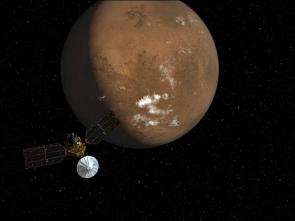
March 8, 2006 Artist's concept of Mar Reconnaissance Orbiter near Mars

Artist's concept of Mar Reconnaissance Orbiter near Mars. Image credit: NASA/JPL

NASA's Mars Reconnaissance Orbiter has begun its final approach to the red planet after activating a sequence of commands designed to get the spacecraft successfully into orbit.

The sequence began Tuesday and will culminate with firing the craft's main thrusters for about 27 minutes on Friday -- a foot on the brakes to reduce velocity by about 20 percent as the spacecraft swings around Mars at about 5,000 meters per second (about 11,000 miles per hour). Mission controllers at NASA's Jet Propulsion Laboratory, Pasadena, Calif., and Lockheed Martin Space Systems, Denver, are monitoring the events closely.

"We have been preparing for years for the critical events the spacecraft must execute on Friday," said JPL's Jim Graf, project manager. "By all indications, we're in great shape to succeed, but Mars has taught us never to get overconfident. Two of the last four orbiters NASA sent to Mars did not survive final approach."

Mars Reconnaissance Orbiter will build upon discoveries by five successful robots currently active at Mars: NASA rovers Spirit and Opportunity, NASA orbiters Mars Global Surveyor and Mars Odyssey, and the European Space Agency's Mars Express orbiter. It will examine Mars' surface, atmosphere and underground layers in great detail from a low orbit. It will aid future missions by scouting possible landing sites and relaying communications. It will send home up to 10 times as much data per minute as any previous Mars mission.

First, it must get into orbit. The necessary thruster burn will begin shortly after 1:24 p.m. Pacific Time on Friday. Engineers designed the burn to slow the spacecraft just enough for Mars' gravity to capture it into a very elongated elliptical orbit. A half-year period of more than 500 carefully calculated dips into Mars' atmosphere -- a process called aerobraking -- will use friction with the atmosphere to gradually shrink the orbit to the size and nearly-circular shape chosen for most advantageous use of the six onboard science instruments.

"Our primary science phase won't begin until November, but we'll actually be studying the changeable structure of Mars' atmosphere by sensing the density of the atmosphere at different altitudes each time we fly through it during aerobraking," said JPL's Dr. Richard Zurek, project scientist for the mission.

Source: NASA


print this article email this article download pdf blog this article bookmark this article     Stumble it Digg this share on Facebook retweet share on Reddit add to delicious
Rate this story - 4 /5 (19 votes)


March 8, 2006 all stories

Comments: 0

4 /5 (19 votes)
  • Stumble this up

  • Digg this

  • share this

  • hide
  • Related Stories

  • A Tale of Planetary Woe (w/ Video)
    created 18 hours ago | popularity not rated yet | comments 0
  • Unusual meteorite found by time-lapse camera observatory
    created Nov 05, 2009 | popularity not rated yet | comments 0
  • Planet Imager will enable telescopes to image extrasolar planets directly
    created Sep 29, 2009 | popularity not rated yet | comments 0
  • Space scientists set for final spacecraft flyby of Mercury
    created Sep 28, 2009 | popularity not rated yet | comments 0
  • Scientists see water ice in fresh meteorite craters on Mars
    created Sep 24, 2009 | popularity not rated yet | comments 0


Other News

Behavior modification could ease concerns about nanoparticles

Behavior modification could ease concerns about nanoparticles

Space & Earth / Environment

created 1hour ago | popularity not rated yet | comments 0

In an advance that could help ease health and environmental concerns about the emerging nanotechnology industry, scientists are reporting development of technology for changing the behavior of nanoparticles ...


A glimpse at the Earth's crust deep below the Atlantic

A glimpse at the Earth's crust deep below the Atlantic

Space & Earth / Earth Sciences

created 40 minutes ago | popularity not rated yet | comments 0

Long-term variations in volcanism help explain the birth, evolution and death of striking geological features called oceanic core complexes on the ocean floor, says geologist Dr Bram Murton of the National ...


Rosetta

Rosetta spacecraft may help unravel cosmic mystery (w/ Video)

Space & Earth / Space Exploration

created 20 minutes ago | popularity not rated yet | comments 0

When Europe's comet chaser Rosetta swings by Earth tomorrow for a critical gravity assist, tracking data will be collected to precisely measure the satellite's change in orbital energy. The results could help ...


A faraway planet intrigues: Exoplanet with extremely tilted orbit raises new interest in stellar astronomy

A faraway planet intrigues: Exoplanet with extremely tilted orbit raises new interest in stellar astronomy

Space & Earth / Astronomy

created 4 hours ago | popularity 5 / 5 (3) | comments 4

(PhysOrg.com) -- Two teams of astronomers have found a planet outside the solar system that might be orbiting backwards compared to its star's rotation, a discovery that could shed light on how unique the ...


Exoplanets Clue to Sun's Curious Chemistry

Exoplanets Clue to Sun's Curious Chemistry

Space & Earth / Astronomy

created 21 hours ago | popularity 4.7 / 5 (15) | comments 12

(PhysOrg.com) -- A ground-breaking census of 500 stars, 70 of which are known to host planets, has successfully linked the long-standing "lithium mystery" observed in the Sun to the presence of planetary systems. ...