An X-Ray Santa Claus in Orion
November 30th, 2007 The Orion Nebula

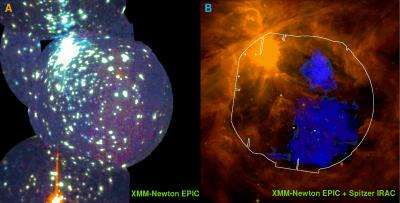
The images show the Orion nebula with its hot gas cloud. The left panel is an image obtained with XMM-Newton data from its European Photon Imaging Camera in X-rays. The right panel shows XMM-Newton data, compared to Spitzer observations of the same region. The Spitzer image is a composite image of data obtained in the infrared. The Orion nebula is the nearest dense star-forming region to Earth that contains stars much more massive than the Sun. XMM-Newton’s newly-discovered gas cloud is composed of winds blowing from these high-mass stars that are heated to millions of degrees as they slam into the surrounding gas. Credit: Panel A: XMM-Newton EPIC (Guedel et al.), Panel B: AAAS/Science (ESA XMM-Newton and NASA Spitzer data)

Right in time for the festive season, ESA's XMM-Newton X-ray observatory has discovered a huge cloud of high-temperature gas resting in a spectacular nearby star-forming region, shaped somewhat like the silhouette of Santa Claus.

An early present for astronomers, the cloud suggests that hot gas from many star-forming regions leaks into the interstellar medium.

The Orion nebula is the nearest dense star-forming region to Earth that contains stars much more massive than the Sun. XMM-Newton’s newly-discovered gas cloud is composed of winds blowing from these high-mass stars that are heated to millions of degrees as they slam into the surrounding gas.

“There is one star in particular that dominates the nebula,” says Manuel Güdel, Paul Scherrer Institut, Switzerland, who led the team that discovered the gas. The star in question is theta1 Orionis C, a giant star around 40 times mass of the Sun, with a surface temperature of 40,000°C. Güdel and his colleagues think that the violent collision between the wind from this star and the surrounding dense gas is largely responsible for the newly-discovered hot gas cloud.

The high-temperature gas fills a region of the nebula that appears to be a huge cavity in optical and infrared images. The new observations, taken with XMM-Newton’s European Photon Imaging Camera (EPIC) camera, suggest that astronomers are seeing only a particular portion of the gas. The X-rays from this portion escape absorption by patches of cold gas covering much of the front of the Orion nebula.

The surrounding pattern of absorbing clouds gives the detected gas its Santa Claus shape, with his prominent hat outlined by the northern gas bubble. In its entirety, the hot gas probably fills the whole nebula.

The team discovered it whilst conducting a survey of the young stars in the region. In the background of many of those images was a faint glow of X-rays. “The diffuse signal came up time and time again. Finally, we realized that it was something real,” says Güdel.

The presence of the hot gas in a fairly common nebula like Orion is surprising. Although theory has predicted such hot gas clouds, previous observations suggested that a large number of massive stars shedding winds, or supernova explosions are required. These are found in some regions of vigorous high-mass star formation, which are scattered only rarely throughout the galaxy. The new observations show that much smaller collections of high mass stars can produce hot gas as well.

There are many star-forming regions similar to the Orion nebula throughout the galaxy, so there should be a network of channels and bubbles being filled up by the hot gas leaking from these various regions. “This is another possible way to enrich the interstellar medium. You don’t have to wait for a sudden supernova to explode. You can do it with just one or two massive stars over millions of years,” says Güdel.

The team now plans to obtain new observations to determine how the gas flows out of the Orion nebula. In particular, they want to see whether it connects with a giant bubble created by supernova explosions from previous generations of massive stars.

Source: European Space Agency


print this article email this article download pdf blog this article bookmark this article     Digg this Stumble it share on Facebook share on Reddit add to delicious save to Yahoo! bookmarks
3.5/5 after 11 votes


November 30th, 2007 all stories
Space & Earth / Astronomy

Comments: 0
Rank: 3.5/5 after 11 votes

  • Stumble this up

  • Digg this

  • Share it:
  • share on Facebook
  • share on MySpace
  • share on Slashdot
  • rss-newsfeed
  • share on Google
  • share on Reddit
  • add to delicious
  • save to Yahoo! bookmarks
  • share on Windows Live
  • Add to Mixx!
Rating: 3.5/5 after 11 votes


Tags


  • Physicists Demonstrate Quantum Memory with Matter Qubits
    Physicists Demonstrate Quantum Memory with Matter Qubits
    Physics / General Physics
    created 19 hours ago | popularity 4.5 / 5 (11) | comments 1
  • 'Holey' Nanosheets for Wastewater Dye Removal
    Nanotechnology / Nanomaterials
    created Jul 01, 2009 | popularity 5 / 5 (5) | comments 1
  • Jellyfish Robot Swims Like its Biological Counterpart
    Jellyfish Robot Swims Like its Biological Counterpart
    Electronics / Robotics
    created Jun 26, 2009 | popularity 4.4 / 5 (7) | comments 1
  • Could Maxwell's Demon Exist in Nanoscale Systems?
    Could Maxwell's Demon Exist in Nanoscale Systems?
    Physics / General Physics
    created Jun 24, 2009 | popularity 4.4 / 5 (18) | comments 29
  • Living Safely with Robots, Beyond Asimov's Laws
    Living Safely with Robots, Beyond Asimov's Laws
    Electronics / Robotics
    created Jun 22, 2009 | popularity 4.6 / 5 (51) | comments 39
  • Other News

    Global warming tactic cools climate but won’t help corals, say researchers

    Space & Earth / Earth Sciences

    created 16 hours ago | popularity 2.3 / 5 (3) | comments 5

    (PhysOrg.com) -- “Geoengineering” experiments proposed to reduce global warming by blocking sunlight with atmosphere-injected particles may cool the world but still leave carbon dioxide levels dangerously high, Stanford scientists ...


    Coolest spacecraft ever in orbit around L2

    Coolest spacecraft ever in orbit around L2

    Space & Earth / Space Exploration

    created 18 hours ago | popularity 4.8 / 5 (4) | comments 3

    (PhysOrg.com) -- Last night, the detectors of Planck's High Frequency Instrument reached their amazingly low operational temperature of -273°C, making them the coldest known objects in space. The spacecraft ...


    Senator may have won fight over private rocket manufacturing

    Space & Earth / Space Exploration

    created 18 hours ago | popularity 4.5 / 5 (2) | comments 2

    For months, a powerful Republican senator from Alabama has fought the Obama administration to block $150 million that the White House wanted to spend to help private companies build rockets capable of reaching the international ...


    The least sea ice in 800 years

    The least sea ice in 800 years

    Space & Earth / Earth Sciences

    created Jul 01, 2009 | popularity 4.3 / 5 (57) | comments 43

    New research, which reconstructs the extent of ice in the sea between Greenland and Svalbard from the 13th century to the present indicates that there has never been so little sea ice as there is now. The ...


    Gas around young galaxy

    Intense heat killed the Universe's would-be galaxies, researchers say

    Space & Earth / Astronomy

    created Jul 01, 2009 | popularity 3.1 / 5 (18) | comments 23

    (PhysOrg.com) -- Our Milky Way galaxy only survived because it was already immersed in a large clump of dark matter which trapped gases inside it, scientists led by Durham University's Institute for Computational ...