How cells keep in shape
December 2, 2007 How cells keep in shape

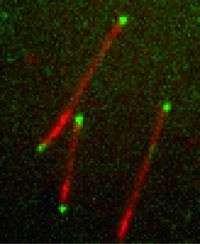
The fluorescence microscope image shows microtubules in red and plus-end tracking proteins that label growing microtubule ends in green. Credit: Peter Bieling, EMBL

Cells in our body come in various shapes and sizes. Each cell is shaped in such a way as to optimise it for a specific function. When things go wrong and a cell does not adopt its dedicated shape, its function can be impaired and the cell can cause problems in the body.

Researchers at the European Molecular Biology Laboratory (EMBL) and the Institute for Atomic and Molecular Physics (AMOLF), The Netherlands, have now decoded a molecular mechanism that plays an important role in the development of a cell’s shape. In this week’s issue of Nature they report a new experimental approach that sheds light on the interaction between proteins and the cell’s skeleton.

That each cell type has its unique shape is due to its cytoskeleton, an internal scaffold built of protein filaments. Especially important are microtubules, dynamic filaments that constantly grow and shrink. Their spatial organisation inside cells depends on a variety of regulator proteins, some of which only interact with the growing ends of these filament.

How these so called plus-end tracking proteins recognise the dynamic structure of a growing microtubule end is a long-standing puzzle. Researchers in the groups of Thomas Surrey and Damian Brunner at EMBL and of Marileen Dogetrom at AMOLF have now developed the first method that allows to simultaneously study multiple plus-end tracking molecules, so called +TIPs, in the test tube.

“+TIPs specifically bind to the fast-growing plus end of a microtubule and follow it as it grows. They act as a plus-end label so that other proteins know where to bind to regulate the filament’s stability,” says Surrey. “For years it has been impossible to reconstitute this behaviour in a test tube. Our new system now revealed which proteins need to be present for plus-end tracking and what the underlying mechanisms are.”

Applying the new method they succeeded in dissecting a minimal molecular system consisting of three end tracking proteins from yeast cells. The proteins were labelled with fluorescence to monitor their behaviour with a microscope. This procedure revealed that one of the proteins has the ability to recognise the specific structure of the growing microtubule tip, binds to it and acts as a loading platform for the other two proteins. The inherent motor activity of one of the other two proteins, which allows it to walk along microtubules, contributes to the ability of the molecular system to follow growing microtubule ends selectively.

“The great advantage of our new assay is that it can be applied to all kinds of other proteins that interact with microtubules,” says Peter Bieling, who carried out the research in Surrey’s lab. “It is a powerful approach that will advance our understanding of the large variety of different microtubule end tracking proteins and can shed light on their mechanics and functions.”

Source: European Molecular Biology Laboratory


print this article email this article download pdf blog this article bookmark this article     Stumble it Digg this share on Facebook retweet share on Reddit add to delicious
Rate this story - 4.3 /5 (9 votes)

Rank Filter

Move the slider to adjust rank threshold, so that you can hide some of the comments.


Display comments: newest first

  • HenisDov - Dec 03, 2007
    • Rank: not rated yet

    How Cells Keep In Shape? No,
    What Genomes Do With Building Materials!

    (1)
    http://www.physor...383.html

    - "Each cell is shaped in such a way as to optimise it for a specific function".

    - "...will advance our understanding of the large variety of different microtubule end tracking proteins and can shed light on their mechanics and functions.%u201D


    (2)
    http://blog.360.y...Q--?cq=1&p=372

    Chapter I.D., "Cells Are Not Organisms"

    - Scientifically, cells are NOT organisms. The outer cell membrane is an Organ. Plain and simple...it is a multifunctional organ of the genome...cellular membranes and cells' contents are evolution products of the in-cell organisms, the genomes. Continued reference to cells as organisms is a gross anachronism that brakes/slows developement of life sciences.

    (3)
    A Cell, in and out, is not only "specific application shaped" but also "specific application equipped", and the questions are:

    - WHEN does it thus become "dedicated" by its genome, and

    - How does it thus become "dedicated" by its genome, and

    - Can/Does the genome ever "undedicate a location-specific-application-dedicated cell".

    Dov Henis


December 2, 2007 all stories

Comments: 1

4.3 /5 (9 votes)
  • Stumble this up

  • Digg this

  • share this

  • hide
  • Related Stories

  • Atomic-level Snapshot Catches Protein Motor in Action (w/ Video)
    created Nov 20, 2009 | popularity not rated yet | comments 0
  • This is your brain on fatty acids
    created Oct 30, 2009 | popularity not rated yet | comments 0
  • Navigating in the ocean of molecules
    created Aug 07, 2009 | popularity not rated yet | comments 0
  • Navigating in the ocean of molecules
    created Jul 27, 2009 | popularity not rated yet | comments 0
  • Discovery to aid in future treatments of third-world parasites
    created Jul 27, 2009 | popularity not rated yet | comments 0


Other News

The six elephants in Sierra Leone were shot and "crudely butchered"

S.Leone elephants 'wiped out' by poachers: official

Biology / Ecology

created 15 hours ago | popularity 5 / 5 (4) | comments 5

Poachers "wiped out" the entire elephant herd in Sierra Leone's only wildlife park, wildlife managers said Thursday after police said they had arrested a gang of 10 poachers.


First-ever blueprint of a minimal cell is more complex than expected

First-ever blueprint of a minimal cell is more complex than expected

Biology / Cell & Microbiology

created 13 hours ago | popularity 5 / 5 (14) | comments 1

What are the bare essentials of life, the indispensable ingredients required to produce a cell that can survive on its own? Can we describe the molecular anatomy of a cell, and understand how an entire organism ...


Ecological speciation by sexual selection on good genes: Is speciation adaptive?

Biology / Ecology

created 13 hours ago | popularity 5 / 5 (1) | comments 0

Darwin suggested that the action of natural selection can produce new species, but 150 years after the publication of his famous book, 'On the Origin of Species', debate still continues on the mechanisms of speciation. New ...


Whiteflies sabotage alarm system of plant in distress

Whiteflies sabotage alarm system of plant in distress

Biology / Plants & Animals

created 17 hours ago | popularity 5 / 5 (2) | comments 0

(PhysOrg.com) -- When spider mites attack a bean plant, the plant responds by producing odours which attract predatory mites. These predatory mites then exterminate the spider mite population, thus acting ...


Knockouts in human cells point to pathogenic targets

Knockouts in human cells point to pathogenic targets

Biology / Cell & Microbiology

created 16 hours ago | popularity not rated yet | comments 0

(PhysOrg.com) -- Whitehead researchers have developed a new approach for genetics in human cells and used this technique to identify specific genes and proteins required for pathogens.