Researchers aim to harness sperm power for nano-robots
December 3, 2007
Researchers aim to harness sperm power for nano-robots

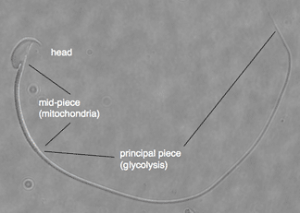
A mouse sperm. The long tail gets the energy it needs to swim from both mitochondria in the midpiece and glycolysis in the principal piece. Cornell scientists have borrowed a strategy from the sperm's principal piece in attempts to generate energy for nanodevices. Credit: Atsushi Asano

Researchers at Cornell are working to use the same energy that drives sperm to power nanoscale robots or to deliver chemo drugs or antibiotics, for example, to targeted sites within the body. The findings were presented at the American Society for Cell Biology's 47th annual meeting, Dec. 3, in Washington, D.C.

By breaking down the individual steps in the biological pathway that sperm use to generate energy, the researchers plan to reproduce that pathway for use in a human-made device.

"Our idea is not the final product but rather an energy-delivery system," said Alex Travis, Cornell assistant professor of reproductive biology at the College of Veterinary Medicine's Baker Institute for Animal Health and the study's senior author.

"As a proof of principle that this kind of strategy could work, we've shown that the first two enzymes could be attached to the same chip and act in series," added Chinatsu Mukai, a postdoctoral associate in Travis' lab and a co-author.

A midsection between the head and the long tail of sperm contains mitochondria, organelles that generate a cell's power. But sperm have also developed a second energy source to power their long tail. They employ a process known as glycolysis, which breaks down glucose to derive ATP, which cells use for energy.

The pathway for glycolysis requires 10 enzymes. Using special "targeting domains," sperm tether these to a fibrous sheath that runs the length of the tail. In this study, the researchers are trying to re-create this glycolytic pathway by modifying each protein's targeting domain so that they can instead bind to nickel ions on a manufactured chip.

So far, they have successfully attached three of the 10 enzymes required to make ATP from glucose, and each has remained functional. If they manage to attach all 10 enzymes, each enzyme will in principle act in a series to ultimately generate ATP to power a nano-device. In the body, such a device could conceivably use readily available blood glucose as fuel.

Potential uses include delivery systems loaded with chemo drugs or antibiotics to target specific cells. Such a system would allow doctors to provide steady doses while reducing side effects that result from treating the entire body with a drug.

Travis' group is trying to get funding to complete attaching the rest of the enzymes in the glycolysis pathway. "We have a provisional patent, so if a company shows interest, we could also work something out with them," said Travis.

Since the researchers only plan to re-create the biological pathway used by sperm to create energy, it will require input from bioengineers and different physicians and veterinarians to develop viable delivery systems and other innovative uses, Travis stressed.

Source: Cornell University

4.1 /5 (19 votes)  

Rank 4.1 /5 (19 votes)
Tags

Relevant PhysicsForums posts

More news stories

'Dark plasmons' transmit energy

Microscopic channels of gold nanoparticles have the ability to transmit electromagnetic energy that starts as light and propagates via "dark plasmons," according to researchers at Rice University.

Nanotechnology / Nanophysics

created 5 hours ago | popularity 5 / 5 (4) | comments 0 | with audio podcast

Nanotube therapy takes aim at breast cancer stem cells

Wake Forest Baptist Medical Center researchers have again proven that injecting multiwalled carbon nanotubes (MWCNTs) into tumors and heating them with a quick, 30-second laser treatment can kill them.

Nanotechnology / Bio & Medicine

created 10 hours ago | popularity 5 / 5 (1) | comments 0 | with audio podcast

Inspired by steel, nanomanufacturing gets wear-resistant carbide tip

(PhysOrg.com) -- Scientists at the University of Pennsylvania, the University of Wisconsin-Madison and IBM Research - Zurich have fabricated an ultrasharp silicon carbide tip possessing such high strength ...

Nanotechnology / Nanophysics

created 15 hours ago | popularity 5 / 5 (3) | comments 1 | with audio podcast

New technology platform for molecule-based electronics

Researchers at the Nano-Science Center at the University of Copenhagen have developed a new nano-technology platform for the development of molecule-based electronic components using the wonder material graphene. At the same ...

Nanotechnology / Nanomaterials

created 12 hours ago | popularity 5 / 5 (2) | comments 0

Australians risking skin cancer to avoid nanoparticles

More than three in five Australians are concerned enough about the health implications of nanoparticles in sunscreens to want to know more about their impact. And while the initial scientific information released suggests ...

Nanotechnology / Bio & Medicine

created 14 hours ago | popularity 5 / 5 (1) | comments 0


Hydrogen from acidic water: Researchers develop potential low cost alternative to platinum for splitting water

A technique for creating a new molecule that structurally and chemically replicates the active part of the widely used industrial catalyst molybdenite has been developed by researchers with the Lawrence Berkeley ...

FDA-approved drug rapidly clears amyloid from the brain, reverses Alzheimer's symptoms in mice

Neuroscientists at Case Western Reserve University School of Medicine have made a dramatic breakthrough in their efforts to find a cure for Alzheimer's disease. The researchers' findings, published in the journal Science, show t ...

Ultraviolet protection molecule in plants yields its secrets

Lying around in the sun all day is hazardous not just for humans but also for plants, which have no means of escape. Ultraviolet (UV) radiation from the sun can damage proteins and DNA inside cells, leading ...

Anyone can learn to be more inventive, cognitive researcher says

There will always be a wild and unpredictable quality to creativity and invention, says Anthony McCaffrey, a cognitive psychology researcher at the University of Massachusetts Amherst, because an "Aha moment" is rare and ...

Cell biologists describes mechanism by which some people may be more susceptible to colon cancer

An international research team led by cell biologists at the University of California, Riverside has uncovered a new insight into colon cancer, the third leading cause of cancer-related deaths in the United ...

New method makes culture of complex tissue possible in any lab

Scientists at the University of California, San Diego have developed a new method for making scaffolds for culturing tissue in three-dimensional arrangements that mimic those in the body. This advance, published online in ...