Scientists generate, modulate, and electrically detect pure spin currents in silicon
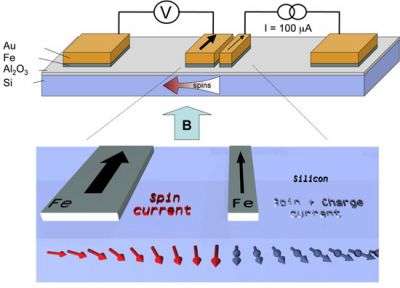
Scientists at the Naval Research Laboratory (NRL) have generated, modulated and electrically detected a pure spin current in silicon, the semiconductor used most widely in the electronic device industry. Magnetic contacts on the surface of an n-type silicon layer enable generation of a spin current which flows separately from a charge current.
The spin orientation is electrically detected as a voltage at a second magnetic contact. The relative magnetizations of these contacts allow full control over the orientation of the spin in the silicon channel. This was accomplished in a lateral transport geometry using lithographic techniques compatible with existing device geometries and fabrication methods.
This demonstration by NRL scientists is a key enabling step for developing devices which rely on electron spin rather than electron charge, an emergent field known as “semiconductor spintronics.” Progress in this field is expected to lead to devices which provide higher performance with lower power consumption and heat dissipation. The complete findings of this study, titled “Electrical injection and detection of spin-polarized carriers in silicon in a lateral transport geometry,” are published in the 19 November 2007 issue of Applied Physics Letters.
The electronics industry has relied largely on the control of charge flow, and through size scaling (i.e. reducing the physical size of elements such as transistors) has continuously increased the performance of existing electronics. However, size scaling cannot continue indefinitely as atomic length scales are reached, and new approaches must be developed. Basic research efforts at NRL and elsewhere have shown that spin angular momentum, another fundamental property of the electron, can be used to store and process information in metal and semiconductor based devices.
The 2007 Nobel Prize in Physics was awarded for the discovery of giant magnetorsistance, a phenomenon based upon spin-polarized electron currents in metals. This research moved from discovery in 1988 to commercial products in approximately 10 years, and is credited with the availability of low-cost, high density hard disk drives which are widely found in consumer products ranging from computers to video games and hand-held electronics. The spin angular momentum of electrons can be used to store and process information in semiconductor devices just as in metals.
Indeed, the International Technology Roadmap for Semiconductors (ITRS) has identified the use of the electron’s spin as a new state variable that should be explored as an alternative to the electron’s charge. The use of pure spin currents to process information is regarded as the “holy grail” of semiconductor spintronics, as it frees one from the constraints of capacitive time constants and resistive voltage drops and heat buildup which accompany charge motion.
Much of the initial research success in this field was achieved in III-V semiconductors with a direct band gap such as gallium arsenide, where powerful optical spectroscopic techniques are relatively easy to apply and enable detailed insight into the behavior of the spin system. Significant strides have recently been made by NRL scientists to utilize spin transport in silicon, an indirect gap material, as they demonstrated efficient injection of spin-polarized electrons from a ferromagnetic metal contact (Nature Physics 3, 542 (2007)).
They have now taken an important step towards the realization of a functional silicon spintronic device. In this very recent work, NRL scientists first inject a spin polarized electrical current from a ferromagnetic iron / aluminum oxide tunnel barrier contact into silicon, which generates a pure spin current flowing in the opposite direction. This spin current produces shifts in the spin-dependent electrochemical potential, which can be electrically detected outside of the charge path at a second magnetic contact as a voltage. The NRL team showed that this voltage is sensitive to the relative orientation of the spin in the silicon and the magnetization of the detecting contact .
They further showed that the orientation of the spin in the silicon could be uniformly rotated by an applied magnetic field, a process referred to as coherent precession, demonstrating that information could be successfully imprinted into the spin system and read out as a voltage. The generation of spin currents, coherent spin precession and electrical detection using magnetic tunnel barrier contacts and a simple lateral device geometry compatible with "back-end" silicon processing will greatly facilitate development of silicon-based spintronic devices.
Source: Naval Research Laboratory


