'Smart' flower bulbs pull themselves to deeper ground
December 3, 2007
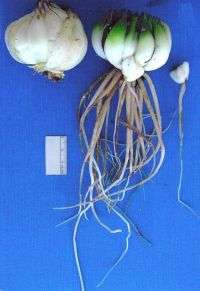
Mature mother bulb before and after root development. Note a bulblet formed on a scale of the middle bulb. On the right is a single bulblet with a contractile root. Credit: A. Carl Leopold
Confused about the right planting depth for flower bulbs? Trust the bulbs! Researchers have discovered that some flower bulbs are actually "smart" enough to adjust themselves to the right planting depth. A recent study published in the Journal of the American Society for Horticultural Science proved that bulbs can adjust their planting position by moving deeper into the ground, apparently in search of moister, more conducive growing conditions.
According to Dr. A. Carl Leopold, William H. Crocker Scientist Emeritus at The Boyce Thompson Institute for Plant Research at Cornell University, when gardeners plant tulips or lilies too shallowly in their gardens, the bulbs will respond to the shallow conditions by literally "pulling" themselves down into deeper ground. "One doesn't think of plants moving, and especially moving down into the ground, but our research proved that this movement occurs.", explained Leopold.
Leopold and the late Dr. Modecai Jaffe had studied plants for decades, but had never focused on bulb movement in soil. The duo was interested in working on the physiology of "contractile roots", or those roots that are responsible for bulbs' movement. Explained Leopold, "Negative growth is very rare in plants, and the sort of contractile proteins that are so well known to drive contraction in animal muscles do not occur in plants. We selected this work as a divergence from the usual studies of growth, and introduced the idea of contraction." He added that hundreds of books have been written about plant root growth, but none mention this phenomenon of negative growth.
The study focused on the "Nelly White" variety of Easter lily. Contractile roots were found to respond to light signals perceived by the bulb. Exposure to certain types of blue light forced new contractile roots to be formed on the bulbs and helped initiate the remarkable bulb movement.
Further explaining the study, Leopold noted that "contraction is evidenced by a formation of epidermal wrinkles, starting at the base of the root and advancing toward the root tip. The movement function occurs in shallowly planted materials, is lessened at deeper locations, and ceases at a vermiculite depth of 15 centimeters. Movement of the bulb in the soil is achieved by a hydraulic shift in cortical cells. Root contraction is stimulated by light."
The research team documented that perception of the light stimulus occurred in the bulblet or the subtending leaf. They also found that responsiveness to light faded as the roots aged. Experiments with light of different wavelengths indicated that the contraction response was triggered most often by blue light, and that blue light was the most effective in stimulating movement, suggesting the presence of a blue-absorbing pigment in the lily bulbs. The signal for contraction moved from the bulbs down into the roots, but the roots themselves did not respond to the light. The deeper the bulbs were planted, the less they formed contractile roots.
Summarizing the team's research, Leopold said that many plants have the ability to move down into soil—either to establish a more protected or stable location as in the case of many bulbs and tubers, or to provide stability for the plant. Bulbs "know" how to move down where environmental conditions are more constant.
Leopold mused, "I have some lily bulbs that were in the ground for nearly a decade, and I was astonished to find the bulbs moved themselves over a foot into the ground!". The research findings may help commercial and amateur gardeners in their quest for more effective bulb planting and growing techniques.
Source: American Society for Horticultural Science
-
Philippine solar light bottles offer hope
Nov 30, 2011 |
5 / 5 (3) |
8
-
Next Mars rover to zap rocks with powerful laser
Dec 23, 2010 |
4.3 / 5 (10) |
10
-
Green zone: After two years, did all her eco-friendly projects pay off?
Oct 21, 2010 |
5 / 5 (7) |
3
-
Scientists create metal that pumps liquid uphill
Jun 02, 2009 |
4.5 / 5 (27) |
22
-
The tulip entered Europe through al-Andalus five centuries before believed
Apr 16, 2009 |
4.6 / 5 (5) |
0
-
Engineers build first sub-10-nm carbon nanotube transistor
Feb 01, 2012 |
4.9 / 5 (31) |
30
-
Something old, something new: Evolution and the structural divergence of duplicate genes
Jan 31, 2012 |
4.6 / 5 (7) |
1
-
The hidden nanoworld of ice crystals: Revealing the dynamic behavior of quasi-liquid layers
Jan 30, 2012 |
5 / 5 (3) |
1
-
Stock market network reveals investor clustering
Jan 27, 2012 |
3.9 / 5 (23) |
8
-
Of microchemistry and molecules: Electronic microfluidic device synthesizes biocompatible probes
Jan 26, 2012 |
5 / 5 (1) |
0
More news stories
Entire genome of extinct human decoded from fossil
(PhysOrg.com) -- In 2010, Svante Pääbo and his colleagues presented a draft version of the genome from a small fragment of a human finger bone discovered in Denisova Cave in southern Siberia. The ...
Feb 07, 2012 |
4.7 / 5 (58) |
46
|
Why are there so few fish in the Earth's oceans?
(PhysOrg.com) -- A Stony Brook University researcher has found that, contrary to popular belief, there are not plenty of fish in the sea.
Feb 08, 2012 |
4.3 / 5 (17) |
26
|
Miami battling invasion of giant African snails
No one knows how they got there. But an invasion of African giant snails has southern Florida in a panic over potential crop damage, disease and general yuckiness surrounding the slimy gastropods.
Feb 10, 2012 |
4.5 / 5 (2) |
5
Deciding to go left or right: Researchers use device to determine that lower animals can navigate too
For decades, scientists have associated binary decision making opting to go left or right with higher-ranking animals, including humans. A team of Harvard researchers, however, is rewriting that ...
Feb 09, 2012 |
4 / 5 (1) |
4
|
Study shows chimps able to understand needs of others
(PhysOrg.com) -- By setting up a unique experiment, a small team of researchers has found that chimpanzees are able to understand need in other chimps, despite their general disinclination to offer aid when ...
Google might launch Drive for cloud storage soon
(PhysOrg.com) -- Google's next big move, according to the Wall Street Journal, is a cloud storage service called Drive. Hardly first to the plate, Google is simply catching up to introducing its cloud reposi ...
Latin America mining boom clashes with conservation
Latin America is experiencing a mining boom as prices rise fuelled by a hike in global demand, but the region is also being hit by a wave of violent protests, strikes and rallies by environmentalists.
Love a click away in Indonesia's Twitter Republic
He was a geeky kid from Yogyakarta, she a glamorous city girl in Jakarta. In a country with one of the world's most vibrant social networking scenes they fell in love on Twitter.
Europeans protest controversial Internet pact
Tens of thousands of people marched in protests in more than a dozen European cities Saturday against a controversial anti-online piracy pact that critics say could curtail Internet freedom.
Walney offshore wind farm is world's biggest (for now)
(PhysOrg.com) -- The Walney wind farm on the Irish Sea--characterized by high tides, waves and windy weather--officially opened this week. The farm is treated in the press as a very big deal as the Walney ...
Navy to begin tests on electromagnetic railgun prototype launcher
The Office of Naval Research (ONR)'s Electromagnetic (EM) Railgun program will take an important step forward in the coming weeks when the first industry railgun prototype launcher is tested at a facility ...
Dec 05, 2007
Rank: not rated yet