Wild strawberries may reduce cancer risk
December 3, 2007 Wild strawberries may reduce cancer risk

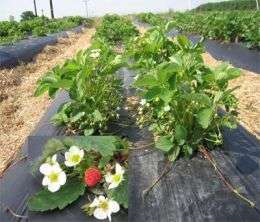
Seven types of wild strawberries, Fragaria virginiana, contain higher antioxidant levels and more potential to reduce cancer risk. Credit: Kim Lewers

We've all seen the term "super food" used to describe those nutrition-loaded edibles that promote health and discourage disease. Powerhouse foods high in antioxidants and phytochemicals that block the development of cancer cells have been touted as nature's way to fight off the potentially devastating disease.

When it comes to familiar super foods, strawberries rank among the best. These tasty red berries are known to be a significant source of vitamin C, a natural antioxidant that attracts and neutralizes free radicals—those invasive, highly reactive molecules that damage the body's natural cancer fighting cells. Many scientists believe that antioxidants can prevent cellular and tissue damage in the human body.

Dr. Shiow Y. Wang, a plant physiologist and biochemist at the U. S. Department of Agriculture's Agricultural Research Service, led a recent study that investigated the antioxidant capacity and anticancer activity of multiple species of wild strawberries. According to Dr. Wang, "antioxidants are natural plant chemicals that play an important role in promoting human health. While we have known that wild strawberries are a good source for obtaining desirable traits to be used in breeding programs, little information was available on antioxidant activities and their inhibitory effects on the growth of cancer cells in specific species of wild strawberries."

The study published in the Journal of the American Society for Horticultural Science found that antioxidant capacity and anti-cancer activity vary greatly among different types of wild strawberries. Researchers discovered seven types of wild strawberries that contain higher antioxidant levels and more potential to reduce cancer risk. "These seven types may be especially useful in developing cultivars with greater anticancer potential. They showed significantly greater anti-proliferation effects than other genotypes we tested", stated Dr. Wang.

Results of the research study will be valuable to scientists, fruit breeders, and produce growers interested in producing berries that are high in antioxidants. Varieties of the "super seven" strawberries may soon become available in local markets in the U.S., giving consumers a sweet new way to fight cancer.

Source: American Society for Horticultural Science


print this article email this article download pdf blog this article bookmark this article     Stumble it Digg this share on Facebook retweet share on Reddit add to delicious
Rate this story - 4.4 /5 (7 votes)


December 3, 2007 all stories

Comments: 0

4.4 /5 (7 votes)
  • Stumble this up

  • Digg this

  • share this

  • hide
  • Related Stories

  • Fruit fly pest identified in wine grapes
    created Oct 15, 2009 | popularity not rated yet | comments 0
  • Franklin's bumble bee may be extinct
    created May 26, 2009 | popularity not rated yet | comments 0
  • Women double fruit, veggie intake with switch to Mediterranean diet plan
    created Dec 17, 2008 | popularity not rated yet | comments 0
  • Fruits, vegetables and teas may protect smokers from lung cancer
    created May 29, 2008 | popularity not rated yet | comments 0
  • Strawberry daiquiris – the extra-healthy cocktail?
    created Apr 19, 2007 | popularity not rated yet | comments 0


  • hide
  • Relevant PhysicsForums posts

  • Has the H1N1 vaccine been scientifically proven to work?
    created 18 hours ago
  • nesfatin
    created Nov 22, 2009
  • Obsessive Compulsive Disorder
    created Nov 20, 2009
  • West's zone 2 starling resistor respiratory physiology
    created Nov 18, 2009
  • More from Physics Forums - Medical Sciences

Other News

Dentistry, a high-tech version: Robots not far off, doctor says

Medicine & Health / Health

created 44 minutes ago | popularity not rated yet | comments 0

Robots may practice dentistry one day, but there will always be humans telling you to open wide, said a teacher on the cutting edge of tooth care.


High salt intake directly linked to stroke and cardiovascular disease

Medicine & Health / Health

created 3 hours ago | popularity 4.7 / 5 (3) | comments 0

High salt intake is associated with significantly greater risk of both stroke and cardiovascular disease, concludes a study published in the BMJ today.


Early protein processes crucial to formation and layering of myelin membrane

Medicine & Health / Research

created 8 hours ago | popularity not rated yet | comments 0

New findings from an international team of researchers probing the nerve-insulating myelin sheath were bolstered by the work of Boston College biologists, who used x-rays to uncover how mutations affect the structure of myelin, ...


Six bad reactions to swine flu vaccine in Canada: official (Update)

Medicine & Health / Medications

created 15 hours ago | popularity 3.7 / 5 (6) | comments 4

Six severe allergic reactions to swine flu vaccinations have been observed in Canada, health authorities said Tuesday, adding that all of the individuals are feeling better.


Eye floaters and flashes of light linked to retinal tear, detachment

Eye floaters and flashes of light linked to retinal tear, detachment

Medicine & Health / Research

created 2 hours ago | popularity not rated yet | comments 0

Suddenly seeing floaters or flashes of light may indicate a serious eye problem that - if untreated - could lead to blindness, a new study shows.