December 3, 2007 weblog
Eco-Friendly Surveillance: NEC Develops Enhancement That Uses Fluorescent Light Tubes
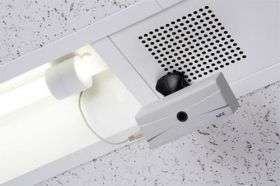
NEC has developed an Eco-Friendly adaptation that allows surveillance cameras to utilize energy from fluorescent light tubes. The surveillance system can be tucked into the false ceiling next to the fluorescent lights.
NEC has developed a wireless security camera that utilizes energy from fluorescent light tubes. Workplace employee surveillance cameras can be neatly tucked away in the false ceilings along side the fluorescent tubes.
The surveillance camera is tethered to the fluorescent light by a single wire with a ring-like adapter at one end. As reported by Digital World Tokyo, the camera is activated when the lights are turned on. The act of flipping the light switch activates the electricity generated by the Sharp-created technology located in the ring through electromagnetic induction.
The magnetic field created by the AC source in the fluorescent light tubes is the energy source the technology development utilizes. The magnetic field frequency of 45 to 100 kHz can be used by the ring to generate enough electricity,(120 mW), to power up the camera. The camera is a standard-VGA resolution unit that takes pictures every ten seconds.
The images are transferred to a PC utilizing an ordinary WiFi chip that draws power from the fluorescent light source. NEC is a leader in surveillance and security solutions for the 21st Century. NEC envisions the use of the energy saving technology will be useful for merchants in determining on-site marketing trends. Other uses include hotel surveillance for security purposes. In the work place, the unobtrusive surveillance system employs green technology and may entitle purchases to be offset by applicable rebates and credits.
NEC is focused on promoting environmentally conscious technologies and enhancements for current devices. NEC is a member of the "Team Minus 6% Project," whose mission it is to reduce energy consumption by six percent. NEC is currently involved in the development of solar power for PCs, recycling and the utilization of energy saving fluorescent light tubes as well as other alternative Eco-friendly energy sources.
Copyright 2007 Mary Anne Simpson & Physorg.com.
All rights reserved. Web Sites and Bloggers may provide the introductory paragraph and a link to the story, but may not copy, redistribute, rewrite or publish the story in whole or in part without written permission of the author or publisher.


