James Webb Space Telescope Component Undergoes Successful Design Review
December 3, 2007 James Webb Space Telescope Component Undergoes Successful Design Review

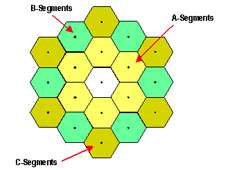
So that the segments work together as a single large mirror, the 18 mirror segments have been divided into 3 groups of six mirrors, each group having a slightly different shape. Credit: NASA

A preliminary design review has concluded and verified the integrated performance of all subsystems in the Optical Telescope Element on NASA’s James Webb Space Telescope.

The Optical Telescope Element or OTE is the "eye" of the Webb Observatory. The telescope consists of a 6.5-meter (21.3 foot) primary mirror; secondary, tertiary and fine steering mirrors; and supporting structures, deployable tower and control electronics.

"The successful completion of the Optical Telescope Element Preliminary Design Review is a significant milestone in the telescope development which demonstrates it's full feasibility and which allows the team to move on to final, detailed designs," said Lee Feinberg, James Webb Space Telescope Optical Telescope Element Manager at NASA's Goddard Space Flight Center, Greenbelt, Md.

"Meeting rigorous technology development requirements and successfully completing component design reviews earlier this year have given us confidence that the telescope will perform its mission within our cost and schedule commitments," said Martin Mohan, JWST program manager for Northrop Grumman’s Space Technology sector. Northrop Grumman is NASA’s prime contactor for the Webb Telescope, leading the design and development effort under contract to NASA Goddard.

Last January, before a team of experts assembled by NASA, the Northrop Grumman the telescope team demonstrated that the technology ready to move into the detailed engineering phase. Technology Readiness Level 6 was achieved for all critical telescope components, meaning prototypes had been successfully tested in a thermal vacuum chamber. The thermal vacuum simulates the very cold temperatures and vacuum of space.

At the review, the team also presented a plan for the final assembly and verification of the telescope. This includes all subsystems, backplane, thermal controls and hardware for sub-assemblies as well as simulated space environment testing at Johnson Space Center, Houston.

Significant progress is being made on key portions of the telescope. Machining of the 18 primary mirror flight segments was completed earlier this year and currently the backplane, which supports the primary mirror, is being fabricated.

The Webb Telescope will be the premier space observatory of the next decade, serving thousands of astronomers worldwide. It will study every phase in the history of our universe, from the first galaxies assembled in the universe, to the formation of solar systems potentially capable of supporting life, to the evolution of our own Solar System.

Source: NASA,


print this article email this article download pdf blog this article bookmark this article     Stumble it Digg this share on Facebook retweet share on Reddit add to delicious
Rate this story - 4 /5 (4 votes)


December 3, 2007 all stories

Comments: 0

4 /5 (4 votes)
  • Stumble this up

  • Digg this

  • share this

  • hide
  • Related Stories

  • First black holes may have incubated in giant, starlike cocoons
    created Nov 24, 2009 | popularity not rated yet | comments 0
  • 3 Questions: Sara Seager on searching for Earth-like planets
    created Nov 23, 2009 | popularity not rated yet | comments 0
  • SOFIA Seeks Secrets of Planetary Birth
    created Nov 19, 2009 | popularity not rated yet | comments 0
  • NASA's Wise Gets Ready to Survey the Whole Sky (w/ Video)
    created Nov 17, 2009 | popularity not rated yet | comments 0
  • The discovery of new Earths is imminent, UD astronomer says
    created Sep 28, 2009 | popularity not rated yet | comments 0


  • hide
  • Relevant PhysicsForums posts

  • Question about 2-body gravity
    created Nov 24, 2009
  • life on Mars
    created Nov 24, 2009
  • Semi-major axis from cartesian co-ordinates
    created Nov 23, 2009
  • Primary Mirror grinding
    created Nov 23, 2009
  • More from Physics Forums - General Astronomy

Other News

Monster Waves on the Sun are Real

Monster Waves on the Sun are Real (w/ Video)

Space & Earth / Astronomy

created 52 seconds ago | popularity not rated yet | comments 0

Sometimes you really can believe your eyes. That's what NASA's STEREO (Solar Terrestrial Relations Observatory) spacecraft are telling researchers about a controversial phenomenon on the sun known as the "solar ...


No Wheel Stall in Diagnostic Drive

Spirit Mars Rover: No Wheel Stall in Diagnostic Drive

Space & Earth / Space Exploration

created 18 minutes ago | popularity not rated yet | comments 0

(PhysOrg.com) -- On Sol 2095 (Tuesday, Nov. 24), Spirit performed a set of diagnostic actions related to a stall of the right-rear wheel on the previous drive, three days earlier.


Climate experts debate strategies for reducing atmospheric carbon and future warming

Climate experts debate strategies for reducing atmospheric carbon and future warming

Space & Earth / Environment

created 38 minutes ago | popularity not rated yet | comments 1

(PhysOrg.com) -- Reducing carbon dioxide to safe levels may require extracting carbon from the air, says Cornell climate researcher.


Image: Prometheus Plays Tug of War with One of Saturn's Rings

Image: Prometheus Plays Tug of War with One of Saturn's Rings

Space & Earth / Space Exploration

created 8 minutes ago | popularity not rated yet | comments 0

(PhysOrg.com) -- The diminutive moon Prometheus whips gossamer ice particles out of Saturn's F ring in this image taken by the Cassini spacecraft on Aug. 21, 2009.


Cosmic 'dig' reveals vestiges of the Milky Way's building blocks

Cosmic 'Dig' Reveals Vestiges of the Milky Way's Building Blocks

Space & Earth / Astronomy

created 4 hours ago | popularity 5 / 5 (8) | comments 1

(PhysOrg.com) -- Peering through the thick dust clouds of our galaxy's "bulge" (the myriads of stars surrounding its center), a team of astronomers has unveiled an unusual mix of stars in the stellar grouping ...