Asteroid Shower

December 3, 2007 Asteroid Shower

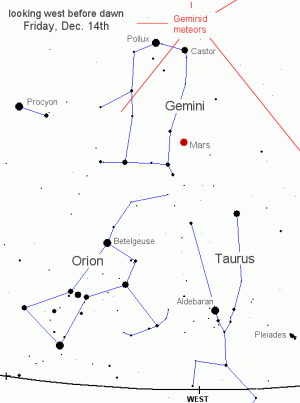
Mark your calendar: The best meteor shower of 2007 peaks on Friday, December 14th.

"It's the Geminid meteor shower," says NASA astronomer Bill Cooke of the Marshall Space Flight Center. "Start watching on Thursday evening, Dec. 13th, around 10 pm local time," he advises. "At first you might not see very many meteors—but be patient. The show really heats up after midnight and by dawn on Friday, Dec. 14th, there could be dozens of bright meteors per hour streaking across the sky."

The Geminids are not ordinary meteors. While most meteor showers come from comets, Geminids come from an asteroid—a near-Earth object named 3200 Phaethon.

"It's very strange," says Cooke. How does an asteroid make a meteor shower?

Comets do it by evaporating. When a comet flies close to the sun, intense heat vaporizes the comet’s "dirty ice" resulting in high-speed jets of comet dust that spew into interplanetary space. When a speck of this comet dust hits Earth's atmosphere traveling ~100,000 mph, it disintegrates in a bright flash of light—a meteor!

Asteroids, on the other hand, don't normally spew dust into space—and therein lies the mystery. Where did Phaethon's meteoroids come from?

One possibility is a collision. Maybe it bumped against another asteroid. A collision could have created a cloud of dust and rock that follows Phaethon around in its orbit. Such collisions, however, are not very likely.

Cooke favors another possibility: "I think 3200 Phaethon used to be a comet."

Exhibit #1 in favor of this idea is Phaethon's orbit: it is highly elliptical, like the orbit of a typical comet, and brings Phaethon extremely close to the sun, twice as close as Mercury itself. Every 1.4 years, Phaethon swoops through the inner solar system where repeated blasts of solar heat could easily reduce a flamboyant comet to the rocky skeleton we see today.

If this scenario is correct, Phaethon-the-comet may have produced many rich streams of dust that spent hundreds or thousands of years drifting toward Earth until the first Geminid meteors appeared during the US Civil War. Since then, Geminids have been a regular shower peaking every year in mid-December.

3200 Phaethon is now catalogued as a "PHA"—a potentially hazardous asteroid whose path misses Earth's orbit by only 2 million miles. It measures 5 km wide, about half the size of the asteroid or comet that wiped out the dinosaurs 65 million years ago, and can be seen through backyard telescopes—in fact, now is a good time to look:

"3200 Phaethon is flying past Earth just a few days before this year’s Geminid meteor shower," notes Cooke. On Dec. 10th, Phaethon will be about 11 million miles away shining like a 14th magnitude star in the constellation Virgo: ephemeris. That's too dim for the naked eye, he says, but a good target for amateur telescopes equipped with CCD cameras.

Cooke doesn't expect the flyby to boost the Geminids—"11 million miles is too distant to affect meteor rates"—but the Geminids don't really need boosting. "It's always a great shower," he says. "Don't miss it."

Source: by Dr. Tony Phillips, Science@NASA


print this article email this article download pdf blog this article bookmark this article     Stumble it Digg this share on Facebook retweet share on Reddit add to delicious
Rate this story - 4.4 /5 (18 votes)


December 3, 2007 all stories

Comments: 0

4.4 /5 (18 votes)
  • Stumble this up

  • Digg this

  • share this

  • hide
  • Related Stories

  • The 2006 Geminid Meteor Shower
    created Dec 13, 2006 | popularity not rated yet | comments 0
  • Lunar Leonid Strikes
    created Dec 04, 2006 | popularity not rated yet | comments 0
  • Making A Meteor
    created Jun 20, 2005 | popularity not rated yet | comments 0
  • The best meteor shower of 2004 peaks on Dec. 13th
    created Dec 10, 2004 | popularity not rated yet | comments 0
  • Lunar Geminids
    created Jan 04, 2007 | popularity not rated yet | comments 0


  • hide
  • Relevant PhysicsForums posts

  • The shape of our solar system's orbits.
    created Nov 07, 2009
  • Above or Below the Line of Nodes
    created Nov 07, 2009
  • Supernova vs. Nova?
    created Nov 07, 2009
  • Supernova's Gamma Rays and Comets
    created Nov 06, 2009
  • More from Physics Forums - General Astronomy

Other News

Deep creep means milder, more frequent earthquakes along Southern California's San Jacinto fault

Deep creep means milder, more frequent earthquakes along Southern California's San Jacinto fault

Space & Earth / Earth Sciences

created 20 hours ago | popularity 4.5 / 5 (4) | comments 0

With an average of four mini-earthquakes per day, Southern California's San Jacinto fault constantly adjusts to make it a less likely candidate for a major earthquake than its quiet neighbor to the east, the ...


Success in 'space elevator' competition (AP)

Success in 'space elevator' competition (Update 3)

Space & Earth / Space Exploration

created Nov 05, 2009 | popularity 4.3 / 5 (33) | comments 50

(AP) -- A robot powered by a ground-based laser beam climbed a long cable dangling from a helicopter on Wednesday to qualify for prize money in a $2 million competition to test the potential reality of the ...


In a Galaxy Far, Far Away...

In a Galaxy Far, Far Away...

Space & Earth / Astronomy

created Nov 06, 2009 | popularity 4.8 / 5 (5) | comments 17

(PhysOrg.com) -- Astronomers have published the discovery of the farthest known object in the cosmos: a star that exploded when the universe was only 630 million years old -- only 4.6% of its current age. ...


'Dropouts' pinpoint earliest galaxies

'Dropouts' pinpoint earliest galaxies

Space & Earth / Astronomy

created Nov 06, 2009 | popularity 4.2 / 5 (10) | comments 13

Astronomers, conducting the broadest survey to date of galaxies from about 800 million years after the Big Bang, have found 22 early galaxies and confirmed the age of one by its characteristic hydrogen signature ...


Space hotel taking bookings for 2012 opening

Space hotel taking bookings for 2012 opening

Space & Earth / Space Exploration

created Nov 05, 2009 | popularity 4.4 / 5 (21) | comments 11

(PhysOrg.com) -- The first orbiting space hotel is on track to open for its first customers in 2012, but hurry, as bookings are filling fast.