Proving an aspect of the AB effect: when Newton's Third Law doesn't work
December 4th, 2007 By Miranda Marquit Adam Caprez

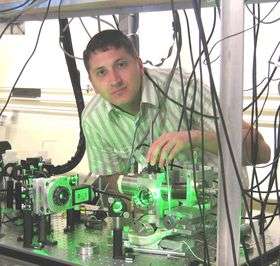
University of Nebraska-Lincoln graduate student Adam Caprez fires up the pulsed electron laser used to test the no forces aspect of the Aharonov-Bohm effect. Credit: Herman Batelaan

An action doesn’t always result in a reaction.

One of the interesting phenomena present in quantum mechanics is the Aharonov-Bohm (AB) effect. The AB effect predicts that a charged particle, usually an electron in experiments, shows effects from electromagnetic fields in regions where the particle is excluded. This leads to the interesting fact that, in electromagnetism, Newton’s Third Law of Motion doesn’t always hold true.

Herman Batelaan explains to PhysOrg.com: “If you want to move anything in the world around you, you need forces. But in the Aharonov-Bohm effect, the electron reacts without any forces. There is no force, but something happens.”

Batelaan, a scientist at the University of Nebraska-Lincoln oversaw an experiment done by graduate student, Adam Caprez, and Brett Barwick to demonstrate the absence of forces in the AB effect. A description of the experiment, and their results, is available in Physical Review Letters: “Macroscopic Test of the Aharonov-Bohm Effect.”

“The interesting thing,” Batelaan says, “is that experimentally scientists have detected evidence of this effect, and it is mentioned in textbooks. But nobody had shown that no forces are there.” The experiment performed at the University of Nebraska-Lincoln constitutes the first demonstration of a lack of forces. “We know the effects, and this is expected.” Batelaan continues. “Theoretically, scientist predicted this, but we want to see this. Now we have it.”

Experimental demonstrations of the AB effect usually include carefully controlled electrons using a distant electromagnetic field. “We understand the physics of this, such that we can take electrons and control them so well that we can see quantum mechanics happening,” Batelaan says. In order to perform the current experiment, the team used a pulse laser to hit a metal needle, a method developed at Stanford.

“You have a pulsed electron source,” Batelaan explains, “and you have something you can time.” Batelaan says that if a force is present there will either be a delay, or an early arrival. The experiment showed no time delay, and this demonstrates that the AB effect lacks forces, even though something is clearly happening with the electrons.

Caprez said that what he found most appealing is that, “we have a rare example where quantum mechanics, electromagnetism and relativity are all working at the same time.”

As far as immediate applications are concerned, Batelaan admits that there isn’t much about this experiment that will be useful on a practical level right now. But, he insists, “This is very fundamental quantum mechanically. It is helpful in terms of a better understanding on the quantum level.” He points out that devices are reducing in size at a rapid pace, and that as science and technology shrink, “we will need to understand the interplay between quantum mechanics and electromagnetic fields as deep as possible.”

Copyright 2007 PhysOrg.com.
All rights reserved. This material may not be published, broadcast, rewritten or redistributed in whole or part without the express written permission of PhysOrg.com.


print this article email this article download pdf blog this article bookmark this article     Digg this Stumble it share on Facebook share on Reddit add to delicious save to Yahoo! bookmarks
4/5 after 96 votes

Rank Filter

Move the slider to adjust rank threshold, so that you can hide some of the comments.


Display comments: newest first

  • LearmSceince - Dec 04, 2007
    • Rank: 3.4 / 5 (5)
    Hype, and bad reporting.
    Newton's 3rd says that momentum is conserved. The "effect" is a phase shift, not a change in momentum. So, if the electron did feel a force, that would be a violation of Newton's law. He showed that there is no violation, the opposite of what the article says.
  • weewilly - Dec 04, 2007
    • Rank: 5 / 5 (2)
    Is this "off the top of the head" type of reporting? Sure would rather get a review of what is found out a day or two later with accuracy than up to the minute fantasies. Physics.org_fantacies
  • gopher65 - Dec 04, 2007
    • Rank: 5 / 5 (1)
    Ah thanks for that LearmSceince (I had to try and spell that name 3 times before I got it righ... wrong). I went 0_o while reading this article, but I hadn't heard of the Aharonov-Bohm Effect, and the article didn't bother to explain itself, so I didn't want to outright dismiss it. Now I'll go look it up. Well, I would have done that anyway I guess.

    This author needs to go work for NewScientist. They'd appreciate her skills there:P. Misleading title, misleading article, and borderline wrong "facts". Yup, definitely NS material.
  • Weir - Dec 05, 2007
    • Rank: 2.5 / 5 (4)
    Non-causal action-at-distance in the experiment implies the existence of quantum forces that are not operative through space and time. The non-locality of a single electron confirms that physical matter has both universal and particular aspects. An atom is the intimate coherence of these two fundamental characteristics common to all physical phenomena.

    This is not consistent with linear causality either in the Newtonian or Relativity sense. The continuous field concept in the sense of matter embedded in a preconceived a priori space-time is faulty. Einstein himself wrote: I consider it quite possible that physics cannot be based on the field concept, that is, on continuous structures. Then nothing remains of my entire castle in the sky, including the theory of gravitation, but also nothing of the rest of modern physics. (In a letter to Michele Besso in 1954, the year before he died.) In a discontinuous universe a different picture emerges that is consistent with the evidence and with common sense.

    Planck's constant indicates a discontinuity in the synchronous projection of particulate matter as in a cosmic movie. The electromagnetic rainbow is sliced across it entire breadth with the recurrent projection of each frame. EM radiation comes to us as a discontinuous series of pulses. The universal component of independently projected atoms regulates their synchronous projection in a series of independent still space frames linked up by light. All relative motion is a series of quantum jumps between these discrete still particle frames. Light is the only activity within each space frame and it is quantized by each space frame, along with space and time. Light comes from inside atoms and has a universal relationship to each atom, accounting for its universal velocity. So light itself defines space. Where there is no light, there is a black hole in space. And obviously physical effects can not be transmitted through the integrated fabric of space-time faster than light if it defines space.

    This requires that Newtons Third Law does not apply in a continuous way to quantum events measured over short periods of time, because there is a primary interval of time associated with the synchronous projection of each atomic space frame. Successive space frames are discontinuously assimilated from an integrated timeless quantum frame (called the Void) by the universal characteristic of matter. The Void is a spatially indeterminate energy field orthogonal to the integrated fabric of space-time that we perceive as continuous even though matter is synchronously oscillating between particulate Form and its energy equivalent in the Void. In this way sub-atomic particles remain implicitly and timelessly correlated. So do all atoms. All relative particle action takes place via the integrating quantum frame, called the Void, and this is synchronously timeless.

    Relative motions introduce synchronous distortions as a result of relative space frame skipping with a corresponding accumulation of quantum energy equivalents in the Void. This accounts for relativistic effects but also introduces a small family of quantum forces, since accumulated energy must at some point find expression on the space frame side of the movie. These quantum effects are not transmitted as a force through space-time. They can only manifest synchronously with the projection of each space frame, and this is inconsistent with Newtons Third Law on a quantum scale. A new quantum-relativity emerges naturally that also accounts for gravitation. This offers a new and more meaningful methodology to the physical and biological sciences. There is more at www.cosmic-mindreach.com.
  • Ragtime - Dec 05, 2007
    • Rank: 1 / 5 (1)
    I have to support weewilly's opinion. Furthemore, I don't understand, why the AB effect is not considered as a force effect. The electron is moving just by action of force - or not? And outside of solenoid is magnetic field too, as the magnetic field is sourceless, its must remain closed. This experiment just shows, the DeBroglie wave affects large area of vacuum, surrounding the particle, that's all. Does the AB effect work with torroid, where the magnetic field remains fully closed inside of coil?
  • Ragtime - Dec 05, 2007
    • Rank: 3.7 / 5 (3)
    BTW Here's the original article, containing the scheme of experiment.

    http://arxiv.org/...2428.pdf
  • Ragtime - Dec 05, 2007
    • Rank: 1 / 5 (2)
    Despite of poor and missleading interpretation in media it's quite nice and well arranged experiment, demonstrating the fundamental aspects of deBroglie wave, which is surrounding the moving particle at the distance, like the fish, swiming fastly beneath the water surface. No wonder, here's no time delay, because this wave (which is spreading by the speed od light) anticipates the actual particle location.

    http://superstrun...wing.gif
  • fleem - Dec 05, 2007
    • Rank: 5 / 5 (2)
    Put it this way. If this really violated conservation of momentum, it wouldn't be simply casually mentioned in obscure literature here and there over the years. Rather, large armies of scientists would be screaming and pulling their hair out. They aren't, so it doesn't.... (probably)
  • templeghost - Dec 06, 2007
    • Rank: not rated yet
    The important question seems to be whether the phase shift changes the momentum of the electron. We need to consider the wave equation of the charged particle.

    The phase was originally unaffected, but then without force but through the action of magnetic vector potentials, the phase was made to change. If the phase of the electron has changed, it seems sure that the momentum of the electron was, at the very least, momentarily affected.

    In the case of the magnetic Aharanov-Bohm effect, it is clear and experimentally verfified that absolutely no force is required to change the phase of surrounding electrons. For instance, a transfomer or electric motor is often shielded so as not to produce large magnetic fields outside the enclosure, however, the magnetic vector potentials are a very fundamental force which do not decay at the same rate as the field.

    Where the classical magnetic field has faded to zero, the magnetic vector potentials still exist and change the phase of charged particles. It seems clear that these vector potentials will interact most strongly with transition metals, especially those with only a single valence electron such as copper, silver and gold.

    In addition, a highly permeable metal such as nickel will surely endure a change in electronic state. Where our biochemistry is guided by a complex interplay of electron transfer, particularly between transition metals, it begs the question, what effect do the magnetic vectors produce in the real world?
  • Ragtime - Dec 06, 2007
    • Rank: 1 / 5 (2)
    ..."absolutely no force is required to change the phase of surrounding electrons"... by the same way, like absolutely no force is required to change the phase of light beam, for example by inserting of half-wave resonator into its path.

    Or not? Can be some action, which influents the inertial reality be ever done without exertion of energy, i.e. some inertial force along certain path?
  • quantum_flux - Dec 10, 2007
    • Rank: not rated yet
    Momentum and energy are conserved on the quantum scale. It's just a matter of considering a 4-vector and an uncertainty principle.
  • LearmSceince - Dec 10, 2007
    • Rank: 5 / 5 (1)
    Ragtime: think of moving something from one place to another on a horizontal surface. Potential energy is the same before and after; kinetic energy is the same (zero) before and after. In the quantum world, you can stop there. In the macro world, consider a frictionless surface and a mechanism which expends energy to start the block moving and then recovers the energy when breaking.

    templeghost: Look at the effects of an MRI scan. No side effects whatsoever.
  • templeghost - Dec 11, 2007
    • Rank: 1 / 5 (2)
    I thought lightheadedness, a metallic taste, nausea and seeing 'lightning' were side effects.

    Has anyone conducted a study to see if multiple MRI scans increase the risk of rare blood cancers?

    Why not start with the records of atheletes who frequently have MRI scans for sports related injuries?

    They have absolutley no conception of what they are doing! Ask the people who work around intense magnetic fields what fantasies they tend to enjoy, you might be surprised how powerful the side effects are.

December 4th, 2007 all stories
Physics / General Physics

Comments: 13
Rank: 4/5 after 96 votes

  • Stumble this up

  • Digg this

  • Share it:
  • share on Facebook
  • share on MySpace
  • share on Slashdot
  • rss-newsfeed
  • share on Google
  • share on Reddit
  • add to delicious
  • save to Yahoo! bookmarks
  • share on Windows Live
  • Add to Mixx!
Rating: 4/5 after 96 votes

  • Related Stories

  • NuTeV Anomaly Helps Shed Light on Physics of the Nucleus
    created Jun 29, 2009 | popularity not rated yet | comments 0
  • Why Saints Sin and Sinners Get Saintly
    created Jun 26, 2009 | popularity not rated yet | comments 0
  • Naming may be key to brain's ability to recognize faces
    created Jun 25, 2009 | popularity not rated yet | comments 0
  • Study pinpoints novel cancer gene and biomarker
    created Jun 24, 2009 | popularity not rated yet | comments 0
  • Imaging the hypnotized brain: Neural mechanisms of suggested paralysis
    created Jun 24, 2009 | popularity not rated yet | comments 0

Tags


  • Physicists Demonstrate Quantum Memory with Matter Qubits
    Physicists Demonstrate Quantum Memory with Matter Qubits
    Physics / General Physics
    created Jul 03, 2009 | popularity 4.4 / 5 (17) | comments 1
  • 'Holey' Nanosheets for Wastewater Dye Removal
    Nanotechnology / Nanomaterials
    created Jul 01, 2009 | popularity 5 / 5 (5) | comments 1
  • Jellyfish Robot Swims Like its Biological Counterpart
    Jellyfish Robot Swims Like its Biological Counterpart
    Electronics / Robotics
    created Jun 26, 2009 | popularity 4.4 / 5 (8) | comments 1
  • Could Maxwell's Demon Exist in Nanoscale Systems?
    Could Maxwell's Demon Exist in Nanoscale Systems?
    Physics / General Physics
    created Jun 24, 2009 | popularity 4.4 / 5 (18) | comments 29
  • Living Safely with Robots, Beyond Asimov's Laws
    Living Safely with Robots, Beyond Asimov's Laws
    Electronics / Robotics
    created Jun 22, 2009 | popularity 4.6 / 5 (52) | comments 40
  • Other News

    UQ researchers break the law -- of physics

    Physics / General Physics

    created 1hour ago | popularity 4.4 / 5 (5) | comments 0

    (PhysOrg.com) -- Two UQ Science researchers have proved two famous physical laws that have been widely used for the past 25 years do not always work.


    Scientists create first electronic quantum processor

    Scientists create first electronic quantum processor

    Physics / General Physics

    created Jun 28, 2009 | popularity 4.8 / 5 (54) | comments 41

    A team led by Yale University researchers has created the first rudimentary solid-state quantum processor, taking another step toward the ultimate dream of building a quantum computer.


    Science journals

    How to Spot an Influential Paper Based on its Citations

    Physics / General Physics

    created Jul 04, 2009 | popularity 4 / 5 (9) | comments 6

    (PhysOrg.com) -- At first it may seem that the number of citations received by a published scientific paper is directly related to that paper's quality of content. The higher the quality, the more people read ...


    Fermilab's CDF observes Omega-sub-b baryon

    Fermilab's CDF observes Omega-sub-b baryon

    Physics / General Physics

    created Jun 29, 2009 | popularity 4.7 / 5 (17) | comments 7

    (PhysOrg.com) -- At a recent physics seminar at the Department of Energy’s Fermi National Accelerator Laboratory, Fermilab physicist Pat Lukens of the CDF experiment announced the observation of a new particle, ...


    New insights, and a new angle, on high-temperature superconductivity

    New insights, and a new angle, on high-temperature superconductivity

    Physics / Superconductivity

    created Jun 29, 2009 | popularity 4.8 / 5 (13) | comments 6

    (PhysOrg.com) -- A Princeton-led research team has revealed surprising information about how electron behavior influences the conduction of electricity in a class of high-temperature superconductors. An increased ...