New hypothesis for origin of life proposed
December 4, 2007 New hypothesis for origin of life proposed

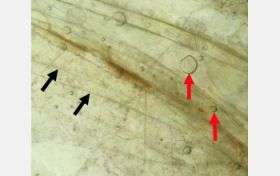
Photo of mica from an abandoned mica mine, with water between some layers, showing edges of mica sheets [e.g., black arrows] and air bubbles in the water [red arrows] and brown bands of organic crud and dirt. Credit: Helen Greenwood Hansma, UC Santa Barbara

Life may have begun in the protected spaces inside of layers of the mineral mica, in ancient oceans, according to a new hypothesis.

The hypothesis was developed by Helen Hansma, a research scientist with the University of California, Santa Barbara and a program director at the National Science Foundation. Hansma will present her findings at a press briefing on Tues., Dec. 4, at the annual meeting of the American Society for Cell Biology in Washington, D.C.

The Hansma mica hypothesis proposes that the narrow confined spaces between the thin layers of mica could have provided exactly the right conditions for the rise of the first biomolecules –– effectively creating cells without membranes. The separation of the layers would have also provided the isolation needed for Darwinian evolution.

“Some think that the first biomolecules were simple proteins, some think they were RNA, or ribonucleic acid,” said Hansma. “Both proteins and RNA could have formed in between the mica sheets.”

RNA plays an important part in translating the genetic code, and is composed of nitrogenous bases, sugar, and phosphates. RNA and many proteins and lipids in our cells have negative charges like mica. RNA’s phosphate groups are spaced one half nanometer apart, just like the negative charges on mica.

Mica layers are held together by potassium. The concentration of potassium inside the mica is very similar to the concentration of potassium in our cells. And the seawater that bathed the mica is rich in sodium, just like our blood.

The heating and cooling of the day to night cycle would have caused the mica sheets to move up and down, and waves would have provided a mechanical energy source as well, according to the new model. Both forms of movement would have caused the forming and breaking of chemical bonds necessary for the earliest biochemistry.

Thus the mica layers could have provided the support, shelter, and an energy source for the development of precellular life, while leaving artifacts in the structure of living things today.

Besides providing a more plausible hypothesis than the prebiotic oceanic “soup” model, Hansma said her new hypothesis also explains more than the so-called “pizza” hypothesis. That model proposes that biomolecules originated on the surfaces of minerals from the Earth’s crust. The “pizza” hypothesis cannot explain how the earliest biomolecules obtained the right amount of water to form stable biopolymers.

A biophysicist, Hansma has worked with mica for decades beginning with her work in biological Atomic Force Microscopy (AFM) in the late 1980s. “We put our samples on mica, because it is so atomically flat, so flat that we can see even bare DNA molecules as little ridges on the mica surface,” said Hansma. “The layered mineral is made of sheets so thin (one nanometer) that there are a million of them in a millimeter-thick sheet of mica.”

Hansma came upon her idea one day last spring when she was splitting some mica under her dissecting microscope. She had collected the specimens in a mica mine in Connecticut. The mica was covered with organic material. “As I was looking at the organic crud on the mica, it occurred to me that this would be a good place for life to originate –– between these sheets that can move up and down in response to water currents which would have provided the mechanical energy for making and breaking bonds,” said Hansma.

Source: University of California - Santa Barbara


print this article email this article download pdf blog this article bookmark this article     Stumble it Digg this share on Facebook retweet share on Reddit add to delicious
Rate this story - 4.3 /5 (100 votes)

Rank Filter

Move the slider to adjust rank threshold, so that you can hide some of the comments.


Display comments: newest first

  • BigTone - Dec 04, 2007
    • Rank: 3.4 / 5 (5)
    Cool idea to have a ready made natural incubator for fragile lifeforms to take shape... I just hope this doesn't become an arbitrary "Goldilocks Zone" requirement for life... It would be a shame if scientists created yet another absolutist movement on this front and we have to listen to crap like - we just haven't detected enough mica on this planet for it to have created its own indigenous microbial life forms...
  • Valentiinro - Dec 04, 2007
    • Rank: 1 / 5 (2)
    Haha yes, good point.
  • mattytheory - Dec 04, 2007
    • Rank: 5 / 5 (1)
    The scientists in this case are only suggesting a new way for life to have possibly originated here on Earth. They say nothing in the article about extending this theory to other worlds. They were merely comparing the structure of our DNA to the similarities in structure of micah at a molecular level (a scale that both share in common). Additionally, classifying this as a "Goldilocks Zone" would be useless because science has already identified other ways in which life can originate.
  • SDMike - Dec 04, 2007
    • Rank: 1 / 5 (2)
    So, why aren't scientists looking at mica that is exposed to seawater and wave action for new forms of life? Why, there should thousands of new life forms being produced every day! Mica mines should be just the place to look for signs of life on earth.

  • Zitface - Dec 04, 2007
    • Rank: 3 / 5 (2)
    This may connect to the recent finding that the double helix structure of DNA reflects a crystalline ancestry.
  • seanpu - Dec 05, 2007
    • Rank: 1 / 5 (3)
    life never originated on earth. there's no evidence for it. Nor does this article attempt to answer the question, where did the information within the DNA come from. Its impossible for Darwinian evolution to answer that question, so this article is practically useless.

    Well done to the author though for finding another way in which cells can be created. Its more likely that some DNA will find its way into the mica and process the environment to make a living cell, but it will not work in reverse.
  • DarkStar - Dec 06, 2007
    • Rank: 1 / 5 (1)
    I may have anticipated Dr. Hansma's findings. The following essay was written, not entirely tongue-in-cheek, in April of 2006, which was the same time period ("one day last spring") quoted by Hansma for her interesting discovery:

    http://www.useles...208.html

    Sorry, Helen, but I deserve to share the spotlight with you! Read my (humorous?) reaction here: http://www.useles...008.html

    S.Dayton
  • out7x - Dec 06, 2007
    • Rank: 2.5 / 5 (2)
    The pre-biotic soup was at the bottom of the ocean, along a seafloor volcanic vent. This allows for the mixing of many chemicals, and heat flow.
  • Ragtime - Dec 06, 2007
    • Rank: 1 / 5 (2)
    In general, the protected, calm zones exhibits the slowest speed of evolution. Try to consider, how slowly the sharks have evolved at the bottom of oceans!

    The Aether Wave Theory considers instead, the life has begun due the strong competetion of bubbles, fragmented repetetivelly at the surface foam of ground sea.

December 4, 2007 all stories

Comments: 9

4.3 /5 (100 votes)
  • Stumble this up

  • Digg this

  • share this

  • hide
  • Related Stories

  • Gadgets: Picks from the PhotoPlus Expo
    created Oct 28, 2009 | popularity not rated yet | comments 0
  • Gene variation is 'major genetic determinant of psoriasis'
    created Aug 27, 2009 | popularity not rated yet | comments 0
  • Discovery to aid study of biological structures, molecules
    created Aug 11, 2009 | popularity not rated yet | comments 0
  • Virtual Worlds May Be the Future Setting of Scientific Collaboration
    created Aug 04, 2009 | popularity not rated yet | comments 0
  • Jade sheds light on Guatemala's geologic history
    created Jul 27, 2009 | popularity not rated yet | comments 0


Other News

Prized mushroom collection returns to China

Biology / Plants & Animals

created 18 hours ago | popularity 4.5 / 5 (2) | comments 0

(AP) -- A Chinese scholar persecuted during the Cultural Revolution for smuggling a rare collection of mushrooms out of China before World War II was honored Saturday when the collection was returned more than 70 years later.


Sea lions killed, but Columbia salmon toll rises (AP)

Sea lions killed, but Columbia salmon toll rises

Biology / Ecology

created 18 hours ago | popularity not rated yet | comments 1

(AP) -- Killing or removing 25 California sea lions over the past two years has not reduced the toll on salmon at the base of Bonneville Dam in the Columbia River.


Laser etching safe alternative for labeling grapefruit

Laser etching safe alternative for labeling grapefruit

Biology / Other

created Nov 03, 2009 | popularity 4.4 / 5 (14) | comments 8

Laser labeling of fruit and vegetables is a new, patented technology in which a low-energy carbon dioxide laser beam is used to label, or "etch" information on produce, thereby eliminating the need for common ...


Wolves, moose and biodiversity: An unexpected connection

Wolves, moose and biodiversity: An unexpected connection

Biology / Ecology

created Nov 02, 2009 | popularity 4.8 / 5 (6) | comments 4

Moose eat plants; wolves kill moose. What difference does this classic predator-prey interaction make to biodiversity?


Caught in the act: Butterfly mate preference shows how 1 species can become 2

Caught in the act: Scientists find butterflies splitting into two species

Biology / Plants & Animals

created Nov 05, 2009 | popularity 4.5 / 5 (8) | comments 2

(PhysOrg.com) -- Breaking up may actually not be hard to do, say scientists who've found a population of tropical butterflies that may be on its way to a split into two distinct species.