The Unusual Insulating Properties of a Superconductor
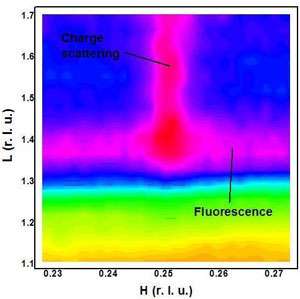
Since their discovery, high-temperature superconductors, a class of remarkable materials that conduct electricity with almost zero resistance, have perplexed scientists. Despite many, many studies, how these materials do what they do is still not well understood. At the National Synchrotron Light Source, scientists have discovered a perhaps odd, yet important clue to the puzzle - that a common high-temperature superconductor actually has distinct insulating properties.
The superconductor is known as "LBCO," named for the elements it contains: lanthanum, barium, copper, and oxygen. LBCO is widely studied and, despite all there is yet to learn, researchers have learned some important things about it. For example, the barium atoms act as the material's sole electric carriers by introducing positively charged vacancies, called "holes," that electrons can jump to. Changing the amount of barium in LBCO thus changes its superconducting behavior. At a certain critical amount of barium - oddly enough - the superconductivity of LBCO disappears.
This disappearance of the superconductivity coincides with the formation of ribbon-like magnetic regions in the material, known as "stripes." Stripes were discovered by Brookhaven Lab physicist John Tranquada in 1995.
"What we were able to show that the holes in LBCO are sandwiched between these magnetic stripes, forming ribbons of electric charge," said Abbamonte. "Significantly, we also found that the magnetic regions have insulating properties. Therefore, the material as a whole is neither a metal nor an insulator, since it retains characteristics of both."
These findings are the result of work performed at NSLS beamline X1B, where the scientists studied LBCO using an x-ray technique called "resonant soft x-ray scattering." They aimed a beam of x-rays at an LBCO sample and used a detector to measure how the x-rays reflected away from the material. They then analyzed these reflections to reveal information about LBCO's electronic structure.
The results of this study are important because they support the theory that stripes are in some way related to superconductivity in high-temperature superconductors.
"Our results seem to support the stripe description of high-temperature superconductors. This is exciting, since it could mean that the scientific community may be very close to truly understanding how these materials perform," said Abbamonte.
The research was published in the December 2005 edition of Nature Physics. The paper's co-authors are Andrivo Rusydi (University of Hamburg), Serban Smadici (BNL/University of Illinois), Genda Gu (BNL), George Sawatzky (University of British Columbia and University of Groningen), and D.L. Feng (Fudan University). The work was supported by the U.S. Department of Energy, the Dutch Science Foundation, and the Netherlands Organization for Fundamental Research on Matter.
Source: National Synchrotron Light Source, by Laura Mgrdichian


