NASA finds stronger storms change heat and rainfall worldwide
March 9, 2006
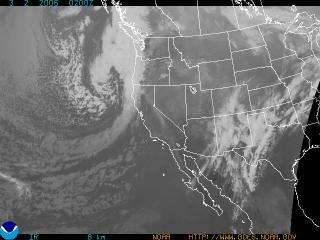
Comma-shaped storm systems in the mid-latitude regions, like the one shown here on the Pacific Northwest coast, produce our everyday weather but also determine the radiation, heat, and water budgets of those regions. This image was taken from the Geostationary Operational Environmental Satellite, Thurs. March 2, 2006. Credit: NOAA
Studies have shown that over the last 40 years, a warming climate has been accompanied by fewer rain- and snow-producing storms in mid-latitudes around the world, but the storms that are happening are a little stronger with more precipitation. A new analysis of global satellite data suggests that these storm changes are affecting strongly the Earth's water cycle and air temperatures and creating contrasting cooling and warming effects in the atmosphere.
The mid-latitudes extend from the subtropics (approximately 30° N and S) to the Arctic Circle (66° 30" N) and the Antarctic Circle (66° 30" S) and include pieces of all of the continents with the exception of Antarctica.
George Tselioudis and William B. Rossow, both scientists at NASA's Goddard Institute for Space Studies (GISS) and Columbia University, New York, authored the study that appears in the January issue of the American Geophysical Union's journal, Geophysical Research Letters.
"There are consequences of having fewer but stronger storms in the middle latitudes both on the radiation and on the precipitation fields," Tselioudis said. Using observations from the International Satellite Cloud Climatology Project (ISCCP) and the Global Precipitation Climatology Project (GPCP), Tselioudis and Rossow determined how the changes in intensity and frequency of storms are both cooling and warming the atmosphere around the world.
Fewer and stronger storms in the mid-latitudes affect the radiation field, that is, the solar energy being absorbed and the heat radiation emitted by the Earth. There are two things happening with storms and energy. The first is that sunlight is reflected back into space from the tops of the clouds, creating a cooling effect at the Earth's surface. Conversely, clouds also act to trap heat radiation and prevent it from escaping into space, creating a warming on the Earth's atmosphere.
A 1998 study of precipitation data for the continental U.S., showed an increase in more extreme rainfall and snowfall events over the previous 70 to 90 years. Further, climate model studies that Tselioudis and others performed in the last few years indicate that additional levels of carbon dioxide will lead to fewer but more potent storms as has been the case in the last 50 years.
In the present study, when a storm change prediction by a leading climate model was examined, the radiation effects of stronger storms were found to be greater than those produced by the related decrease in the number of storms. Fewer storms mean less cloud cover to reflect sunlight and that adds heat to the Earth. However, more intense storms tend to produce thicker clouds which cool the atmosphere. Tselioudis and Rossow looked at both of those factors, and calculated that the cooling effect is larger than the warming in all months except June, July and August, when the two effects cancel each other.
In terms of precipitation from these storms, the effects of increasing storm intensity also surpass those of decreasing storm frequency. In the northern mid-latitudes, the stronger storms produce 0.05–0.08 millimeter (mm)/day (.002-.003 inch/day) more precipitation. Although this number seems small, the average precipitation daily in the northern mid-latitudes is only around 2 mm/day (.08 inch/day), implying that the strengthening of the storms produces a 3-4% precipitation increase that comes in the form of more intense rain and snow events.
The long-term changes in sunlight and heat produced by the storms have been hard to observe because scientists only have observations for the last 25 years. Also, there are other things that affect how much sunlight is being reflected and absorbed by the Earth, and those are constantly changing. For example, when black soot falls on snow, the black soot absorbs heat from the sun, whereas the white ice would have reflected most of it.
This study presents a method that uses current climate relationships and climate change model predictions to arrive at more complete estimates of radiation and precipitation changes that may occur in a warmer climate.
Source: NASA Goddard Space Flight Center
-
THEMIS satellite sees a great electron escape
Jan 31, 2012 |
5 / 5 (1) |
1
-
Erratic, extreme day-to-day weather puts climate change in new light
Nov 15, 2011 |
4 / 5 (8) |
10
-
Rising air pollution worsens drought, flooding, study shows
Nov 13, 2011 |
4.6 / 5 (9) |
3
-
Modeling the local impact of global climate change
Sep 16, 2011 |
5 / 5 (3) |
14
-
Saharan dust impacts West African monsoon precipitation
Mar 21, 2011 |
4.5 / 5 (2) |
0
-
Engineers build first sub-10-nm carbon nanotube transistor
Feb 01, 2012 |
4.9 / 5 (31) |
30
-
Something old, something new: Evolution and the structural divergence of duplicate genes
Jan 31, 2012 |
4.6 / 5 (7) |
1
-
The hidden nanoworld of ice crystals: Revealing the dynamic behavior of quasi-liquid layers
Jan 30, 2012 |
5 / 5 (3) |
1
-
Stock market network reveals investor clustering
Jan 27, 2012 |
3.9 / 5 (23) |
8
-
Of microchemistry and molecules: Electronic microfluidic device synthesizes biocompatible probes
Jan 26, 2012 |
5 / 5 (1) |
0
More news stories
Europe stakes billion-dollar bet on new rocket
A pencil-slim rocket is scheduled to lift into space from South America on Monday, carrying a billion-dollar bet that Europe can grab a juicy slice of the market to place satellites in low orbit.
Space & Earth / Space Exploration
7 hours ago |
3.5 / 5 (2) |
0
NASA sees wide-eyed cyclone Jasmine
Cyclone Jasmine's eye has opened wider on NASA satellite imagery, as it moves through the Southern Pacific Ocean.
Space & Earth / Earth Sciences
23 hours ago |
3.5 / 5 (2) |
2
NASA sees Giovanna reach cyclone strength, threaten Madagascar
Tropical Storm 12S built up steam and became a cyclone on February 10, 2012 as NASA's Terra satellite passed overhead. Residents of east-central Madagascar should prepare for this cyclone to make landfall ...
Space & Earth / Earth Sciences
23 hours ago |
not rated yet |
0
Political leaders play key role in how worried Americans are by climate change: study
More than extreme weather events and the work of scientists, it is national political leaders who influence how much Americans worry about the threat of climate change, new research finds.
Feb 06, 2012 |
5 / 5 (6) |
69
Humans may have helped the decline of African rainforests 3000 years ago
(PhysOrg.com) -- Large areas of rainforests in Central Africa mysteriously disappeared over three thousand years ago, to be replaced by savannas. The prevailing theory has been that the cause was a change ...
Walney offshore wind farm is world's biggest (for now)
(PhysOrg.com) -- The Walney wind farm on the Irish Sea--characterized by high tides, waves and windy weather--officially opened this week. The farm is treated in the press as a very big deal as the Walney ...
GPS court ruling leaves US phone tracking unclear
A US Supreme Court decision requiring a warrant to place a GPS device on the car of a criminal suspect leaves unresolved the bigger issue of police tracking using mobile phones, legal experts say.
Study finds that anti-diabetic medication can prevent the long-term effects of maternal obesity
In a study to be presented today at the Society for Maternal-Fetal Medicine's annual meeting, The Pregnancy Meeting, in Dallas, Texas, researchers will report findings that show that short therapy with the anti-diabetic medication ...
Netflix settlement trims 14 pct off 4Q earnings
(AP) -- Netflix pressed the rewind button on its fourth-quarter earnings after settling allegations that the video subscription service violated a consumer-privacy law.
Europeans protest controversial Internet pact
Tens of thousands of people marched in protests in more than a dozen European cities Saturday against a controversial anti-online piracy pact that critics say could curtail Internet freedom.
Google users warned of threat to smartphone wallets
Users of Google smartphone wallets were being warned on Friday that there is a way to crack pass codes intended to thwart thieves from going on illicit shopping sprees.