Vega main engine test in Kourou
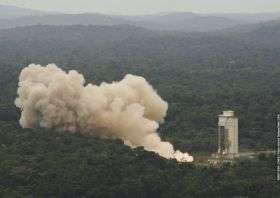
A prototype of the P80 rocket motor, which will power the first stage of ESA's new small launcher - Vega, was successfully tested on 4 December at the Guiana Space Centre, Europe's Spaceport in Kourou, French Guiana. Ignition occurred at 12:35 local time (15:35 UTC/GMT).
The motor delivered a mean thrust of about 190 tonnes for a nominal duration of 111 seconds. This is roughly one third of the thrust delivered by each of Ariane 5's solid booster stages.
More than 600 parameters were recorded during the firing test to monitor the performance of the motor. Initial analysis confirms that the measurements are fully in line with predictions.
Solid propellant rockets cannot be shut down once they have been ignited. The test engine was equipped with specially designed cutters to break open the casing and stop the test, should a malfunction have made this necessary.
Qualification for flight
The first firing of the P80 took place on 30 November 2006. This was a qualification model and served to finalise the validation of the motor behaviour predictions and of the chosen technologies.
The motor tested yesterday was representative of the flight configuration. Once the data recorded during the test have been analysed and the engine has undergone post-test inspection, this firing is expected to complete qualification of the P80 in readiness for Vega's maiden flight, scheduled to take place by the end of 2008.
The P80 motor is about 12 metres high and 3 metres in diameter, and is loaded with 88 tonnes of solid propellant. Unlike previous motors of this size, it contains a single propellant segment, instead of several segments cast separately before being mated together.
Taking advantage of its similar dimensions, the propellant casting for the P80 is carried out at the Guiana Propellant Plant in Kourou, in the same pit as the 100-tonne lower segments of Ariane 5's solid boosters. However, instead of the steel outer structure used for the Ariane boosters, the P80 has a lightweight, filament-wound composite casing. It also incorporates a new, simplified design of igniter with a carbon fibre structure.
A new, steerable nozzle fabricated from composite material has been developed, with a simplified architecture made up of fewer elements, to reduce production costs. It also includes complex-formed cast metal parts and a new thermal insulation material. The nozzle joint is more flexible than on previous engines, allowing thrust vector control by means of electromechanical actuators. This is an additional technological improvement on a motor of this size, which usually needs to employ a more complex hydraulic system.
“The first data received show that the pressure curve is following perfectly the prediction. It is an outstanding result,” said Caroline Cros, the ESA team member responsible for P80 development “and I congratulate the industrial team, as well as our CNES and ASI partners, for this achievement.”
Today's test was performed on the solid booster test stand (Bâtiment d'Essai d'Accélérateur à Poudre - BEAP) in Kourou, the same facility used for firing tests on Ariane 5's solid-propellant motors. The P80 will now be disassembled for detailed inspection. Some of its components will be returned to Europe for examination and analysis.
“The qualification of the P80 motor is a cornerstone. It is the biggest mono-segment, filament-wound-case solid-fuel rocket motor ever developed and this takes us a step closer to the Vega maiden flight,” said Stefano Bianchi, ESA's Head of the Vega programme. “The programme has a tight schedule for the maiden flight. We can proceed - as from today - with increased confidence. Let's make sure we will meet the next major milestones as scheduled.”
About P80 and Vega
The P80 is being developed both as Vega's first stage and as a technology demonstrator. The development is part of the Vega programme, managed by an integrated project team led by ESA and involving staff from ESA, ASI - the Italian Space Agency and CNES - the French space agency. CNES also has a major responsibility in the management of the P80 development.
The industrial team is led by the French-Italian joint venture Europropulsion, under delegation from Avio SpA of Italy. Among the main industrial subcontractors involved in the P80 are SABCA of Belgium (thrust vector control system), Snecma Propulsion Solide of France (nozzle) and APP of the Netherlands (igniter).
ESA's Vega small satellite launcher is an all-solid-propellant, three-stage vehicle with a liquid-fuelled injection module, developed with the support of seven ESA Member States (Italy, France, Belgium, Switzerland, Spain, The Netherlands, and Sweden).
ELV SpA, a joint venture between Avio SpA and ASI, is the prime contractor for the Vega launcher development.
Vega is designed to lift single or multiple payloads to orbits of up to 1 500 km in altitude. Its baseline payload capability is to carry 1 500 kg to a circular, 700 km altitude, Sun-synchronous orbit. It can launch satellites ranging in mass from 300 kg to more than 2 tonnes.
This range of performance covers the needs of multiple applications in the fields of remote sensing, environmental monitoring, Earth science, space science, fundamental physics and research and technology for future space applications and systems.
Once qualified, Vega will be marketed and operated by Arianespace at the Guiana Space Centre, as a complement to Ariane 5 and Soyuz. It will serve the small to mid-sized satellite launch market.
Source: European Space Agency


