Instrument to make detailed measurements of sun activity
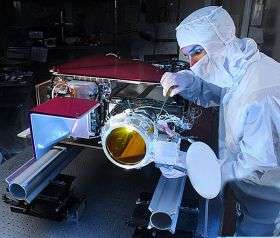
For five years, Stanford research physicist Phil Scherrer and his team have raised a sophisticated space telescope with the attention a parent gives to a child, preparing it for the day when it flies away on a satellite to study the weather on the sun—and maybe save an astronaut from dying of radiation sickness.
A couple of weeks ago, Scherrer's Helioseismic and Magnetic Imager (HMI) left home. A FedEx truck carried it nonstop across the country to NASA's Goddard Space Flight Center in Maryland, where it will be mounted next to other instruments on NASA's Solar Dynamics Observatory. The entire satellite will be subjected to rigorous testing (sometimes known as "shake and bake") to ensure it can withstand the vibration and heat of a launch into space.
A year from now, when an Atlas V missile finally lofts the HMI into geosynchronous orbit 22,500 miles above Earth, it will, with total disregard for the usual parental advice, stare directly into the sun. For several years it will record, in unprecedented detail, the behavior of powerful magnetic fields in the sun and the subtle surface undulations that surrender information about crucial activity deep within. Every two seconds, for at least five years, HMI will snap a high-resolution image and download it to a radio link in New Mexico.
"That's an awful lot of data,'' Scherrer said.
The ultimate mission of HMI (designed in partnership with Lockheed-Martin's Solar and Astrophysics Lab and built at the Lockheed-Martin lab in Palo Alto) and the other two instruments aboard NASA's Solar Dynamics Observatory satellite is to hasten the day when accurate weather forecasts for the sun will be readily available. Space travelers, airline pilots, communication satellites, electric lines, pipelines, telephones and radios all can be harmed when events on the sun send unusually high amounts of solar particles streaming toward Earth.
The sun offers up a smorgasbord of these disruptive events. There are sunspots, operating on their 11-year cycle, solar flares, "coronal mass ejections" and the solar wind.
Astronauts without proper shielding could be killed by high-energy particle radiation produced in the sun's corona during a flare. "It's just like being in a reactor," Scherrer said. NASA's plans for a moon colony or a human expedition to Mars are greatly complicated by the threat of solar storms. A two-year Mars mission would be much safer if there were a two-year solar weather forecast predicting the planetary equivalent of clear skies.
The central question for Scherrer is the origin of variations in the sun's magnetic fields. Convection flows of hot material rise to the surface of the sun, like bubbles the size of California rising in a pot of boiling water, and create magnetic fields by their movement.
Variation in those fields can lead to instability, a key to solar events. HMI's continuous recording of the magnetic fields will provide a deeper understanding of their role.
To understand the other major aspect of the HMI mission, think of the sun as an acoustic instrument with sound waves continuously rebounding around inside, the way seismic waves reverberate inside Earth. (Or, as Scherrer says, "The sun is just a big ball of gas filled up with sound waves bouncing around in all directions.")
These sound waves, generated by hot, bubbling gases, cause small bulges on the sun's surface. To find them, HMI's instruments will measure the sun at 12 million different points. The speed and other characteristics of the waves will offer indications of the flows beneath the surface, possibly identifying precursor events that could provide advance warning of dangerous storms.
The science is known as helioseismology, and it is no small task. "It's like deducing the interior structure of a piano by listening to it fall down a flight of stairs," Scherrer said. The wave motion can even be used to calculate the presence of sunspots on the far side of the sun, which takes about 27 days to spin on its axis. As a result, sunspots can be, in effect, heard before they are seen.
To some extent, this has been done before, by HMI's predecessor on the SOHO (Solar and Heliospheric Observatory) satellite. But while SOHO could see only a portion of the sun at any given time, HMI will provide a "full-disc" view at all times. HMI will be able to follow a developing solar event for the full 13 days it is visible, before the sun's rotation takes it from view. SOHO's view was limited to two days.
HMI will conduct both of its crucial measurements—of the magnetic field and the seismic waves—by looking at a very narrow frequency of light in the visible outer layer of the sun, a spectral line that corresponds to the presence of iron.
A slight shift in the color of the light (the Doppler effect) indicates that a portion of the sun's surface is moving slightly toward or away from the satellite, in time with the sun's internal reverberations. The same color line, when photographed with polarizing lenses, measures the magnetic vector field. Some of the calcite crystals involved in these devices cannot be manufactured, Scherrer said—they grow in caves.
Making these precise measurements of motion on the sun's surface from Earth orbit, 93 million miles away, is not easy. "We have to subtract the motion of the spacecraft," Scherrer said. "The spacecraft is going around the Earth at a speed of 3 kilometers per second; the sun itself is rotating at 2 kilometers per second at the equator. And the surface is bouncing up and down from these waves at 500 meters per second. So we have to sort it all out. It's serious computing."
The great value of the satellite he has nurtured, Scherrer said, will be its ability to see the entire sun, in high-definition, almost all the time, giving science a better understanding of the evolution of solar events.
Source: Stanford University


