Toolbox
  • User rankingRating: 4.5
  • Add to favoritesBookmark
  • Save as PDFSave as PDF
  • PrintPrint
  • EmailEmail
  • Blog ItBlog It
  • Stumble ItStumble It!
Digg It Reddit del.icio.us Save to Yahoo! bookmarks Save to Windows live Share on facebook Save to MySpace Slashdot it science news feed Add to google
- size +

This is your brain on violent media
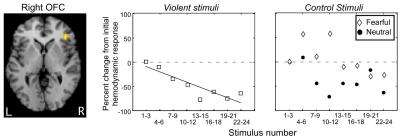
The yellow area of the brain is the right lateral orbitofrontal cortex or right ltOFC which has been previously associated with decreased control over a variety of behaviors including reactive aggression. The first graph illustrates that as the numbe ...
The yellow area of the brain is the right lateral orbitofrontal cortex, or right ltOFC, which has been previously associated with decreased control over a variety of behaviors, including reactive aggression. The first graph illustrates that as the number of violent movies watched increased, the right ltOFC activity diminished. The second graph shows that when subjects watched the non-violent control clips, there were no systematic changes in the activation of this area. Credit: Columbia University Medical Center
Violence is a frequent occurrence in television shows and movies, but can watching it make you behave differently?
Although research has shown some correlation between exposure to media violence and real-life violent behavior, there has been little direct neuroscientific support for this theory until now.

Researchers at Columbia University Medical Center’s Functional Magnetic Resonance Imaging (fMRI) Research Center have shown that watching violent programs can cause parts of your brain that suppress aggressive behaviors to become less active.

In a paper in the Dec. 5 on-line issue of PLoS ONE, Columbia scientists show that a brain network responsible for suppressing behaviors like inappropriate or unwarranted aggression (including the right lateral orbitofrontal cortex, or right ltOFC, and the amygdala) became less active after study subjects watched several short clips from popular movies depicting acts of violence. These changes could render people less able to control their own aggressive behavior. Indeed the authors found that, even among their own subjects, less activation in this network was characteristic of people reporting an above average tendency to behave aggressively. This characteristic was measured through a personality test.

A secondary finding was that after repeated viewings of violence, an area of the brain associated with planning behaviors became more active. This lends further support to the idea that exposure to violence diminishes the brain’s ability to inhibit behavior-related processing.

None of these changes in brain activity occurred when subjects watched non-violent but equally engaging movies depicting scenes of horror or physical activity.

“These changes in the brain’s behavioral control circuits were specific to the repeated exposure to the violent clips,” said Joy Hirsch, Ph.D., professor of Functional Neuroradiology, Psychology, and Neuroscience and Director of the Center for fMRI at CUMC, and the PLoS ONE paper’s senior author. “Even when the level of action in the control movies was comparable, we just did not observe the same changes in brain response that we did when the subjects viewed the violent clips.”

“Depictions of violent acts have become very common in the popular media,” said Christopher Kelly, the first author on the paper and a current CUMC medical student. “Our findings demonstrate for the first time that watching media depictions of violence does influence processing in parts of the brain that control behaviors like aggression. This is an important finding, and further research should examine very closely how these changes affect real-life behavior.”

Source: Columbia University Medical Center
» Next Article in Medicine & Health - Research: Household chemical may affect breast development

would you recommend this story?


User Rating

4.5 out of 5 after 35 total votes
  • not at all
  • 1
  • 2
  • 3
  • 4
  • 5
  • highly

Leave a Comment or

Rank filter

Move the slider to adjust rank threshold, so that you can hide some of the comments.
Posted by vit 12/06/07 10:30
Rank: 5/5 after 1 vote
I wonder: What about reading violent books?
Posted by David6502 12/06/07 11:58
Rank: 3/5 after 2 votes
I noticed a link between violent media and real-life behaviour in myself many years ago. After playing the computer game Doom for a couple of hours, running around chasing and shooting monsters then getting behind the wheel of my car. My driving was faster and more aggressive. I don't play such games nowadays and I drive much slower and courteously. Link? Dunno.
Posted by MongHTan,PhD 12/06/07 16:24
Not rated yet.
Somehow the URL was cut short; let me try again:

http://forum.phys...ic=14583&view=findpost&p=278859 and the post date was October 31 2007, in case this URL would be cut short again!
Posted by SteveD 12/09/07 14:47
Not rated yet.
The most disturbing possibility is that repeated and prolonged exposure in a developing mind, leads to perminent suppression of that control.
Has any research been done in this area?
Are there effects similar to inividuals exposed to a violent environment such as in a war zone?
Posted by roguetrekker 12/09/07 17:06
Rank: 1/5 after 1 vote
I would think those in a war zone would be experiencing "fight or flight". It would be my guess that during "fight or flight" little of the brain would be focused on anything but survival. I would also guess that this response to lack of control of violent behavior might be encouraged by the "fight or flight" syndrome to help people get over any qualms they may have to violence in order to survive. Just evolution at work.
Posted by k0parsh3u 12/13/07 21:49
Not rated yet.
first of all it may be a short time effect and second of all let our brain how it is, don't exhaust yourself to find everything now
I hope this won't have bad results like censuring movies and games, now THIS would make me have aggresive behaviour