Like humans, monkey see, monkey plan, monkey do
December 6, 2007 Like humans, monkey see, monkey plan, monkey do

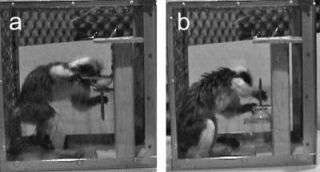
Tamarin grasping the stem of a plastic champagne glass to pull the glass from the apparatus in order to extract a marshmallow stuck inside the glass. In (a), the monkey exhibits the thumb-up grasp orientation, and in (b), the monkey exhibits the thumb-down grasp orientation. Credit: Dan Weiss

How many times a day do you grab objects such as a pencil or a cup? We perform these tasks without thinking, however the motor planning necessary to grasp an object is quite complex. The way human adults grasp objects is typically influenced more by their knowledge of what they intend to do with the objects than the objects' immediate appearance. Psychologists call this the “end-state comfort effect,” when we adopt initially unusual, and perhaps uncomfortable, postures to make it easier to actually use an object.

For example, waiters will pick up an inverted glass with their thumb pointing down if they plan to pour water into the glass. While grabbing thumb-down may feel awkward at first, it allows the waiter to be more comfortable when the glass is turned over and water poured inside.

Does this occur because motor planning abilities were crucial in facilitating the evolution of complex tool use in humans? If so, then is this something that other animals, non-tool users, would do?

Pennsylvania State University psychologists, Dan Weiss, Jason Wark, and David Rosenbaum decided to see if cotton-top tamarins (non-tool users) would show the end-state comfort effect. In the first experiment, Weiss and colleagues presented the monkeys with a small cup containing a marshmallow. The cup was either suspended upright or upside down. Would these monkeys, a non-tool using species, adopt an unusual grasping pattern while removing the cup from the apparatus to retrieve the marshmallow?

The results, which appear in the December issue of Psychological Science, a journal of the Association for Psychological Science, are fascinating. The monkeys grabbed the inverted cup with their thumb pointing down, thereby behaving much like human adults. In the second experiment, the monkeys were confronted with a new handle shape and still displayed grasps that were consistent with end-state comfort.

This research is the first to provide evidence for more sophisticated motor planning than has previously been attributed to a nonhuman species. The authors suggest that formulating relatively long-term motor plans is a necessary but not sufficient condition for tool use. “Our results may be taken to suggest that the reason tamarins don’t use tools in the wild is not that they lack the ability to plan ahead, but rather that the scope of their planning is limited,” say the researchers.

Source: Association for Psychological Science


print this article email this article download pdf blog this article bookmark this article     Stumble it Digg this share on Facebook retweet share on Reddit add to delicious
Rate this story - 5 /5 (10 votes)

Rank Filter

Move the slider to adjust rank threshold, so that you can hide some of the comments.


Display comments: newest first

  • nilbud - Dec 08, 2007
    • Rank: not rated yet
    Shock news planning required to avoid fall from tree.

December 6, 2007 all stories

Comments: 1

5 /5 (10 votes)
  • Stumble this up

  • Digg this

  • share this

  • hide
  • Related Stories


Other News

Hammerhead shark

Wide heads give hammerheads exceptional stereo view

Biology / Plants & Animals

created 17 hours ago | popularity 4.4 / 5 (5) | comments 4

Hammerhead sharks are some of the Ocean's most distinctive residents. 'Everyone wants to understand why they have this strange head shape,' says Michelle McComb from Florida Atlantic University. One possible ...


Golden Oldie: Key Role for Ancient Protein in Algae Photosynthesis

Golden Oldie: Key Role for Ancient Protein in Algae Photosynthesis

Biology / Biotechnology

created 8 hours ago | popularity not rated yet | comments 1

The discovery that an ancient light harvesting protein plays a pivotal role in the photosynthesis of green algae should help the effort to develop algae as a biofuels feedstock. Researchers with the Lawrence ...


Tough yet stiff deer antler is materials scientist's dream

Biology / Plants & Animals

created 17 hours ago | popularity 3 / 5 (1) | comments 2

Prized for their impressive antlers, red deer have been caught in the hunters' sights for generations. But a deer's antlers are much more than decorative. They are lethal weapons that stags crash together when duelling. John ...


Indonesia rejects Bali plan for turtle sacrifices (AP)

Indonesia rejects Bali plan for turtle sacrifices

Biology / Ecology

created 15 hours ago | popularity not rated yet | comments 0

(AP) -- Indonesia has rejected a push by the resort island of Bali for rare turtles to be legally slain in Hindu ceremonies, siding with conservationists of the protected reptiles against religious advocates, ...


Ecologists sound out new solution for monitoring cryptic species

Biology / Ecology

created 17 hours ago | popularity not rated yet | comments 0

Ecologists have at last worked out a way of using recordings of birdsong to accurately measure the size of bird populations. This is the first time sound recordings from a microphone array have been translated into accurate ...