Tiny pest-eating insect fights fruit flies
December 6, 2007 Tiny pest-eating insect fights fruit flies

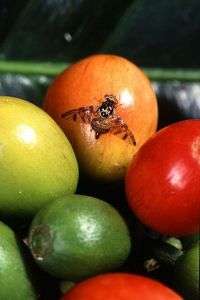
Mediterranean fruit fly, a worldwide agricultural pest. Credit: Scott Bauer

Farmers and vineyard owners have a new weapon in their pest management arsenal. A commonly used parasitoid, or parasitic insect that kills its host, has proven to be quite effective in the control of fruit flies in vineyards. These tiny pest-devouring insects are considered to be powerful "biocontrol agents" since they reduce the need for chemical pest management applications.

Jean Pierre Kapongo, Ph.D., an entomologist specializing in environmental health at the University of Guelph in Ontario, Canada, recently published the results of a research study that will aid vintners and fruit farmers in their ability to produce healthier crops. According to Kapongo, vineyard owners and farmers can now control fruit flies (Ceratitis capitata) with Muscidifurax raptor, an insect currently used in the control of other types of pests.

The study investigated the use of Muscidifurax raptor to control fruit flies in vineyards. Until recently, fruit flies were usually controlled with chemical insecticides and selected natural enemies. Kapongo explained that these traditional control methods were not popular with farmers because of the adverse effects of chemicals and the unreliability of using living parasites.

"Now we have discovered a parasitoid that is easily produced and effective in controlling fruit flies.", Kapongo commented. He added that insectaries, where parasitic insects are commercially produced and sold, are ready to increase production of the insects in response to market demands from vineyard owners.

Kopongo noted that using the Muscidifurax raptor parasitoid to control flies benefits the environment and promotes agricultural sustainability because the method lessens the need for chemical pesticides. Researchers believe that the study results will have additional application for controlling flies that threaten animals in confined environments such as poultry houses, dairies and horse stables.

Source: American Society for Horticultural Science


print this article email this article download pdf blog this article bookmark this article     Stumble it Digg this share on Facebook retweet share on Reddit add to delicious
Rate this story - 4.5 /5 (2 votes)


December 6, 2007 all stories

Comments: 0

4.5 /5 (2 votes)
  • Stumble this up

  • Digg this

  • share this

  • hide
  • Related Stories


Other News

Ancient penguin DNA raises doubts about accuracy of genetic dating techniques

Ancient penguin DNA raises doubts about accuracy of genetic dating techniques

Biology / Evolution

created 9 hours ago | popularity 5 / 5 (11) | comments 2

Penguins that died 44,000 years ago in Antarctica have provided extraordinary frozen DNA samples that challenge the accuracy of traditional genetic aging measurements, and suggest those approaches have been ...


Striped skunk

Skunk's Strategy Not Just Black and White

Biology / Plants & Animals

created 6 hours ago | popularity 2 / 5 (1) | comments 4

Predators with experience of skunks avoid them both because of their black-and-white coloration and their distinctive body shape, according to UC Davis wildlife researcher Jennifer Hunter. The study was published ...


California's Ancient Kelp Forest

Biology / Ecology

created 5 hours ago | popularity 5 / 5 (2) | comments 0

(PhysOrg.com) -- The kelp forests off southern California are considered to be some of the most diverse and productive ecosystems on the planet, yet a new study indicates that today's kelp beds are less extensive and lush ...


A motley collection of boneworms

A motley collection of boneworms (w/ Video)

Biology / Plants & Animals

created 4 hours ago | popularity 5 / 5 (2) | comments 1

(PhysOrg.com) -- It sounds like a classic horror story -- eyeless, mouthless worms lurk in the dark, settling onto dead animals and sending out green "roots" to devour their bones. In fact, such worms do exist ...


Device enables world's first voluntary gorilla blood pressure reading

Device enables world's first voluntary gorilla blood pressure reading

Biology / Plants & Animals

created 7 hours ago | popularity 5 / 5 (1) | comments 0

Zoo Atlanta recently became the first zoological institution in the world to obtain voluntary blood pressure readings from a gorilla. This groundbreaking stride was made possible by the Gorilla Tough Cuff, ...