Supercomputer simulation of universe may help in search for missing matter
December 6, 2007 Universe Supercomputer Simulation

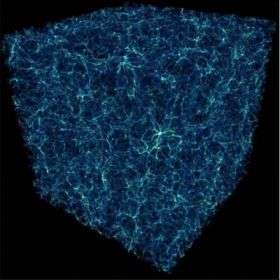
Pictured is a portion of a supercomputer simulation of the universe showing a region roughly 1.5 billion light-years on a side. The bright object in the center is a galaxy cluster about 1 million-billion times the mass of the sun. In between the filaments, which store most of the universe's mass, are giant, spherical voids nearly empty of matter. Credit: University of Colorado at Boulder

Much of the gaseous mass of the universe is bound up in a tangled web of cosmic filaments that stretch for hundreds of millions of light-years, according to a new supercomputer study by a team led by the University of Colorado at Boulder.

The study indicated a significant portion of the gas is in the filaments -- which connect galaxy clusters -- hidden from direct observation in enormous gas clouds in intergalactic space known as the Warm-Hot Intergalactic Medium, or WHIM, said CU-Boulder Professor Jack Burns of the astrophysical and planetary sciences department. The team performed one of the largest cosmological supercomputer simulations ever, cramming 2.5 percent of the visible universe inside a computer to model a region more than 1.5 billion light-years across. One light-year is equal to about six trillion miles.

A paper on the subject will be published in the Dec. 10 issue of the Astrophysical Journal. In addition to Burns, the paper was authored by CU-Boulder Research Associate Eric Hallman of APS, Brian O'Shea of Los Alamos National Laboratory, Michael Norman and Rick Wagner of the University of California, San Diego and Robert Harkness of the San Diego Supercomputing Center.

It took the researchers nearly a decade to produce the extraordinarily complex computer code that drove the simulation, which incorporated virtually all of the known physical conditions of the universe reaching back in time almost to the Big Bang, said Burns. The simulation -- which uses advanced numerical techniques to zoom-in on interesting structures in the universe -- modeled the motion of matter as it collapsed due to gravity and became dense enough to form cosmic filaments and galaxy structures.

"We see this as a real breakthrough in terms of technology and in scientific advancement," said Burns. "We believe this effort brings us a significant step closer to understanding the fundamental constituents of the universe."

According to the standard cosmological model, the universe consists of about 25 percent dark matter and 70 percent dark energy around 5 percent normal matter, said Burns. Normal matter consists primarily of baryons - hydrogen, helium and heavier elements -- and observations show that about 40 percent of the baryons are currently unaccounted for. Many astrophysicists believe the missing baryons are in the WHIM, Burns said.

"In the coming years, I believe these filaments may be detectable in the WHIM using new state-of-the-art telescopes," said Burns, who along with Hallman is a fellow at CU-Boulder's Center for Astrophysics and Space Astronomy. "We think that as we begin to see these filaments and understand their nature, we will learn more about the missing baryons in the universe."

Two of the key telescopes that astrophysicists will use in their search for the WHIM are the 10-meter South Pole Telescope in Antarctica and the 25-meter Cornell-Caltech Atacama Telescope, or CCAT, being built in Chile's Atacama Desert, Burns said. CU-Boulder scientists are partners in both observatories.

The CCAT telescope will gather radiation from sub-millimeter wavelengths, which are longer than infrared waves but shorter than radio waves. It will enable astronomers to peer back in time to when galaxies first appeared -- just a billion years or so after the Big Bang -- allowing them to probe the infancy of the objects and the process by which they formed, said Burns.

The South Pole Telescope looks at millimeter, sub-millimeter and microwave wavelengths of the spectrum and is used to search for, among other things, cosmic microwave background radiation - the cooled remnants of the Big Bang, said Burns. Researchers hope to use the telescopes to estimate heating of the cosmic background radiation as it travels through the WHIM, using the radiation temperature changes as a tracer of sorts for the massive filaments.

The CU-Boulder-led team ran the computer code for a total of about 500,000 processor hours at two supercomputing centers --the San Diego Supercomputer Center and the National Center for Supercomputing Applications at the University of Illinois at Urbana-Champaign. The team generated about 60 terabytes of data during the calculations, equivalent to three-to-four times the digital text in all the volumes in the U.S. Library of Congress, said Burns.

Burns said the sophisticated computer code used for the universe simulation is similar in some respects to a code used for complex supercomputer simulations of Earth's atmosphere and climate change, since both investigations focus heavily on fluid dynamics.

Source: University of Colorado at Boulder


print this article email this article download pdf blog this article bookmark this article     Stumble it Digg this share on Facebook retweet share on Reddit add to delicious
Rate this story - 4.6 /5 (39 votes)

Rank Filter

Move the slider to adjust rank threshold, so that you can hide some of the comments.


Display comments: newest first

  • TimESimmons - Dec 06, 2007
    • Rank: 2.5 / 5 (2)
    Supercomputer or not I bet their simulation didn't produce spiral arms.

    http://www.presto...ndex.htm
  • earls - Dec 06, 2007
    • Rank: 4 / 5 (2)
    Heh. Yes, this image looks just like the purple/orange one they did a few years back. Both are large scale views, I'd like to get close up to one of the tentacles...

    Also, I was reading this article and a kid behind me said "what's that a picture of?" "The Universe." "Oh, I didn't know the Universe was a square."
  • MrGrynch - Dec 07, 2007
    • Rank: 3 / 5 (2)
    The filamentary nature of the universe is due to the self-separating charge forces that pervade it. There doesn't need to be anything in-between them to describe their behavior, since the charge force is billions of times stronger than gravity.

    Without embracing the effects of charges in space, dark matter is the only way to explain what is being seen. Plasma cosmology resolves this.

    Regarding the formation of spiral galaxies, this has been simulated from the plasma cosmology standpoint through simulations of Dr. Anthony Peratt.

    On a related note, they've recently announced the observance of "Alfven Waves" from the sun, which is ironic. They are referring to predictions made by the father of MHD while ignoring his admonishments about the nature of magnetism in space plasmas, which is the basis of Plasma Cosmology. So-called reconnection layers are actually plasma double layers that occasional explode, and then reform to seal the current leak.
  • TimESimmons - Dec 07, 2007
    • Rank: 1 / 5 (1)
    Thank you MrGrynch. Any idea where I can get hold of relevant papers.
  • earls - Dec 07, 2007
    • Rank: 1 / 5 (1)
    Electric Universe background and books: http://www.thunderbolts.info

    Peratt's site: http://plasmascie...rse.html

    All about Alfven with some links to papers: http://en.wikiped..._Alfvén

    There's quite a bit of EU/PU information out there.

    More background info with links: http://en.wikiped...universe

    Enjoy, I hope you find this information is as "eye-opening", informative, and interesting as I did.
  • TimESimmons - Dec 08, 2007
    • Rank: 1 / 5 (1)
    Thnak you I will have a read.
  • TimESimmons - Dec 10, 2007
    • Rank: 1 / 5 (1)
    The theory of Plasma Cosmology seems to state that enormous currents flow through the plasma of deep space and these cause the shapes and behaviour of galaxies.

    There may be large currents and magnetic fields throughout the universe and these may influence the movement of plasma in deep space. However the objects that contribute most of the mass of a galaxy, stars and molecular clouds, are uncharged and therefore will not be directly affected. It is therefore difficult to see how Plasma Cosmology could offer an explanation for the apparent extra mass of galaxies and clusters.

    http://www.presto...ndex.htm

December 6, 2007 all stories

Comments: 7

4.6 /5 (39 votes)
  • Stumble this up

  • Digg this

  • share this

  • hide
  • Related Stories

  • Galaxy Evolution Explorer Mission Celebrates Sixth Anniversary
    created Apr 28, 2009 | popularity not rated yet | comments 0
  • Science's breakthrough of the year: Cellular reprogramming
    created Dec 18, 2008 | popularity not rated yet | comments 0
  • Oak Ridge supercomputer is the world's fastest for science
    created Nov 17, 2008 | popularity not rated yet | comments 0
  • Argonne supercomputer to simulate extreme physics of exploding stars
    created May 01, 2008 | popularity not rated yet | comments 0
  • GLAST spacecraft arrives in Florida to prepare for launch
    created Mar 07, 2008 | popularity not rated yet | comments 0


  • hide
  • Relevant PhysicsForums posts

  • Sideral question
    created 7 hours ago
  • Doppler shifted blackbody spectrum
    created 9 hours ago
  • Earth v. Moon
    created 11 hours ago
  • help me with coordinates and orbits
    created 12 hours ago
  • basic 'our universe' question..
    created 22 hours ago
  • deriving keplers law
    created Nov 19, 2009
  • More from Physics Forums - General Astronomy

Other News

Unseasonably hot and dry weather combined with strong winds to fan scores of blazes in the country's southeastern states

Australia issues 'catastrophic' alerts as fires rage

Space & Earth / Environment

created 4 hours ago | popularity 4 / 5 (1) | comments 0

Australia has issued "catastrophic" alerts after record-breaking temperatures and wild lightning storms sparked more than 100 fires across the country, officials said Saturday.


Atlantis astronauts take 2nd spacewalk of mission (AP)

Atlantis astronauts take 2nd spacewalk of mission

Space & Earth / Space Exploration

created 8 hours ago | popularity 5 / 5 (1) | comments 0

(AP) -- An astronaut anticipating the birth of his daughter at any moment embarked on the first spacewalk of his career Saturday, tackling a load of maintenance work outside the International Space Station.


Commuters wait on the platform shrouded by fog in London

Climate change not man-made, say majority of Britons: poll

Space & Earth / Environment

created Nov 15, 2009 | popularity 3.3 / 5 (15) | comments 45

Less than half of Britons believes that human activity is to blame for global warming, according to a poll carried out for The Times newspaper and published on Saturday.


Mysteriously warm times in Antarctica

Mysteriously warm times in Antarctica

Space & Earth / Earth Sciences

created Nov 18, 2009 | popularity 4.3 / 5 (20) | comments 27

(PhysOrg.com) -- A new study of Antarctica's past climate reveals that temperatures during the warm periods between ice ages (interglacials) may have been higher than previously thought. The latest analysis ...


UN: Fight climate change with free condoms (AP)

UN: Fight climate change with free condoms

Space & Earth / Environment

created Nov 18, 2009 | popularity 3.1 / 5 (11) | comments 22

(AP) -- The battle against global warming could be helped if the world slowed population growth by making free condoms and family planning advice more widely available, the U.N. Population Fund said Wednesday.