Team to chemically transform carbon dioxide into carbon-neutral liquid fuels
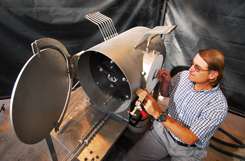
Using concentrated solar energy to reverse combustion, a research team from Sandia National Laboratories is building a prototype device intended to chemically “reenergize” carbon dioxide into carbon monoxide using concentrated solar power. The carbon monoxide could then be used to make hydrogen or serve as a building block to synthesize a liquid combustible fuel, such as methanol or even gasoline, diesel and jet fuel.
The prototype device, called the Counter Rotating Ring Receiver Reactor Recuperator (CR5, for short), will break a carbon-oxygen bond in the carbon dioxide to form carbon monoxide and oxygen in two distinct steps. It is a major piece of an approach to converting carbon dioxide into fuel from sunlight.
The Sandia research team calls this approach “Sunshine to Petrol” (S2P). “Liquid Solar Fuel” is the end product — the methanol, gasoline, or other liquid fuel made from water and the carbon monoxide produced using solar energy.
CR5 inventor Rich Diver says the original idea for the device was to break down water into hydrogen and oxygen. The hydrogen could then fuel a potential hydrogen economy.
The Sandia researchers came up with the idea to use the CR5 to break down carbon dioxide, just as it would water. Over the past year they have shown proof of concept and are completing a prototype device that will use concentrated solar energy to reenergize carbon dioxide or water, the products of combustion. This will form carbon monoxide, hydrogen, and oxygen, which ultimately could be used to synthesize liquid fuels in an integrated S2P system.
Coresearchers on the project are Jim E. Miller and Nathan Siegel. Project champion is Ellen B. Stechel, manager of Sandia’s Fuels and Energy Transitions Department.
Stechel says that researchers have known for a long time that theoretically it might be possible to recycle carbon dioxide, but many thought it could not be made practical, either technically or economically.
“Hence, it has not been pursued with much vigor,” she says. “Not only did we think it was possible, the team has developed a prototype that they fully anticipate will successfully break down carbon dioxide in a clever and viable two-step process.”
Stechel notes that one driver for the invention is the need to reduce greenhouse gases.
“This invention, though probably a good 15 to 20 years away from being on the market, holds a real promise of being able to reduce carbon dioxide emissions while preserving options to keep using fuels we know and love,” she says. “Recycling carbon dioxide into fuels provides an attractive alternative to burying it.”
Providing funding for Sunshine to Petrol is Sandia’s internal Laboratory Directed Research and Development (LDRD) program. The research has also attracted interest and some funding from DoD/DARPA (Defense Advanced Research Projects Agency).
“What’s exciting about this invention is that it will result in fossil fuels being used at least twice, meaning less carbon dioxide being put into the atmosphere and a reduction of the rate that fossil fuels are pulled out of the ground,” Diver says.
As an example, he says, coal would be burned at a clean coal power plant. The carbon dioxide from the burning of the coal would be captured and reduced to carbon monoxide in the CR5. The carbon monoxide would then be the starting point of making gasoline, jet fuel, methanol, or almost any type of liquid fuel.
The prospect of a liquid fuel is significant because it fits in with the current gasoline and oil infrastructure. After the synthesized fuel is made from the carbon monoxide, it could be transported through a pipeline or put in a truck and hauled to a gas station, just like gasoline refined from petroleum is now. Plus it would work in ordinary gasoline and diesel engine vehicles.
Miller says that while the first step would be to capture the carbon dioxide from sources where it is concentrated — e.g., power plants, smokestacks, and breweries — the ultimate goal would be to snatch it out of the air. A S2P system that includes atmospheric carbon dioxide capture could produce carbon-neutral liquid fuels.
“Our overall objective with this prototype is to demonstrate the practicality of the CR5 concept and to determine how test results from small-scale testing can be expanded to work in real devices,” Miller says. “The design is conservative compared to what might eventually be developed.”
Diver says the prototype should be completed by early next year. He hand-built the precision device in a shop at Sandia’s National Solar Thermal Test Facility and is now waiting on a few parts to finalize it. Initial tests will break down water into hydrogen and oxygen. That will be followed by tests that similarly break down carbon dioxide to carbon monoxide and oxygen.
Besides having a nearly completed prototype, the research team has already proven that the chemistry works repeatedly through multiple cycles without losing performance and on a short enough cycle time for a practical device.
“We just now have to do it all in one continuous working device,” Siegel says.
Source: Sandia National Laboratory


