Laser light alone can open, close world's fastest optical shutter without heating or cooling
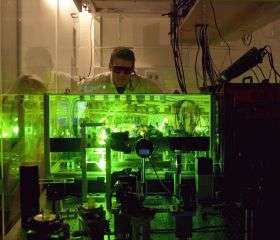
It’s a rare case of all light and no heat: A new study reports that a laser can be used to switch a film of vanadium dioxide back and forth between reflective and transparent states without heating or cooling it.
It is one of the first cases that scientists have found where light can directly produce such a physical transition without changing the material’s temperature.
It is also among the most recent examples of “coherent control,” the use of coherent radiation like laser light to affect the behavior of atomic, molecular or electronic systems. The technique has been used to control photosynthesis and is being used in efforts to create quantum computers and other novel electronic and optical devices. The new discovery opens the possibility of a new generation of ultra-fast optical switches for communications.
The study, which was published in the Sept. 18 issue of Physical Review Letters, was conducted by a team of physicists from Vanderbilt University and the University of Konstanz in Germany headed by Richard Haglund of Vanderbilt and Alfred Leitenstorfer from Konstanz.
Vanadium dioxide’s uncanny ability to switch back and forth between transparent and reflective states is well known. At temperatures below 154 degrees Fahrenheit, vanadium dioxide film is a transparent semiconductor. Heat it to just a few degrees higher, however, and it becomes a reflective metal. The semiconducting and metallic states actually have different crystalline structures. Among a number of possible applications, people have experimented with using vanadium dioxide film as the active ingredient in “thermochromic windows” that can block sunlight when the temperature soars and as microscopic thermometers that could be injected into the body.
In 2005, a research collaboration teaming Haglund and René Lopez (now at the University of North Carolina, Chapel Hill) with Andrea Cavalleri and Matteo Rini from the Lawrence Berkeley National Laboratory tested the vanadium dioxide transition with an ultra-fast laser that produced 120-femtosecond pulses. (A femtosecond is a quadrillionth of a second. At this time scale, an eye blink lasts almost forever. In the three-tenths of a second it takes to blink an eye, light can travel 56,000 miles. By contrast, it takes 100 femtoseconds to cross the width of a human hair.)
Using this laser, the researchers determined that VO2 film can flip from transparent to reflective in a remarkably short time: less than 100 femtoseconds. This was the fastest phase transition ever measured. However, the mechanism that allowed it to make such rapid transitions remained a matter of scientific debate.
Now, in a two-year collaboration with the Leitenstorfer group, the Vanderbilt researchers have used a laser with even shorter, 12-femtosecond pulses to “strobe” the vanadium dioxide transition with the fastest pulses ever used for this purpose. The result" “This transition takes place even faster than we thought possible,” says Haglund. “It can shift from transparent to reflective and back to transparent again in less than 100 femtoseconds, making the transition more than twice as fast as we had thought.”
In order to identify the driving mechanism for the rapid change of state in vanadium dioxide, Leitenstorfer’s graduate student Carl Kübler developed a method that converts the near-infrared photons produced by their 12-femtosecond pulse laser into a broad spectrum of infrared wavelengths that bracket a well-known vibration in the vanadium dioxide crystal lattice. At the same time, the Vanderbilt researchers figured out how to grow VO2 film on a diamond substrate that is transparent to infrared light.
This allowed the researchers to show that the energy in the laser beam goes directly into the crystal lattice of the VO2, driving it to shift from its transparent, crystalline form to its more compact and symmetric metallic configuration.
The laser light doesn’t produce this shift by heating the VO2 lattice until it melts, as the conventional wisdom about phase transitions suggested. Instead, the researchers found that the stream of photons directly drive the oxygen atoms from one position to another by a process that is rather like pumping a swing in time with its natural frequency.
“People have believed for a long time that what happened in this phase transition was that the electrons get excited and then, somehow or another, the crystal structure changes,” says Haglund. “But it turns out that the change in crystal structure is associated with this coherent molecular vibration.”
Such a rapid transition is only possible because the difference between the metallic and semiconductor geometries is extremely small. “You can think of the movement that results as a breathing motion of the oxygen ‘cage’ that surrounds the vanadium ions,” says Haglund. “That makes it possible for the structure to change from the semiconducting to the metallic states. It’s a little like taking a deep breath to get into last summer’s clothes.”
This mechanism also allows the researchers to trigger the transition without changing the film’s temperature. “We can focus the laser beam on a transparent vanadium dioxide film and create a small reflective spot. We can switch it on and off in less than 100 femtoseconds provided we haven’t dumped so much energy into the film that we’ve heated it up. However, the more laser energy you dump in the VO2, the longer it takes to return to the semiconducting state,” Haglund says.
Source: Vanderbilt University


