Images of Saturn's Small Moons Tell the Story of Their Origins
December 6, 2007
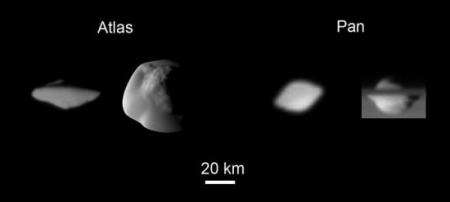
The highest resolution images of Pan (right) and Atlas (left) reveal distinctive "flying saucer" shapes created by prominent equatorial ridges not seen on the other small moons of Saturn. Image credit: NASA/JPL/Space Science Institute
Imaging scientists on NASA's Cassini mission are telling a tale of how the small moons orbiting near the outer rings of Saturn came to be. The moons began as leftover shards from larger bodies that broke apart and filled out their "figures" with the debris that made the rings.
It has long been suspected that Saturn's rings formed in the disintegration of one or several large icy bodies, perhaps pre-existing moons, by giant impacts. The resulting debris quickly spread and settled into the equatorial plane to form a thin disk surrounding the planet. And the small, irregularly shaped ring-region moons were believed to be the leftover pieces from this breakup.
Now, several years' worth of cosmic images of Saturn's 14 known small moons have been used to derive the sizes and shapes of most of them, and in about half the cases, even masses and densities. This information, published in the Dec. 7 issue of the journal Science, has led to new insights into how some of these moons may have formed.
The tip-off was the very low density of the inner moons, about half that of pure water ice, and sizes and shapes that suggested they have grown by the accumulation of ring material. The trouble was, these moons are within and near the rings, where it is not possible for small particles to fuse together gravitationally. So how did they do it? They got a jump start.
"We think the only way these moons could have reached the sizes they are now, in the ring environment as we now know it to be, was to start off with a massive core to which the smaller, more porous ring particles could easily become bound," said Carolyn Porco, Cassini imaging team leader from the Space Science Institute in Boulder, Colo. Porco is the lead author of the first of two related articles published in this week's issue of Science.
Simple calculations and more complicated computer simulations have shown that ring particles will readily become bound to a larger seed having the density of water ice. By this process, a moon will grow even if it is relatively close to Saturn. The result is a ring-region moon about two to three times the size of its dense ice core, covered with a thick shell of porous, icy ring material. To make a 30-kilometer moon (19 miles) requires a seed of about 10 kilometers (6 miles).
Where did such large cores come from? And when did this all take place?
"The core may in fact be one of the remnants from the original ring-forming event," said co-author Derek Richardson, professor of astronomy at the University of Maryland, College Park, "which might have been left intact all this time and protected from additional collisional breakup by the mantle of ring particles around it."
Just exactly when the rings formed is not known. "But it is not out of the question that the moons date back to the time of ring formation," said Porco.
The researchers show that the cores of Pan and Daphnis, which orbit within gaps in the outer A ring, were large enough to open narrow gaps. Accretion, or accumulation of material, they say, probably occurred quickly. The moons grew and their gaps widened, achieving their present sizes before the gaps were completely emptied of material, and probably before the local rings reached their present thickness.
So how did Pan in the main rings, and Atlas, which orbits just beyond the outer edge of the main rings, get the prominent equatorial ridges that make them look like flying saucers? The second paper reports evidence for a secondary stage of accretion that occurred after the moons' growth was completed and after the rings flattened to their present 20-meter (66 feet) thickness.
"Our computer simulations show that the ridges must have accreted rapidly when Saturn's rings were thin, forming small accretion disks around the equators of Pan and Atlas," said Sebastien Charnoz, lead author and an associate of imaging team member Andre Brahic at the University Paris-Diderot and CEA Saclay, in France. "The ridges might be the remains of 'fossilized' accretion disks, fundamental structures seen at all scales in the universe, from planetary rings to galaxies."
Source: NASA
-
Image: Saturn's rings and Enceladus
Feb 08, 2012 |
3 / 5 (2) |
0
-
Image: Saturn and its moon Dione
Feb 03, 2012 |
3.3 / 5 (3) |
0
-
STAR TRAK for February 2012
Feb 02, 2012 |
5 / 5 (1) |
0
-
Solar eclipse over the USA
Jan 30, 2012 |
5 / 5 (4) |
8
-
Image: Closest Dione flyby
Jan 23, 2012 |
4.8 / 5 (4) |
0
-
Engineers build first sub-10-nm carbon nanotube transistor
Feb 01, 2012 |
4.9 / 5 (31) |
30
-
Something old, something new: Evolution and the structural divergence of duplicate genes
Jan 31, 2012 |
4.6 / 5 (7) |
1
-
The hidden nanoworld of ice crystals: Revealing the dynamic behavior of quasi-liquid layers
Jan 30, 2012 |
5 / 5 (3) |
1
-
Stock market network reveals investor clustering
Jan 27, 2012 |
3.9 / 5 (23) |
8
-
Of microchemistry and molecules: Electronic microfluidic device synthesizes biocompatible probes
Jan 26, 2012 |
5 / 5 (1) |
0
-
Scale of the Universe
11 hours ago
-
Titan's lack of impact craters
Feb 09, 2012
-
Real pictures of black hole eating a star?
Feb 08, 2012
-
Hypothetical way to travel faster than light, but not technically exceed lightspeed
Feb 06, 2012
-
How do scientists monitor the Sun's activity?
Feb 05, 2012
-
Search patterns in observational studies
Feb 05, 2012
- More from Physics Forums - General Astronomy
More news stories
Humans may have helped the decline of African rainforests 3000 years ago
(PhysOrg.com) -- Large areas of rainforests in Central Africa mysteriously disappeared over three thousand years ago, to be replaced by savannas. The prevailing theory has been that the cause was a change ...
Could Venus be shifting gear?
(PhysOrg.com) -- ESAs Venus Express spacecraft has discovered that our cloud-covered neighbour spins a little slower than previously measured. Peering through the dense atmosphere in the infrared, the ...
Space & Earth / Space Exploration
18 hours ago |
5 / 5 (7) |
8
|
NASA budget will axe Mars deal with Europe: scientists
US President Barack Obama's budget proposal to be submitted next week for 2013 will cut NASA's budget by 20 percent and eliminate a major partnership with Europe on Mars exploration, scientists said Thursday.
Space & Earth / Space Exploration
21 hours ago |
5 / 5 (2) |
18
Two new moons for Jupiter
Advances in technology have lead to the discovery of new planets outside of our Solar System, and now even new moons in our own backyard.
Space & Earth / Space Exploration
18 hours ago |
4 / 5 (1) |
7
Mars Science Laboratory computer issue resolved
(PhysOrg.com) -- Engineers have found the root cause of a computer reset that occurred two months ago on NASA's Mars Science Laboratory and have determined how to correct it.
Space & Earth / Space Exploration
19 hours ago |
4.7 / 5 (6) |
3
|
Anonymous knocks CIA website offline (Update)
The website of the Central Intelligence Agency was inaccessible on Friday after the hacker group Anonymous claimed to have knocked it offline.
New error-correcting codes guarantee the fastest possible rate of data transmission
Error-correcting codes are one of the triumphs of the digital age. Theyre a way of encoding information so that it can be transmitted across a communication channel such as an optical fiber o ...
Google users warned of threat to smartphone wallets
Users of Google smartphone wallets were being warned on Friday that there is a way to crack pass codes intended to thwart thieves from going on illicit shopping sprees.
New power source discovered
(PhysOrg.com) -- Researchers at the Massachusetts Institute of Technology (MIT) and RMIT University have made a breakthrough in energy storage and power generation.
Small modular reactor design could be a 'SUPERSTAR'
(PhysOrg.com) -- Though most of today's nuclear reactors are cooled by water, we've long known that there are alternatives; in fact, the world's first nuclear-powered electricity in 1951 came from a reactor ...
The power of estrogen -- male snakes attract other males
A new study has shown that boosting the estrogen levels of male garter snakes causes them to secrete the same pheromones that females use to attract suitors, and turned the males into just about the sexiest ...