Organic Chemistry for the YouTube Generation
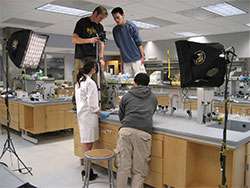
No matter how long they pore over their lab manuals, students feel anxious when they step into a science laboratory. Now a series of dynamic videos created by undergraduate students at the University of California, San Diego is helping them relax and focus on what really matters—the science behind the experiment.
“Students can’t concentrate on concepts when they are stressed about the technical details of performing an experiment,” said Haim Weizman, a lecturer in U.C. San Diego’s Department of Chemistry and Biochemistry, who spearheaded the video project. “By helping them prepare for the lab, the videos allow students to concentrate on the molecules and see the beauty of what is happening.”
Over the last few months, the videos, which can be viewed here have been downloaded more than 15,000 times from YouTube and SciVee, a website where scientists can trade research techniques. SciVee was developed by Phillip Bourne, a professor of pharmacology at UCSD.
Each video is approximately five to seven minutes long and features a student demonstrating a critical procedure in organic chemistry, such as the purification of a substance by distillation or recrystallization. Students have difficulty visualizing how to perform such procedures from the instructions in the laboratory manual alone.
UCSD visual arts students produced the videos. To keep the atmosphere dynamic, they used catchy music and editing that juxtaposed footage filmed from multiple angles.
“Collaborating with a group of UCSD students to produce these videos was an important part of the philosophy behind this project,” explained Weizman. “They share social characteristics with the target audience, which helps make a more relevant product. It was exciting to work with the students and watch the picture that I had in my mind be brought to life on the screen.”
Organic chemistry is a Waterloo for many students. The video project is one part of Weizman’s research, which seeks to understand why students find the subject so difficult, and to help fill in the gaps. Weizman wants students to see how organic chemistry is connected to real life. Since many of his students are planning to go into medicine or the biological sciences, he makes links to drug development.
“Chemistry is not their bread and butter,” he said. “So we take something that is close to their hearts—drugs—and show how all the techniques they are learning are related to this.”
The videos go beyond demonstrating experimental techniques. They incorporate animations to illustrate what is happening at the molecular level. For example, as a substance moves from one phase to another during an extraction, an animation shows that this occurs because the molecules of the substance donate hydrogen ions to molecules of a base.
To help hearing-impaired students, Weizman had captions added to the videos. He discovered that the captions were also useful for English language learners who found it helpful to be able to read and listen to the narration simultaneously.
This autumn was the first time Weizman was able to pilot the videos with his organic chemistry students. In surveys, students unanimously reported that they found the videos useful in preparing for the laboratory. They commented that the videos helped them feel “more comfortable walking into lab,” and that they were “well done” and “entertaining.” Weizman said his former students “were almost jealous that the videos were not available when they took the course.”
The difference is very noticeable according to Weizman. Students who watched the videos were considerably more adept in the laboratory.
“This quarter, when I walked into lab, I would see all of the students doing things the way they should be done,” said Weizman. “I don’t remember ever seeing that before.”
Source: UCSD


