Identifying gems and minerals on Earth and on Mars
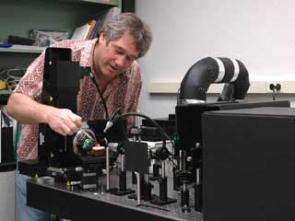
It'll be a snap to identify gemstones once Robert Downs finishes his library of spectral fingerprints for all the Earth's minerals. Downs is almost halfway there. So far, the associate professor of geosciences at The University of Arizona in Tucson has cataloged about 1,500 of the approximately 4,000 known minerals using a technique called Raman spectroscopy. The effort is known as the RRUFF Project.
"We're developing a tricorder," Downs said, referring to the instrument used on the "Star Trek" television show that could be waved over materials to identify their chemical composition.
Downs' work is destined for space. Although Downs' current Raman spectrometer takes up an area the size of a tabletop, his colleague M. Bonner Denton, a UA professor of chemistry and of geosciences, is developing a pocket-sized Raman spectrometer to be used on the 2009 Mars rover.
Downs is collaborating with George Rossman of the California Institute of Technology in Pasadena to develop the database of minerals.
The technology being developed for Mars will help create handheld instruments for use on Earth.
One use for a hand-held instrument would be the identification of gemstones. Downs and Denton will both give presentations on that aspect of the project on Sunday afternoon, March 12, at the 57th Annual Pittsburgh Conference on Analytical Chemistry and Applied Spectroscopy (PITTCON 2006).
Their presentations will be part of the symposium, "Gemstone/Mineral Analysis: Developing Non-Destructive Analytical Methods and Assessment Standards for Identification and Classification," held in room 222A of the Orange County Convention Center in Orlando, Fla..
Denton's 2:55 p.m. presentation, "The Present and Future Potential of Raman Spectroscopy in the Characterization of Gems and Minerals," will be followed at 3:15 p.m. by Downs' presentation, "The RRUFF Project: Creating an Integrated Database of Oriented Raman Spectra, X-Ray Diffraction and Electron Microprobe Analyses of Minerals."
Other ways to accurately identify minerals, such as X-ray diffraction and electron microprobe, require grinding a bit of the sample to powder or polishing the sample in a specific manner.
However, such rough treatment may not be the method of choice to determine that a glittering gemstone is truly a diamond, rather than just a piece of cubic zirconia.
Unlike other methods of identifying minerals, a Raman spectrometer does not require destructive sampling. It shoots a laser beam at the sample. The laser excites atoms within the sample, which then emit a very weak light of a wavelength in a pattern characteristic of the material.
"It's like a fingerprint," Downs said.
The technique is named after Sir C.V. Raman, who won a 1930 Nobel Prize for figuring out the underlying physics.
But no Raman spectrometer, big or small, can conclusively identify Mars rocks or any other kinds of minerals without the kind of comprehensive database Downs is creating.
When an unknown material is analyzed with a Raman spectrometer, it can be identified by comparing it with reference information from a database.
RRUFF Project: http://rruff.geo.arizona.edu
Source: University of Arizona


