Cowon's Q5W the iPhone of Personal Media Players?
December 7, 2007 by Lisa Zyga
Cowon Q5W
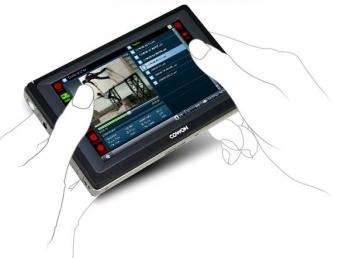
Cowon has recently released the Q5W personal media player in the US - a device akin to the iPhone in its long list of features that far surpasses other gadgets of its kind.
The Cowon Q5W can do just about everything but make a phone call. To start off, it has Wi-Fi, Bluetooth, FM radio, GPS, an audio player, photo browser, and a video player, with a 5-inch touchscreen LCD, built-in speakers, and 40-60GB of storage.
The device can hook up to the Internet anywhere there´s a Wi-Fi connection, and it runs on Windows CE, providing Internet Explorer and MSN Messenger. Users can type with an onscreen keyboard, and navigate with a stylus.
One of the greatest features of the Cowon Q5W is its compatibility with a wide variety of music, video and photo formats. Video formats include DivX, XviD, MPEG4, WMV7/8/9, music formats include MP3, WMA, ASF, OGG, WAV, FLAC, APE, MPC, and photo formats include JPEG, BMP, PNG, and even RAW files from various camera manufacturers. Also, its 800x400-pixel screen resolution makes images and video bright and crisp.
The device also has voice-guided, 2D/3D GPS, along with a car dock, and conveniently plugs in to the cigarette lighter adaptor. Also, while you´re in the car, the built-in FM transmitter can wirelessly transfer sound to the car´s speakers, giving a better overall sound.
In addition, the Cowon Q5W´s other features include a flash-player, wireless remote, and a voice recorder. Due to its near-pocket-size, its 600MHz processor has been described as a bit sluggish by Gizmodo compared with a PC. For a PMP, its average battery life is 13 hours for audio and seven hours for video.
Finally, the cost of the Cowon Q5W is $599 for 60GB storage, and $549 for 40GB storage.
via: Gizmodo
More information: Cowon
-
Engineers build first sub-10-nm carbon nanotube transistor
Feb 01, 2012 |
4.9 / 5 (29) |
30
-
Something old, something new: Evolution and the structural divergence of duplicate genes
Jan 31, 2012 |
4.6 / 5 (7) |
1
-
The hidden nanoworld of ice crystals: Revealing the dynamic behavior of quasi-liquid layers
Jan 30, 2012 |
5 / 5 (3) |
1
-
Stock market network reveals investor clustering
Jan 27, 2012 |
3.9 / 5 (23) |
8
-
Of microchemistry and molecules: Electronic microfluidic device synthesizes biocompatible probes
Jan 26, 2012 |
5 / 5 (1) |
0
-
dynamics 2/32
3 hours ago
-
dynamics
3 hours ago
-
Vibration Absorbtion Problem
8 hours ago
-
Does anyone make a small high temperature and high pressure pump?
14 hours ago
-
Strange indexing in Fortran Code
Feb 07, 2012
-
Car Port post load calculation
Feb 07, 2012
- More from Physics Forums - General Engineering
More news stories
Google rumored to have built Heads-Up-Display glasses prototype
(PhysOrg.com) -- 9to5Google is reporting that they have received a tip from someone they believe to be a reliable source saying that Google is working on a Heads-Up-Display (HUD) pair of eye-glasses. The per ...
Review: Soulo converts iPad into karaoke machine
Karaoke lovers typically fall into two categories: Those who enjoy it, and those whose arms have to be twisted to get up and sing in public.
Electronics / Consumer & Gadgets
5 hours ago |
not rated yet |
0
Hitachi ships the industry's first 25-nanometer SLC NAND flash enterprise-class SSDs
Demonstrating its commitment to delivering leading-edge technologies and solutions for enterprise-class servers and storage systems, Hitachi Global Storage Technologies (Hitachi GST) today announced that its ...
13 hours ago |
not rated yet |
0
New Nokia phone no standout, but worth a look
The first of Nokia's new generation of smartphones isn't flashy and certainly isn't an iPhone killer. But it's a nice device, and at $40 with a two-year contract, a bargain.
Electronics / Consumer & Gadgets
Feb 03, 2012 |
1 / 5 (2) |
4
Intel packs performance and reliability into its latest SSD 520 series
Intel Corporation announced today its fastest, most robust client/consumer solid-state drive (SSD) to date, the Intel Solid-State Drive 520 Series (Intel SSD 520), a 6 gigabit-per-second (gbps) SATA III SSD ...
Feb 07, 2012 |
5 / 5 (1) |
3
Astronomy team discovers nearby dwarf galaxy
(PhysOrg.com) -- A team led by UCLA research astronomer Michael Rich has used a unique telescope to discover a previously unknown companion to the nearby galaxy NGC 4449, which is some 12.5 million light years ...
Amasia: As next supercontinent forms, Arctic Ocean, Caribbean will vanish first
(PhysOrg.com) -- Geologists at Yale University have proposed a new theory to describe the formation of supercontinents, the epic process by which Earths major continental blocks combine into a single ...
Physicists build highly efficient 'no-waste' laser
A team of University of California, San Diego researchers has built the smallest room-temperature nanolaser to date, as well as an even more startling device: a highly efficient, "thresholdless" laser that ...
Why are there so few fish in the Earth's oceans?
(PhysOrg.com) -- A Stony Brook University researcher has found that, contrary to popular belief, there are not plenty of fish in the sea.
Transparent iron? For the first time, an experiment shows that atomic nuclei can become transparent
At the high-brilliance synchrotron light source PETRA III, a team of DESY scientists headed by Dr. Ralf Röhlsberger has succeeded in making atomic nuclei transparent with the help of X-ray light. At the ...
Study shows how DNA finds its match
It's been more than 50 years since James Watson and Francis Crick showed that DNA is a double helix of two strands that complement each other. But how does a short piece of DNA find its match, out of the millions ...