It Comes From Space to Solve our Energy Problems
March 11, 2006
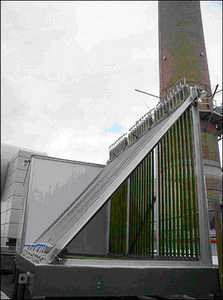
Figure 1: Early prototype bioreactor on the roof of the MIT cogeneration plant. Greenfuel has advanced the design and scale since. Cambridge, Mass (photo courtesy of: the http://fraserdomain.com)
GreenFuel Technologies Corporation, a start-up company in Cambridge Massachusetts, wants to use little green algae to cleanse the smoke from polluting smokestacks, converting it back into bio-fuels such as diesel or ethanol.
Originally inspired by NASA studies into regenerative life-support, the technology incorporates specially shaped tubes of water and site-specific algae at the end of large-scale sources of Carbon Dioxide such as coal-burning plants, reducing CO2 emissions by up to 40% and NOx by up to 86%, according to the company.
“This is a really big idea.” said GreenFuel founder and MIT Aeronautics Professor Isaac Berzin during a recent interview with Scientific American.
While the idea of using algae to clean smoke is not new, GreenFuel has made two breakthroughs that it believes will make the concept viable. First, it developed techniques to tailor algal species to specific sites, increasing efficiency and reducing problems such as die-off that have plagued other attempts. “There are a lot of variables which go into selecting a given strain of algae, from basic environmental factors such as climate and light levels, to power-plant factors like the nature of output gases, to post-processing requirements.” explained Marty Goldenblatt, VP of Sales, in a recent interview with PhysOrg. “We use rapid adaptation devices which allows us to find what set of algae is best for different conditions.”
The company has also optimized the algal growth system itself, creating a triangular tubing arrangement which causes rising bubbles of smoke to mix the algae, ensuring all of it has adequate light levels. The geometry also simplifies harvesting, allowing gravity to sweep out heavily grown tubes.
“You can think of it as milking a cow.” Berzin has said.
Central to GreenFuel’s business proposition, harvested algae can then be converted to bio-diesel, Ethanol, or other products that customers can sell for profit. While captured CO2 and NOx would be re-released in another combustion process, each molecule will have been used more than once, greatly reducing overall emissions.
Somewhat ironically, GreenFuel’s founder and MIT Aeronautics Professor Isaac Berzin got the idea to use algae to save the environment here at home while working on a project to help take humans to other worlds. Contracted to develop an advanced life-support system for NASA, Berzin worked with aquatic microbes like algae that could turn carbon dioxide from human breath and other waste sources back into oxygen. He soon realized algae’s ability to capture carbon make it ideal for reducing pollution from pollution-generating plants on Earth.
With such promising technology, what impedes full-scale implementation? “Space.” Says Goldenblatt, “Like all solar-based energy we need land over which to expose the algae. This can limit where we deploy.” Another hurtle involves convincing often-conservative utility executives to invest in cutting edge technology.
These issues notwithstanding, GreenFuel is pressing forward and gaining steam. They received over $11 million in second round Venture Capitol funding this December and recently moving to a 13,000 square foot facility. Currently, they are in negotiations with the New York State Energy Research Group to conduct analyses and initial tests of power plants in that state.
By Matthew Silver, Copyright 2006 PhysOrg.com
-
Earth's massive extinction: The story gets worse
Jan 05, 2012 |
4 / 5 (25) |
36
-
'Animal embryo' fossils are actually microbes (Update)
Dec 22, 2011 |
4.6 / 5 (11) |
1
-
Model shows how facade pollutants make it into the environment
Dec 10, 2011 |
5 / 5 (2) |
0
-
How energy analysis can create more bang for the energy research buck
Nov 02, 2011 |
not rated yet |
0
-
Harnessing the Earth, the atom and the leaf
Oct 27, 2011 |
not rated yet |
0
-
Engineers build first sub-10-nm carbon nanotube transistor
Feb 01, 2012 |
4.9 / 5 (31) |
30
-
Something old, something new: Evolution and the structural divergence of duplicate genes
Jan 31, 2012 |
4.6 / 5 (7) |
1
-
The hidden nanoworld of ice crystals: Revealing the dynamic behavior of quasi-liquid layers
Jan 30, 2012 |
5 / 5 (3) |
1
-
Stock market network reveals investor clustering
Jan 27, 2012 |
3.9 / 5 (23) |
8
-
Of microchemistry and molecules: Electronic microfluidic device synthesizes biocompatible probes
Jan 26, 2012 |
5 / 5 (1) |
0
More news stories
Humans may have helped the decline of African rainforests 3000 years ago
(PhysOrg.com) -- Large areas of rainforests in Central Africa mysteriously disappeared over three thousand years ago, to be replaced by savannas. The prevailing theory has been that the cause was a change ...
Could Venus be shifting gear?
(PhysOrg.com) -- ESAs Venus Express spacecraft has discovered that our cloud-covered neighbour spins a little slower than previously measured. Peering through the dense atmosphere in the infrared, the ...
Space & Earth / Space Exploration
5 hours ago |
5 / 5 (5) |
7
|
Mars Science Laboratory computer issue resolved
(PhysOrg.com) -- Engineers have found the root cause of a computer reset that occurred two months ago on NASA's Mars Science Laboratory and have determined how to correct it.
Space & Earth / Space Exploration
6 hours ago |
5 / 5 (5) |
3
|
Clam fields found at deep, low-temperature Mariana vents
(PhysOrg.com) -- Scientists have marveled at the unusual life forms thriving at high temperature hydrothermal vents of the deep ocean.
Space & Earth / Earth Sciences
6 hours ago |
not rated yet |
0
|
Two new moons for Jupiter
Advances in technology have lead to the discovery of new planets outside of our Solar System, and now even new moons in our own backyard.
Space & Earth / Space Exploration
5 hours ago |
not rated yet |
2
Human cognitive performance suffers following natural disasters, researchers find
Not surprisingly, victims of a natural disaster can experience stress and anxiety, but a new study indicates that it might also cause them to make more errors - some serious - in their daily lives. In their upcoming Human Fa ...
"Twisted Metal" gamers get shot at real gunplay
Fans of "Twisted Metal" will get to welcome a long-awaited sequel of the car-battle videogame with a real-world bang by blasting an ice cream truck to bits with a machine gun.
Putting the squeeze on planets outside our solar system
(PhysOrg.com) -- Using high-powered lasers, scientists at Lawrence Livermore National Laboratory and collaborators discovered that molten magnesium silicate undergoes a phase change in the liquid state, abruptly ...
The power of estrogen -- male snakes attract other males
A new study has shown that boosting the estrogen levels of male garter snakes causes them to secrete the same pheromones that females use to attract suitors, and turned the males into just about the sexiest ...
Both maternal and paternal age linked to autism
Older maternal and paternal age are jointly associated with having a child with autism, according to a recently published study led by researchers at The University of Texas Health Science Center at Houston (UTHealth).
New error-correcting codes guarantee the fastest possible rate of data transmission
Error-correcting codes are one of the triumphs of the digital age. Theyre a way of encoding information so that it can be transmitted across a communication channel such as an optical fiber o ...