Solving another mystery of an amazing water walker
December 10, 2007
Solving another mystery of an amazing water walker

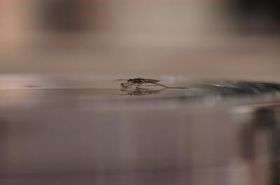
Scientists have found a new explanation for the water strider's "miraculous" ability to lead onto a liquid surface without sinking. Credit: Ho-Young Kim, Seoul National University, Korea

Walking on water may seem like a miracle to humans, but it is a ho-hum for the water strider and scientists who already solved the mystery of that amazing ability. Now researchers in Korea are reporting a long-sought explanation for the water strider’s baffling ability to leap onto a liquid surface without sinking. The study is scheduled for the Dec. 18 issue of ACS’ Langmuir.

In the new study, Ho-Young Kim and Duck-Gyu Lee note that scientists already have discovered the hydrophobic, or water-repellent, structure of the water strider’s legs and how they allowed the creatures to scoot along ponds and placid lakes. However, their ability to jump onto or “bounce” off liquid surfaces remained a lingering scientific mystery.

Kim and Lee solved it by dropping a highly water-repellent sphere onto the surface of water at different speeds, carefully tracking its motion with high-speed cameras. They found that the ball must be traveling within a narrow velocity range in order to bounce off the water’s surface. The sphere may sink if it goes too fast and won’t bounce back if too slow.

“The highly improved ability of heavy hydrophobic solids to keep afloat on water even after impacting upon water with a high velocity appears to explain partially why water striders have superhydrophobic legs,” say the authors. “Application of our study can be extended to developing semi-aquatic robots that mimic such insects having the surprising mobility on water.”

Source: American Chemical Society

4.3 /5 (8 votes)  

Rank 4.3 /5 (8 votes)
Tags

Relevant PhysicsForums posts

More news stories

Fool's gold may prove an unlikely alternative to overexploited catalytic materials

Catalytic materials, which lower the energy barriers for chemical reactions, are used in everything from the commercial production of chemicals to catalytic converters in car engines. However, with current catalytic materials ...

Chemistry / Materials Science

created 3 hours ago | popularity 5 / 5 (2) | comments 1 | with audio podcast

Unpicking HIV’s invisibility cloak

Drug researchers hunting for alternative ways to treat human immunodeficiency virus (HIV) infections may soon have a novel target—its camouflage coat. HIV hides inside a cloak unusually rich in a sugar ...

Chemistry / Biochemistry

created 3 hours ago | popularity 5 / 5 (2) | comments 0

Hydrogen from acidic water: Researchers develop potential low cost alternative to platinum for splitting water

A technique for creating a new molecule that structurally and chemically replicates the active part of the widely used industrial catalyst molybdenite has been developed by researchers with the Lawrence Berkeley ...

Chemistry / Materials Science

created 22 hours ago | popularity 5 / 5 (12) | comments 11 | with audio podcast

No entry without protein recycling: Researchers discover new coherence in enzyme transport

The group of Prof. Dr. Ralf Erdmann at the Ruhr-Universität Bochum, Germany, discovered a connection of peroxisomal protein import and receptor export. In the Journal of Biological Chemistry, they disclo ...

Chemistry / Biochemistry

created 3 hours ago | popularity not rated yet | comments 0

Flexible paper robots

(PhysOrg.com) -- These inexpensive robots can stretch, bend and twist under control, and lift objects up to 120 times their own weight. Being soft, they can apply gentle and even pressure, and adapt to varied ...

Chemistry / Materials Science

created 20 hours ago | popularity 5 / 5 (5) | comments 3 | with audio podcast


Hovering not hard if you're top-heavy, researchers find

Top-heavy structures are more likely to maintain their balance while hovering in the air than are those that bear a lower center of gravity, researchers at New York University's Courant Institute of Mathematical Sciences ...

Grass to gas: Researchers' genome map speeds biofuel development

Researchers at the University of Georgia have taken a major step in the ongoing effort to find sources of cleaner, renewable energy by mapping the genomes of two originator cells of Miscanthus x giganteus, a large perenn ...

Drug halts organ damage in inflammatory genetic disorder

A new study shows that Kineret (anakinra), a medication approved for the treatment of rheumatoid arthritis, is effective in stopping the progression of organ damage in people with neonatal-onset multisystem inflammatory disease ...

Cochlear implants may be safe, effective for organ transplant patients

Cochlear implants may be a safe, effective option for some organ transplant patients who've lost their hearing as an unfortunate consequence of their transplant-related drug regime, researchers report.

Researchers develop new method for creating tissue engineering scaffolds

Researchers at Northwestern University have developed a new method for creating scaffolds for tissue engineering applications, providing an alternative that is more flexible and less time-intensive than current technology.

Molecular profiling reveals differences between primary and recurrent ovarian cancers

There is a need to analyze tumor specimens at the time of ovarian cancer recurrence, according to a new study published in Molecular Cancer Therapeutics. Researchers used a diagnostic technology called molecular profiling to examine ...