NASA satellite reveals unprecedented view of mysterious 'night-shining' clouds
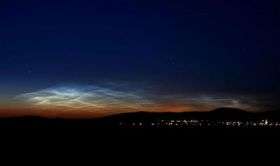
NASA's AIM satellite has provided the first global-scale, full-season view of iridescent polar clouds that form 50 miles above Earth’s surface.
The Aeronomy of Ice in the Mesosphere (AIM) mission is the first satellite dedicated to the study of these noctilucent or "night-shining" clouds. They are called "night shining" clouds by observers on the ground because their high altitude allows them to continue reflecting sunlight after the sun has set below the horizon. AIM has provided the first global-scale view of the clouds over the entire 2007 Northern Hemisphere season with an unprecedented horizontal resolution of 3 miles by 3 miles.
Very little is known about these 'clouds at the edge of space', also called Polar Mesospheric Clouds. How do they form over the summer poles, why are they being seen at lower latitudes than ever before, and why have they been growing brighter and more frequent" During its mission lifetime, AIM will observe a total of two complete polar mesospheric cloud seasons in each polar region, documenting for the first time the entire complex life cycle of Polar Mesospheric Clouds.
"The AIM mission has changed our view of Polar Mesospheric Clouds and their surroundings after only one season of observations," stated AIM Principal Investigator James Russell III of Hampton University, Hampton, Va. "The measurements show the brightest clouds ever observed with more variability and structure than expected, signifying extreme sensitivity to the environment in which the clouds form. They also show that the clouds exist over a broader range in height than was believed to be the case before AIM was launched. The unprecedented sensitivity has revealed for the first time the presence of very small ice particles believed to be responsible for the mysterious radar phenomenon known as "Polar Mesospheric Summertime Echoes".
The bright "night-shining" clouds were seen by the spacecraft's instruments regularly, first appearing on May 25th and lasting until August 25th.
The AIM satellite reported daily observations of the clouds at all longitudes and over a broad latitude range extending from 60 degrees North to 85 degrees North. The AIM satellite is currently making the first global observations of the Southern Hemisphere cloud season. The clouds consist of ice crystals formed when water vapor condenses onto dust particles in these coldest regions of our planet, at temperatures that may dip to minus 210 to minus 235 degrees Fahrenheit.
New results from AIM's first Northern Hemisphere season observations show:
-- The most detailed picture of the clouds ever collected showing that they appear every day, they are widespread, and they are highly variable on hourly to daily time scales.
-- That Polar Mesospheric Cloud brightness varies over horizontal scales of about two miles; and over small regions, clouds measured by AIM are ten-fold brighter than measured by previous space-based instruments.
-- The unexpected result that mesospheric ice occurs in one continuous layer extending from below the main peak at 51 miles up to around 55 miles.
-- Observations of a previously suspected, but never before seen, population of very small ice particles believed to be responsible for strong radar echoes from the summertime mesosphere. This was made possible because of the unprecedented sensitivity of the AIM measurements.
-- Polar Mesospheric Cloud structures resolved for the first time that exhibit complex features present in normal tropospheric clouds. This startling similarity suggests that the mesosphere may share some of the same dynamical processes responsible for weather near the surface. If this similarity holds up in further analysis, this opens up an entirely different view of potential mechanisms that can explain why the clouds form and how they vary.
The new results were produced by David Rusch and the Cloud Imaging and Particle Size experiment team, University of Colorado, Laboratory for Atmospheric and Space physics (result 1, 2 and 5); and Larry Gordley and Mark Hervig and the Solar Occultation for Ice Experiment team, Gats, Inc., Newport News, Va. (results 3 and 4).
Source: Goddard Space Flight Center


