Scientists sort cells with beams of light
December 10, 2007 Laser beam 'fire hose' used to sort cells

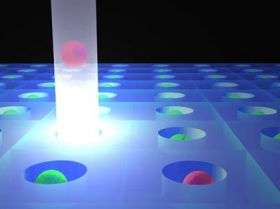
MIT has developed a new system for sorting cells that involves special "traps" in a silicone layer bonded to a microscope slide. Cells with specific properties are then levitated out of their traps using the pressure of a beam of targeted light from a low-cost laser. A flowing fluid then sweeps the selected cells off to a separate reservoir Image courtesy / Joseph Kovac, MIT

Separating out particular kinds of cells from a sample could become faster, cheaper and easier thanks to a new system developed by MIT researchers that involves levitating the cells with light.

The system, which can sort up to 10,000 cells on a conventional glass microscope slide, could enable a variety of biological research projects that might not have been feasible before, its inventors say. It could also find applications in clinical testing and diagnosis, genetic screening and cloning research, all of which require the selection of cells with particular characteristics for further testing.

Joel Voldman, an associate professor in MIT’s Department of Electrical Engineering and Computer Science, and Joseph Kovac, a student in the department, developed the new system, which is featured as the cover story in the Dec. 15 issue of the journal Analytical Chemistry.

Present methods allow cells to be sorted based on whether or not they emit fluorescent light when mixed with a marker that responds to a particular protein or other compound. The new system allows more precise sorting, separating out cells based not just on the overall average fluorescent response of the whole cell but on responses that occur in specific parts of the cell, such as the nucleus. The system can also pick up responses that vary in how fast they begin or how long they last.

“We’ve been interested in looking at things inside the cell that either change over time, or are in specific places,” Voldman says. Separating out cells with such characteristics “can’t be done with traditional cell sorting.”

For example, if cells differ in how quickly they respond to a particular compound used in the fluorescent labeling, the new system would make it possible to “select out the ones that are faster or slower, and see what’s different,” says Voldman, who also has appointments in MIT’s Research Laboratory of Electronics and the Microsystems Technology Laboratories.

“It seems like that should be easy, but it isn’t,” he said. There are other ways of accomplishing the same kind of cell separation, but they require complex and expensive equipment, or are limited in the number of cells they can process.

The new system uses a simple transparent silicone layer bonded to a conventional glass microscope slide. Fabricated in the layer are a series of tiny cavities, or traps, in which cells settle out after being added to the slide in a solution. Up to 10,000 cells could be sorted on a single slide.

Looking through the microscope, either a technician or a computerized system can check each cell to determine whether it has fluorescence in the right area or at the right time to meet the selection criteria. If so, its position is noted by the computer. At the end of the selection process, all of the cells whose positions were recorded are then levitated out of their traps using the pressure of a beam of targeted light from a low-cost laser. A flowing fluid then sweeps the selected cells off to a separate reservoir.

The laser levitation of the cells acts like “a fire hose pushing up a beach ball,” Voldman says. But the laser method is gentle enough that the living cells remain viable after the process is complete, allowing further biological testing.

Voldman and Kovac are continuing to refine the system, working on making it easier to use and on improving its ability to keep samples sterile. Voldman says that unlike expensive separation techniques such as optical tweezers, the new system could cost only a few thousand dollars. As a result, it could be employed in a variety of biological research laboratories or clinical settings, not just in big, centralized testing facilities.

Source: Massachusetts Institute of Technology


print this article email this article download pdf blog this article bookmark this article     Stumble it Digg this share on Facebook retweet share on Reddit add to delicious
Rate this story - 4.4 /5 (7 votes)

Rank Filter

Move the slider to adjust rank threshold, so that you can hide some of the comments.


Display comments: newest first

  • SledPants - Dec 10, 2007
    • Rank: not rated yet
    Couldn't this technology eventually be used to create force fields and the such as in star trek series?
  • NanoStuff - Dec 16, 2007
    • Rank: not rated yet
    Anything is possible in make believe land.

December 10, 2007 all stories

Comments: 2

4.4 /5 (7 votes)
  • Stumble this up

  • Digg this

  • share this

  • hide
  • Related Stories

  • Engineers develop new way to fuse cells
    created Jan 04, 2009 | popularity not rated yet | comments 0
  • Scientists visualize how bacteria talk to one another
    created 7 hours ago | popularity not rated yet | comments 0
  • Findings show nanomedicine promising for treating spinal cord injuries
    created 7 hours ago | popularity not rated yet | comments 0
  • New finding suggests prostate biopsy is not always necessary
    created Nov 06, 2009 | popularity not rated yet | comments 0
  • Researchers find new way to attack inflammation in Graves' eye disease
    created Nov 06, 2009 | popularity not rated yet | comments 0


Other News

Toward home-brewed electricity with 'personalized solar energy'

Toward home-brewed electricity with 'personalized solar energy'

Chemistry / Materials Science

created Nov 04, 2009 | popularity 3.4 / 5 (9) | comments 4

New scientific discoveries are moving society toward the era of "personalized solar energy," in which the focus of electricity production shifts from huge central generating stations to individuals in their ...


Scientists Reproduce a Building Block of Life in Laboratory

Scientists Reproduce a Building Block of Life in Laboratory

Chemistry / Biochemistry

created Nov 06, 2009 | popularity 4.8 / 5 (23) | comments 0

(PhysOrg.com) -- NASA scientists studying the origin of life have reproduced uracil, a key component of our hereditary material, in the laboratory.


Newly Discovered Fat Molecule: An Undersea Killer with an Upside

Newly Discovered Fat Molecule: An Undersea Killer with an Upside

Chemistry / Biochemistry

created Nov 05, 2009 | popularity 4.8 / 5 (9) | comments 0

(PhysOrg.com) -- A chemical culprit responsible for the rapid, mysterious death of phytoplankton in the North Atlantic Ocean has been found by collaborating scientists at Rutgers University and the Woods Hole ...


CU-Boulder map of human bacterial diversity shows wide interpersonal differences

Map of Human Bacterial Diversity Shows Wide Interpersonal Differences

Chemistry / Biochemistry

created Nov 05, 2009 | popularity 4.7 / 5 (11) | comments 0

(PhysOrg.com) -- A University of Colorado at Boulder team has developed the first atlas of bacterial diversity across the human body, charting wide variations in microbe populations that live in different ...


Mimicking nature, scientists can now extend redox potentials

Mimicking nature, scientists can now extend redox potentials

Chemistry / Biochemistry

created Nov 04, 2009 | popularity 4.8 / 5 (5) | comments 0

(PhysOrg.com) -- New insight into how nature handles some fundamental processes is guiding researchers in the design of tailor-made proteins for applications such as artificial photosynthetic centers, long-range ...