Hazy red sunset on extrasolar planet
December 11th, 2007 Hazy red sunset on extrasolar planet

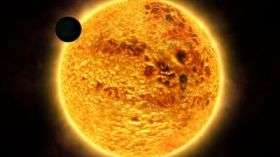
An artist's impression of the extrasolar planet HD 189733b seen here with its parent star looming behind. The planet is slightly larger than our own Solar System's Jupiter. Its atmosphere is a scorching eight hundred degrees Celsius. Astronomers have found that the sunset on HD 189733b would look similar to a hazy red sunset on Earth. Credit: ESA, NASA and Frederic Pont (Geneva University Observatory)

A team of astronomers have used the NASA/ESA Hubble Space Telescope to detect, for the first time, strong evidence of hazes in the atmosphere of a planet orbiting a distant star. The discovery comes after extensive observations made recently with Hubble’s Advanced Camera for Surveys (ACS).

The team, led by Frédéric Pont from the Geneva University Observatory in Switzerland, used Hubble’s ACS to make the first detection of hazes in the atmosphere of the giant planet. "One of the long-term goals of studying extrasolar planets is to measure the atmosphere of an Earth-like planet, this present result is a step in this direction" says Pont. "HD 189733b is the first extrasolar planet for which we are piecing together a complete idea of what it really looks like."

The new observations were made as the extrasolar planet, dubbed HD 189733b, passed in front of its parent star in a transit. As the light from the star passes through the atmosphere around the limb of the giant extrasolar planet, the gases in the atmosphere stamp their unique signature on the starlight from HD 189733.

The planet itself, orbiting close to its parent star, is a ‘hot-Jupiter’ type of gas giant slightly larger than Jupiter. The proximity to its star results in an atmospheric temperature of roughly seven hundred degrees Celsius. Measurements of the way light varies as the planet passes in front of its parent star indicates that HD 189733b has neither Earth-sized moons nor any discernable Saturn-like ring system.

Hubble’s ACS camera, coupled with a grism (a kind of cross between a prism and a diffraction grating) allowed the astronomers to make extremely accurate measurements of the spectrum of HD 189733b, allowing conclusions to be drawn about the composition of the planet’s atmosphere. The exquisite level of precision needed to make this observation can only, at the moment, be achieved from space. The combination of a large planet and relatively small parent star – only 76% of the diameter of our Sun – contributes to the success of this delicate experiment.

Where the scientists had expected to see the fingerprints of sodium, potassium and water there were none. This finding, combined with the distinct shape of the planet’s spectrum, infers that high level hazes (with an altitude range of roughly 1000 km) are present. So the atmosphere on HD 189733b would look very similar to a gorgeous red sunset over Athens! Venus and Saturn’s moon Titan, in our own Solar System, are also covered with haze. According to the scientists the haze probably consists of tiny particles (less than 1/1000 mm in size) of condensates of iron, silicates and aluminium oxide dust (the compound on Earth which the mineral sapphire is made of).

As part of the observations of HD 189733, the teams of astronomers also needed to accurately account for the variations in the star’s brightness during the set of observations. ‘Starspots’ like those seen on our own Sun may cover several percent of the star and are thought to be about 1000 degrees Celsius cooler than the rest of HD 189733’s surface. It was found that there is a starspot on the star’s surface which is over 80,000 km across.

Source: Hubble Information Centre


print this article email this article download pdf blog this article bookmark this article     Digg this Stumble it share on Facebook share on Reddit add to delicious save to Yahoo! bookmarks
4.3/5 after 7 votes


December 11th, 2007 all stories
Space & Earth / Astronomy

Comments: 0
Rank: 4.3/5 after 7 votes

  • Stumble this up

  • Digg this

  • Share it:
  • share on Facebook
  • share on MySpace
  • share on Slashdot
  • rss-newsfeed
  • share on Google
  • share on Reddit
  • add to delicious
  • save to Yahoo! bookmarks
  • share on Windows Live
  • Add to Mixx!
Rating: 4.3/5 after 7 votes

  • Related Stories

  • Water supply shifts as global climate changes
    created Jun 15, 2009 | popularity not rated yet | comments 0
  • The search for ET just got easier
    created Jun 10, 2009 | popularity not rated yet | comments 0
  • New definition could further limit habitable zones around distant suns
    created Jun 10, 2009 | popularity not rated yet | comments 0
  • A serious search for extraterrestrial life
    created May 26, 2009 | popularity not rated yet | comments 0
  • Scientists Develop New Method to Find Alien Oceans, Earth-like Planets (w/Videos)
    created May 26, 2009 | popularity not rated yet | comments 0

Tags


  • Physicists Demonstrate Quantum Memory with Matter Qubits
    Physicists Demonstrate Quantum Memory with Matter Qubits
    Physics / General Physics
    created Jul 03, 2009 | popularity 4.4 / 5 (17) | comments 1
  • 'Holey' Nanosheets for Wastewater Dye Removal
    Nanotechnology / Nanomaterials
    created Jul 01, 2009 | popularity 5 / 5 (5) | comments 1
  • Jellyfish Robot Swims Like its Biological Counterpart
    Jellyfish Robot Swims Like its Biological Counterpart
    Electronics / Robotics
    created Jun 26, 2009 | popularity 4.4 / 5 (8) | comments 1
  • Could Maxwell's Demon Exist in Nanoscale Systems?
    Could Maxwell's Demon Exist in Nanoscale Systems?
    Physics / General Physics
    created Jun 24, 2009 | popularity 4.4 / 5 (18) | comments 29
  • Living Safely with Robots, Beyond Asimov's Laws
    Living Safely with Robots, Beyond Asimov's Laws
    Electronics / Robotics
    created Jun 22, 2009 | popularity 4.6 / 5 (52) | comments 40
  • Other News

    US ambitions to send astronauts back to the moon as a prelude to missions to Mars have been put in doubt

    Forty years ago man first walked on the moon

    Space & Earth / Space Exploration

    created 21 hours ago | popularity 4.3 / 5 (4) | comments 2

    Forty years ago on July 20, 1969, American astronaut Neil Armstrong realized the oldest dream of human civilizations when he became the first man to walk on the moon.


    The least sea ice in 800 years

    The least sea ice in 800 years

    Space & Earth / Earth Sciences

    created Jul 01, 2009 | popularity 4.1 / 5 (63) | comments 59

    New research, which reconstructs the extent of ice in the sea between Greenland and Svalbard from the 13th century to the present indicates that there has never been so little sea ice as there is now. The ...


    Gas around young galaxy

    Intense heat killed the Universe's would-be galaxies, researchers say

    Space & Earth / Astronomy

    created Jul 01, 2009 | popularity 3.4 / 5 (21) | comments 27

    (PhysOrg.com) -- Our Milky Way galaxy only survived because it was already immersed in a large clump of dark matter which trapped gases inside it, scientists led by Durham University's Institute for Computational ...


    Scientists' Drill Hits Magma: Only Third Time on Record

    Scientists' Drill Hits Magma: Only Third Time on Record

    Space & Earth / Earth Sciences

    created Jun 29, 2009 | popularity 4.7 / 5 (22) | comments 20

    (PhysOrg.com) -- Scientists drilling a borehole deep into Iceland’s rocky crust to explore new methods of using geothermal energy hit a major roadblock on Thursday: Their drill ran into molten rock at a depth ...


    NASA manager pitches a cheaper return-to-moon plan

    Space & Earth / Space Exploration

    created Jun 30, 2009 | popularity 4.1 / 5 (8) | comments 18

    (AP) -- Like a car salesman pushing a luxury vehicle that the customer no longer can afford, NASA has pulled out of its back pocket a deal for a cheaper ride to the moon.