Building blocks of life formed on Mars
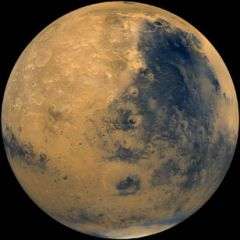
December 11, 2007 Mars

Mars. Credit: NASA

Organic compounds contain carbon and hydrogen and form the building blocks of all life on Earth. By analyzing organic material and minerals in the Martian meteorite Allan Hills 84001, scientists at the Carnegie Institution's Geophysical Laboratory have shown for the first time that building blocks of life formed on Mars early in its history. Previously, scientists have thought that organic material in ALH 84001 was brought to Mars by meteorite impacts or more speculatively originated from ancient Martian microbes.

The Carnegie-led team made a comprehensive study of the ALH 84001 meteorite and compared the results with data from related rocks found on Svalbard, Norway. The Svalbard samples occur in volcanoes that erupted in a freezing Arctic climate about 1 million years ago—possibly mimicking conditions on early Mars.

“Organic material occurs within tiny spheres of carbonate minerals in both the Martian and Earth rocks,” explained Andrew Steele, lead author of the study. “We found that the organic material is closely associated with the iron oxide mineral magnetite, which is the key to understanding how these compounds formed.”

The organic material in the rocks from Svalbard formed when volcanoes erupted under freezing conditions. During cooling, magnetite acted as a catalyst to form organic compounds from fluids rich in carbon dioxide (CO2) and water (H2O). This event occurred under conditions where no forms of life are likely to exist. The similar association of carbonate, magnetite and organic material in the Martian meteorite ALH 84001 is very compelling and shows that the organic material did not originate from Martian life forms but formed directly from chemical reactions within the rock. This is the first study to show that Mars is capable of forming organic compounds at all.

The organic material in the Allan Hills meteorite may have formed during two different events. The first, similar to the Svalbard samples, was during rapid cooling of fluids on Mars. A second event produced organic material from carbonate minerals during impact ejection of ALH 84001 from Mars.

“The results of this study show that volcanic activity in a freezing climate can produce organic compounds,” remarked co-author Hans E.F. Amundsen from Earth and Planetary Exploration Services. “This implies that building blocks of life can form on cold rocky planets throughout the Universe.”

“Our finding sets the stage for the Mars Science Laboratory (MSL) mission in 2009,” remarked Steele, who is a member of the Sample Analysis on Mars (SAM) instrument team onboard MSL. “We now know that Mars can produce organic compounds. Part of the mission's goal is to identify organic compounds, their sources, and to detect molecules relevant to life. We know that they are there. We just have to find them.”

The research is published in Meteoritics & Planetary Science: http://meteoritics.org/index.htm

Source: Carnegie Institution


Rate this story - 4.6 /5 (20 votes)

Rank Filter

Move the slider to adjust rank threshold, so that you can hide some of the comments.


Display comments: newest first

  • Nikola - Dec 11, 2007
    • Rank: 3.5 / 5 (2)
    I think that we will find, as we continue to explore the Universe, that life is abundant. Look at the Hubble Ultra Deep Field image. No life in any of those 50,000 galaxies? I don't think so. Just my opinion though.
  • Tomkaten - Dec 11, 2007
    • Rank: 3.5 / 5 (2)
    Sorry, but we don't explore the Universe. We've barely begun exploring our closest planetary neighbor. Finding germs and bacteria there will bring about an amazing revelation for mankind.

    But when it comes to intelligent life, allow me to have certain reservations. The Universe is so vast, that it's silly to assume we're going to find it any time soon, if ever... It's just the way it is. Interstellar travel is just a myth right now.
    It may sound funny, but IMO the most pressing disovery that would enable us to travel to other stars would be to find a way to prolong human existence indefinitely. While that would do wonders for space explorations, it would definitely bring about other insurmountable problems.
  • earls - Dec 11, 2007
    • Rank: 1 / 5 (2)
    Non-sense.

December 11, 2007 all stories

Comments: 3

4.6 /5 (20 votes)

  • hide
  • Related Stories


  • hide
  • Relevant PhysicsForums posts

  • Spreading Life in the Universe
    created 16 hours ago
  • Force of Gravity in terms of Density
    created Feb 08, 2010
  • what is the relation between gravity and light?
    created Feb 08, 2010
  • Does the Thermoelectric effect apply in sun?
    created Feb 07, 2010
  • More from Physics Forums - General Astronomy

Other News

India announces long-range nuclear-capable missile test

Space & Earth / Space Exploration

created 21 minutes ago | popularity 5 / 5 (1) | comments 0

India will test a nuclear-capable missile with a range of over 5,000 kilometres (3,000 miles) within a year, its top military scientist said Wednesday, risking a rise in regional tensions.


Space shuttle Endeavour pulls in at space station (AP)

Space shuttle Endeavour pulls in at space station

Space & Earth / Space Exploration

created 5 hours ago | popularity 5 / 5 (1) | comments 0

(AP) -- Shuttle Endeavour arrived to a warm welcome at the International Space Station early Wednesday, delivering a new room and observation deck that will come close to completing construction 200 miles ...


Climate 'Tipping Points' May Arrive Without Warning, Says Top Forecaster

Space & Earth / Environment

created 15 hours ago | popularity 3 / 5 (8) | comments 10 | with audio podcast

(PhysOrg.com) -- A new University of California, Davis, study by a top ecological forecaster says it is harder than experts thought to predict when sudden shifts in Earth's natural systems will occur -- a worrisome finding ...


38 percent of world's surface in danger of desertification

38 percent of world's surface in danger of desertification

Space & Earth / Environment

created 12 hours ago | popularity 2 / 5 (4) | comments 6

A team of Spanish researchers has measured the degradation of the planet's soil using the Life Cycle Assessment (LCA), a scientific methodology that analyses the environmental impact of human activities, and ...


A new 3-D map of the interstellar gas within 300 parsecs from the sun

A new 3D map of the interstellar gas within 300 parsecs from the Sun

Space & Earth / Astronomy

created 18 hours ago | popularity 5 / 5 (5) | comments 0 | with audio podcast

(PhysOrg.com) -- Astronomy & Astrophysics is publishing new 3D maps of the interstellar gas in the local area around our Sun. A French-American team of astronomers presents new absorption measurements toward ...