Greenland melt accelerating, according to CU-Boulder study
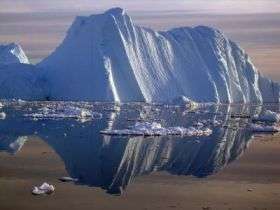
The 2007 melt extent on the Greenland ice sheet broke the 2005 summer melt record by 10 percent, making it the largest ever recorded there since satellite measurements began in 1979, according to a University of Colorado at Boulder climate scientist.
The melting increased by about 30 percent for the western part of Greenland from 1979 to 2006, with record melt years in 1987, 1991, 1998, 2002, 2005 and 2007, said CU-Boulder Professor Konrad Steffen, director of the Cooperative Institute for Research in Environmental Sciences. Air temperatures on the Greenland ice sheet have increased by about 7 degrees Fahrenheit since 1991, primarily a result of the build-up of greenhouse gases in Earth’s atmosphere, according to scientists.
Steffen gave a presentation on his research at the fall meeting of the American Geophysical Union held in San Francisco from Dec. 10 to Dec. 14. His team used data from the Defense Meteorology Satellite Program’s Special Sensor Microwave Imager aboard several military and weather satellites to chart the area of melt, including rapid thinning and acceleration of ice into the ocean at Greenland’s margins.
Steffen maintains an extensive climate-monitoring network of 22 stations on the Greenland ice sheet known as the Greenland Climate Network, transmitting hourly data via satellites to CU-Boulder to study ice-sheet processes.
Although Greenland has been thickening at higher elevations due to increases in snowfall, the gain is more than offset by an accelerating mass loss, primarily from rapidly thinning and accelerating outlet glaciers, Steffen said. “The amount of ice lost by Greenland over the last year is the equivalent of two times all the ice in the Alps, or a layer of water more than one-half mile deep covering Washington, D.C.”
The Jacobshavn Glacier on the west coast of the ice sheet, a major Greenland outlet glacier draining roughly 8 percent of the ice sheet, has sped up nearly twofold in the last decade, he said. Nearby glaciers showed an increase in flow velocities of up to 50 percent during the summer melt period as a result of melt water draining to the ice-sheet bed, he said.
“The more lubrication there is under the ice, the faster that ice moves to the coast,” said Steffen. “Those glaciers with floating ice ‘tongues’ also will increase in iceberg production.”
Greenland is about one-fourth the size of the United States, and about 80 percent of its surface area is covered by the massive ice sheet. Greenland hosts about one-twentieth of the world's ice -- the equivalent of about 21 feet of global sea rise. The current contribution of Greenland ice melt to global sea levels is about 0.5 millimeters annually.
The most sensitive regions for future, rapid change in Greenland’s ice volume are dynamic outlet glaciers like Jacobshavn, which has a deep channel reaching far inland, he said. “Inclusion of the dynamic processes of these glaciers in models will likely demonstrate that the 2007 Intergovernmental Panel on Climate Change assessment underestimated sea-level projections for the end of the 21st century,” Steffen said.
Helicopter surveys indicate there has been an increase in cylindrical, vertical shafts in Greenland’s ice known as moulins, which drain melt water from surface ponds down to bedrock, he said. Moulins, which resemble huge tunnels in the ice and may run vertically for several hundred feet, switch back and forth from vertical to horizontal as they descend toward the bottom of the ice sheet, he said.
“These melt-water drains seem to allow the ice sheet to respond more rapidly than expected to temperature spikes at the beginning of the annual warm season,” Steffen said. “In recent years the melting has begun earlier than normal.”
Steffen and his team have been using a rotating laser and a sophisticated digital camera and high-definition camera system provided by NASA’s Jet Propulsion Laboratory to map the volume and geometry of moulins on the Greenland ice sheet to a depth of more than 1,500 feet. “We know the number of moulins is increasing,” said Steffen. “The bigger question is how much water is reaching the bed of the ice sheet, and how quickly it gets there.”
Steffen said the ice loss trend in Greenland is somewhat similar to the trend of Arctic sea ice in recent decades. In October, CU-Boulder’s National Snow and Ice Data Center reported the 2007 Arctic sea-ice extent had plummeted to the lowest levels since satellite measurements began in 1979 and was 39 percent below the long-term average tracked from 1979 to 2007.
Source: University of Colorado at Boulder


