THEMIS probes view auroral substorms, bowshock explosions
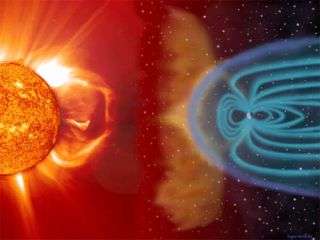
Five satellites launched last February to probe magnetic storms around the Earth will move into prime observing position next month, but they already have produced important new information on the interactions between the solar wind and the Earth's magnetic field.
NASA's Time History of Events and Macroscale Interactions during Substorms (THEMIS) mission, managed and operated by the University of California, Berkeley, took advantage of its orbital position between the sun and Earth during the past 10 months to observe the dynamics of a rapidly developing substorm, confirm the existence of giant magnetic ropes and witness small explosions in the outskirts of Earth's magnetic field.
These findings will be presented at a media briefing today (Tuesday, Dec. 11) at the annual meeting of the American Geophysical Union in San Francisco.
The discoveries began on March 23, when a substorm erupted over Alaska and Canada, producing vivid auroras for more than two hours. Substorms are sudden bursts of energy in Earth's atmosphere that turn the undulating curtains of the Northern Lights into hyperactive light shows lasting from minutes to hours.
A network of ground cameras and magnetometers stretching from Alaska to eastern Canada photographed the display from below and recorded magnetic field changes while the satellites measured particles and fields from above.
"The substorm behaved quite unexpectedly," said THEMIS principal investigator Vassilis Angelopoulos, an associate professor of earth and space sciences at UCLA and a research physicist at UC Berkeley's Space Sciences Laboratory. "The auroras surged westward twice as fast as anyone thought possible, crossing 15 degrees of longitude in less than one minute. The storm traversed an entire polar time zone, or 400 miles, in 60 seconds flat."
Photographs taken by ground cameras and NASA's Polar satellite revealed a series of staccato outbursts, each lasting about 10 minutes. Angelopoulos said that some of the bursts died out while others reinforced each other and went on to become major onsets.
Angelopoulos said he was quite impressed with the substorm's power and estimated the total energy of the two-hour event at 500,000 billion Joules. That's equivalent to the energy of a magnitude 5.5 earthquake. Where does all that energy come from? THEMIS may have found the answer.
"The satellites have found evidence of magnetic ropes connecting Earth's upper atmosphere directly to the sun," said David Sibeck, project scientist for the mission at NASA's Goddard Space Flight Center in Greenbelt, Md. "We believe that solar wind particles flow in along these ropes, providing energy for geomagnetic storms and auroras."
A magnetic rope is a twisted bundle of magnetic fields organized much like the twisted hemp of a rope. Spacecraft have detected hints of these ropes before, but a single spacecraft was insufficient to map their 3-D structure. THEMIS' five identical micro-satellites were able to perform the feat.
"THEMIS encountered its first magnetic rope on May 20," said Sibeck. "It was very large, about as wide as Earth, and located approximately 40,000 miles (70,000 kilometers) above Earth's surface in a region called the magnetopause." The magnetopause is where the solar wind and Earth's magnetic field meet and push against one another like sumo wrestlers locked in combat. There, the rope formed and unraveled in just a few minutes, providing a brief but significant conduit for solar wind energy.
THEMIS also has observed a number of explosions in Earth's magnetic bow shock. "The bow shock is like the bow wave in front of a boat," explained Sibeck. "It is where the solar wind first feels the effects of Earth's magnetic field. Sometimes a burst of electrical current within the solar wind will hit the bow shock and -bang! We get an explosion."
One such explosion occurred on July 4, releasing as much energy as 100 million firecrackers (10 gigajoules), according to UC Berkeley research physicist Jonathan Eastwood. These so-called "hot flow anomalies" occur when a discontinuity in the solar magnetic field - evidenced by an electrical current - hits the bowshock and decelerates from a million miles per hour to a dead stop. The area of plasma heats rapidly by a factor of 10 to as much as 10 million degrees Celsius, exploding in a burst of energy recorded by three THEMIS probes that happened to be at ground zero, Eastwood said.
Nearly two dozen ground stations captured the blowback from this explosion, a magnetic pressure pulse that in three minutes coursed across North America from the East Coast to the West Coast at a speed of 60,000 miles per hour.
"The unique combination of the THEMIS satellites and the ground based observatories allowed us to follow the event from the cradle to the grave, and has given us new insights into the basic physics that drive these and other magnetospheric events," Eastwood said.
Eastwood hopes that during its mission, THEMIS will record other hot flow anomalies, which occur an average of three times a day, to shed more light on their cause and evolution.
The THEMIS satellites are equipped with instruments that measure ions, electrons and electromagnetic radiation in space. The satellites will line up along the sun-Earth line from January to March to perform their key measurements. Researchers expect to observe, for the first time, the origin of substorm onsets in space and learn more about their evolution. Scientists from the United States, Canada, Western Europe, Russia and Japan are contributing to the scientific investigation over the next two years.
THEMIS is the fifth medium-class mission under NASA's Explorer Program, which provides frequent flight opportunities for world-class scientific investigations within the scientific areas of heliophysics and astrophysics.
Source: UC Berkley


