A little plaster goes a long way
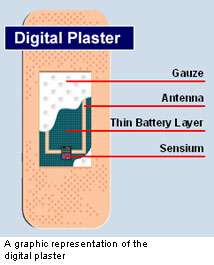
Getting ‘plastered’ has a whole new meaning thanks to a device the size of a band aid which monitors a patient’s health and wellbeing via a mobile phone.
Toumaz Technology, a company based on Imperial College London research, won the electronic category in the prestigious 2007 Institution of Engineering Technology (IET) Innovation Engineering Award for its Sensium Ultra Low-Power Wireless Body Monitoring System, better known as the ‘digital plaster’.
Toumaz Technology’s disposable digital plaster sticks to a patient’s chest and has an ultra low power wireless smart sensor in a silicon chip attached to the plaster, which monitors in real-time a range of vital signs like ECG, body temperature, respiration and physical activity.
This information is processed and sent to a base station where an electronic medical record is kept. When needed, the information is instantly downloaded by a health practitioner to a mobile phone for analysis.
Commenting about the possibilities of the technology, Professor Christofer Toumazou, Director of Imperial’s Institute for Biomedical Engineering and Toumaz Technology Chairman and Co-Founder, said the digital plaster could cut down recovery times in hospitals because patients could have the benefits of being monitored in the comfort of their own home.
“The digital plaster is a revolution in healthcare. It has real benefits for health professionals who, at the touch of button, can monitor the vital statistics of a patient recovering. It also has benefits in preventative medicine for people who simply wish to monitor their own wellbeing to improve their health,” said Professor Toumazou.
The IET, one of the world’s leading professional societies for the engineering and technology community, hosted the 2007 Innovation in Engineering Awards to promote industrial innovation and best practice in engineering.
Speaking about the IET award, Professor Toumazou said:
“I am thrilled that the IET recognised the massive healthcare benefits that this disposable, low cost digital plaster will provide. It is great to see our technology out there and receiving such a positive response from global healthcare, medical device and pharmaceutical companies, and now award judges too.”
The ceremony was hosted by TV personality Johnny Ball at the Marriott Grosvenor Square, London.
The IET is a professional society for the engineering and technology community. It has more than 150,000 members in 127 countries. The institution provides a global knowledge network to facilitate the exchange of knowledge and ideas and promotes the positive role of science, engineering and technology in the world.
This award follows the recent announcement by Imperial Innovations that Toumaz Technology Ltd has been acquired by AIM-listed investment group Nanoscience Inc (30 November 2007.)
Imperial Innovations, the technology commercialisation company of Imperial College London, who has been a shareholder in Toumaz since its formation in 2000, says the Nanoscience takeover will enable Toumaz to accelerate the development of its digital plaster technology.
Source: Imperial College London


