Researchers build new model of bio-exploration
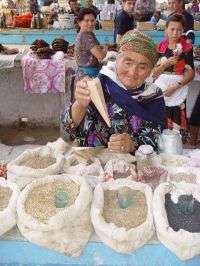
Two land-grant universities have developed a new approach to global bio-exploration, one that returns most of the fruits of discovery to the countries that provide the raw materials on which the research depends.
The Global Institute for Bio-Exploration, a joint initiative of the University of Illinois and Rutgers University, has become a model of sustainable, non-exploitive research in the developing world.
The program began in 2003 when research teams from the two universities joined forces to work in several former Soviet Union republics under an International Cooperative Biodiversity Groups program funded with $4 million grant from the National Institutes of Health. Based on lessons learned in Central Asia, the researchers built on this model to create the institute, which is now expanding into Africa and South America.
The institute builds relationships with and trains those in developing countries to prospect for plants that have interesting biological properties, said U. of I. natural resources and environmental sciences professor Mary Ann Lila, a co-founder of the institute.
“Rather than the typical bio-prospecting approach, where people take plants back to their labs in Western Europe or the U.S., we teach locals to conduct simple assays in the field,” Lila said. When field results identify plants with potentially useful properties, the researchers do follow-up studies in the laboratory.
“But when a discovery is made in the field with a local, the intellectual property rights stay there,” Lila said. The country is required to use any money it receives from licensing fees or royalties to develop its own research infrastructure and protect wild lands.
Pharmaceutical companies already have shown interest.
So far, the institute – also known by the acronym GIBEX – has generated 17 licensing agreements, a dozen of them from Central Asian leads, with companies hoping to make use of plants that have medical or cosmetic potential.
The program began in the former Soviet republics of Kazakhstan, Kyrgyzstan, Tajikistan and Uzbekistan. Horticulturalists are drawn to the “Stans,” Lila said, because the region has a rich heritage as a center of fruit and nut production, and because many of the plants that survive there have desirable characteristics.
“The Stans are among the most inland countries in the world,” she said. “They have the coldest winters, the hottest summers. They have mountain ranges. They have plants that are incredibly stressed because of the short growing season and the altitudes. These plants may not grow well, they may not look pretty, but they’re intense with bioactive compounds.”
Kazakhstan is where the apple began. Uzbekistan is the home of Ajuga turkestanica, a plant that produces a steroid-like compound with metabolic-stimulating properties. (The Uzbekistan studies were suspended in 2006 because of political instability there.) Two species of Rhodiola, a plant with potential as an antidepressant, are found in this region, along with Artemisia leucodes, an aromatic plant related to tarragon that may be useful in treating inflammation.
The program also is developing techniques for analyzing the soup of chemical compounds in wild plants. By screening plants in the field, the researchers are able to identify biological traits that might not be detectable after harvesting the plants and bringing them into a lab. This “screens to nature” technique is a departure from the laboratory based, one-enzyme-at-a-time analysis typical of pharmaceutical research, which often fails to detect the therapeutic potential of plants traditionally used by indigenous peoples.
“Twenty-five percent of human drugs are based on a template from a plant,” Lila said. “The pharmaceutical industry is now turning back to researchers in plants to try and have new discoveries,” she said. “They’re also looking more and more outside of our borders to see what works in other countries.”
The GIBEX model supports the country of exploration in several ways, Lila said. It mines and preserves local knowledge of the medicinal properties of native plants. It trains people to appreciate and study their own natural resources. It builds science infrastructure and it reduces “brain drain,” giving educated scientists a reason to stay home and explore their own back yards, she said.
These benefits have produced widespread interest in the developing world, and the program is expanding to Africa and South America. Two major conferences on the screens-to-nature model will be held in Tanzania and South Africa in 2008. And in January a delegation from Illinois and Rutgers will train people at the Maquipucuna Reserve, near Quito, Ecuador, to apply the field techniques. (Rafael Correa, the president of Ecuador, is a U. of I. alumnus, as is the vice president of the Universidad San Francisco de Quito.)
“We are having real partnerships with scientists in these countries,” Lila said. “This way we bring it into the country. We train the country. They stay and they develop their infrastructure there.”
The new approach also is being tried in North America, Lila said. An Illinois graduate student, Josh Kellogg, will bring the screens-to-nature techniques to Native American populations in Alaska and North Dakota. This research, the subject of Kellogg’s master’s thesis, will focus on the anti-diabetic properties of edible plants long used by indigenous people in both states.
Source: University of Illinois at Urbana-Champaign


