New Tibetan Ice Cores Missing A-Bomb Blast Markers; Suggest Himalayan Ice Fields Haven't Grown In Last 50 Years
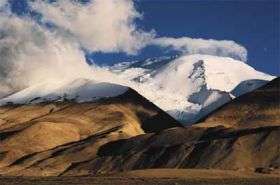
Ice cores drilled last year from the summit of a Himalayan ice field lack the distinctive radioactive signals that mark virtually every other ice core retrieved worldwide.
That missing radioactivity, originating as fallout from atmospheric nuclear tests during the 1950s and 1960s, routinely provides researchers with a benchmark against which they can gauge how much new ice has accumulated on a glacier or ice field.
In 2006, a joint U.S.-Chinese team drilled four cores from the summit of Naimona'nyi, a large glacier 6,050 meters (19,849 feet) high on the Tibetan Plateau.
The researchers routinely analyze ice cores for a host of indicators – particulates, dust, oxygen isotopes, etc. -- that can paint a picture of past climate in that region.
Scientists believe that the missing signal means that this Tibetan ice field has been shrinking at least since the A-bomb test half a century ago. If true, this could foreshadow a future when the stockpiles of freshwater will dwindle and vanish, seriously affecting the lives of more than 500 million people on the Indian subcontinent.
“There's about 12,000 cubic kilometers (2,879 cubic miles) of fresh water stored in the glaciers throughout the Himalayas – more freshwater than in Lake Superior,” explained Lonnie Thompson, distinguished university professor of earth sciences at Ohio State University and a researcher with the Byrd Polar Research Center on campus.
“Those glaciers release meltwater each year and feed the rivers that support nearly a half-billion people in that region. The loss of these ice fields might eventually create critical water shortages for people who depend on glacier-fed streams.”
Thompson and his colleagues worry that this massive loss of meltwater would drastically impact major Indian rivers like the Ganges, Indus and Brahmaputra that provide water for one-sixth of the world's population.
Thompson outlined his findings in an address at the annual meeting of the American Geophysical Union in San Francisco this week.
The Beta radioactivity signals – from strontium90, cesium136, tritium (hydrogen3) and chlorine36 – are the remnants of radioactive fallout from the 1950s-60s atomic tests. They are “present in ice cores retrieved from both polar regions and from tropical glaciers around the globe and they suggest that those ice fields have retained snow (mass) that fell during the last 50 years,” he said.
“In ice cores drilled in 2000 from Kilimanjaro's northern ice field (5890 meters high), the radioactive fallout from the 1950s atomic test was found only 1.8 meters below the surface.
“By 2006 the surface of that ice field had lost more than 2.5 meters of solid ice (and hence recorded time) – including ice containing that signal. Had we drilled those cores in 2006 rather than 2000, the radioactive horizon would be absent – like it is now on Naimona'nyi in the Himalayas,” he said.
In 2002 Thompson predicted that the ice fields capping Kilimanjaro would disappear between 2015 and 2020.
“If what is happening on Naimona'nyi is characteristic of the other Himalayan glaciers, glacial meltwater will eventually dwindle with substantial consequences for a tremendous number of people,” he said.
Scientists estimate that there are some 15,000 glaciers nested within the Himalayan mountain chain forming the main repository for fresh water in that part of the world. The total area of glaciers in the Tibetan Plateau is expected to shrink by 80 percent by the year 2030.
The work is supported in part by the National Science Foundation.
Working on the project along with Thompson were Yao Tandong, Institute for Tibetan Plateau Research, Chinese Academy of Sciences; Ellen Mosley-Thompson, professor of geography at Ohio State and research scientist at the Byrd Center; Mary E. Davis, a research associate with the Byrd Center; doctoral student Natalie M. Kehrwald; Jürg Beer, Swiss Federal Institute of Aquatic Science and Technology; Ulrich Schotterer, University of Bern; and Vasily Alfimov, Paul Scherrer Institute and ETH in Zurich.
Source: by Earle Holland, Ohio State University


