Early warning system predicted shaking from Oct. 30 quake
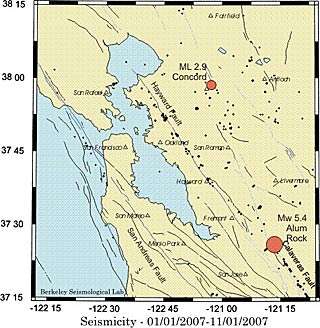
A California earthquake early warning system now being tested accurately predicted the ground shaking in San Francisco a few seconds before the city felt the Oct. 30, 2007, magnitude 5.4 quake near San Jose, according to a statewide team of seismologists.
Active early warning systems already created in places like Japan, Taiwan, Mexico and Turkey automatically stop elevators at the nearest floor, halt trains, isolate hazardous chemical systems and machinery and move people to a safer location or position.
According to Richard Allen, University of California, Berkeley, assistant professor of earth and planetary science and one of the leaders of the early warning testing being conducted by the California Integrated Seismic Network (CISN), the California system, if fully implemented, could provide similar services through information transmitted via TV and radio networks, the internet, cell phones and other closed circuit systems.
Allen discussed the ongoing tests of a statewide early warning system today (Monday, Dec. 10) during a media briefing at the annual meeting of the American Geophysical Union in San Francisco. He and his California colleagues will present further details during three scientific sessions today and tomorrow.
Current testing of the system should be completed by July 2009, providing the state with an estimate of the likely accuracy and warning times that the system could provide in future earthquakes should a public warning system be built.
CISN is a collaboration that includes UC Berkeley's Seismological Laboratory, the U. S. Geological Survey, the California Institute of Technology, the Southern California Earthquake Center based at the University of Southern California and the Swiss Seismological Service.
Earthquake early warning systems are designed to provide a warning that arrives seconds to tens of seconds prior to earthquake shaking. The Japan Meteorological Agency recently turned on its first national earthquake warning system, in October 2007, bringing to four the number of nations providing rapid warning to mitigate the impacts of earthquakes, Allen said.
In California, CISN is testing three early warning algorithms on real-time seismic networks across the state to determine how effective such warnings could be. ElarmS, the algorithm being testing in Northern California, detected the Oct. 30 Alum Rock quake - the largest earthquake in the San Francisco Bay region since the 1989 Loma Prieta earthquake - and estimated the magnitude of the event to within 0.5 magnitude units using only 3 or 4 seconds' worth of data. ElarmS also predicted the distribution of ground shaking across the region with errors less than one unit on the Modified Mercalli Intensity Scale, Allen said.
Even with the algorithm's 15-second processing delay, ElarmS predicted the ground shaking intensity a few seconds before the peak ground shaking occurred in San Francisco. Work by the CISN early warning group has shown that this delay could be reduced to less than 5 seconds, Allen said, meaning that in a repeat earthquake, Oakland and San Francisco could have about a 10-second warning.
In a repeat of the 1989 Loma Prieta earthquake, on the other hand, warning systems like those being tested by the CISN could provide a 10- to 20-second warning to Oakland and San Francisco, where 84 percent of the casualties and much of the damage occurred. San Jose would have less warning time. Because the amount of warning depends on the distance of the quake's epicenter, earthquakes to the north of the Bay Area, such as those on the San Andreas or Hayward-Rodgers Creek faults, would provide San Jose with more warning than Oakland or San Francisco.
Allen noted that the success of a statewide warning system hinges on the density of early warning-capable seismic stations. Although there are many seismic stations in the San Francisco and Los Angeles areas, almost none of these have the necessary dataloggers to provide the fast data delivery that would be required. Similarly, lack of early warning-capable stations all along the state's fault systems lessens the ability to warn metropolitan regions about more distant earthquakes that still might cause substantial damage in metropolitan regions.
The CISN study will recommend technical requirements for such a system.
Japan's system, for example, uses around 900 seismic stations. California, by comparison, currently has approximately 260 stations that could be upgraded to an early warning capability.
Source: UC Berkeley


