Wind Turbines Produce 'Green' Energy -- and Airflow Mysteries
December 11, 2007 Wind Turbines Produce 'Green' Energy -- and Airflow Mysteries

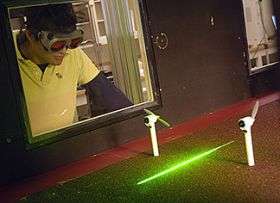
Using laser pulses and model wind turbines, Johns Hopkins researchers are able to collect important data about the airflow that is likely to occur around full-size machines that produce "green" energy. Photo by Will Kirk

Using smoke, laser light, model airplane propellers and a campus wind tunnel, a team led by Johns Hopkins University researchers is trying to solve the airflow mysteries that surround wind turbines, an increasingly popular source of "green" energy. The National Science Foundation recently awarded the team a three-year, $321,000 grant to support the project.

The rise in oil prices and a growing demand for energy from non-polluting sources has led to a global boom in construction of tall wind turbines that convert the power of moving air into electricity. The technology of these devices has improved dramatically in recent years, making wind energy more attractive.

For example, Denmark is able to produce about 20 percent of its electric energy through wind turbines. But important questions remain: Could large wind farms, whipping up the air with massive whirling blades, alter local weather conditions? Could changing the arrangement of these turbines lead to even more efficient power production? The researchers from Johns Hopkins and Rensselaer Polytechnic Institute hope their work will help answer such questions.

"With diameters spanning up to 100 meters across, these wind turbines are the largest rotating machines ever built," said research team leader Charles Meneveau, a turbulence expert in Johns Hopkins' Whiting School of Engineering. "There's been a lot of research done on wind turbine blade aerodynamics, but few people have looked at the way these machines interact with the turbulent wind conditions around them. By studying the airflow around small, scale-model windmills in the lab, we can develop computer models that tell us more about what's happening in the atmosphere at full-size wind farms."

To collect data for such models, Meneveau's team is conducting experiments in a campus wind tunnel. The tunnel uses a large fan to generate a stream of air moving at about 40 mph. Before it enters the testing area, the air passes through an "active grid," a curtain of perforated plates that rotate randomly and create turbulence so that air currents in the tunnel more closely resemble real-life wind conditions. The air currents then pass through a series of small model airplane propellers mounted atop posts, mimicking an array of full-size wind turbines.

The researchers gather information on the interaction of the air currents and the model turbines by using a high- tech procedure called stereo particle-image-velocimetry. First, they "seed" the air in the tunnel with a form of smoke — tiny particles that move with the prevailing airflow. Above the model turbines, a laser generates two sheet-like pulses of light in quick succession. A camera captures the position of particles at the time of each flash.

"When the images are processed, we see that there are two dots for every particle," said Meneveau, who is the university's Louis M. Sardella Professor of Mechanical Engineering. "Because we know the time difference between the two laser shots, we can calculate the velocity. So we get an instantaneous snapshot of the velocity vector at each point. Having these vector maps allows us to calculate how much kinetic energy is flowing from one place to another, in much greater detail than what was possible before."

Raul B. Cal, a Johns Hopkins postdoctoral fellow who is working on the project with Meneveau, said this data could lead to a better understanding of real wind farm conditions. "What happens when you put these wind turbines too close together or too far apart? What if you align them staggered or in parallel?" he asked. "All of these are different effects that we want to be able to comprehend and quantify, rather than just go out there and build these massive structures, implementing them and not knowing what's going to happen."

Meneveau pointed out that dense clusters of wind turbines also could affect nearby temperatures and humidity levels, and cumulatively, perhaps, alter local weather conditions. Highly accurate computer models will be needed to unravel the various effects involved. "Our research will provide the fluid dynamical data necessary to improve the accuracy of such computer models," Meneveau said. "We'd better know what the effects are in order to implement wind turbine technology in the most sustainable and efficient fashion possible."

Meneveau and Cal are collaborating with Luciano Castillo, associate professor in the Department of Mechanical, Aerospace and Nuclear Engineering at Rensselaer Polytechnic Institute, and Hyung S. Kang, an associate research scientist in the Department of Mechanical Engineering at Johns Hopkins.

Source: Johns Hopkins University


print this article email this article download pdf blog this article bookmark this article     Stumble it Digg this share on Facebook retweet share on Reddit add to delicious
Rate this story - 4.5 /5 (26 votes)

Rank Filter

Move the slider to adjust rank threshold, so that you can hide some of the comments.


Display comments: newest first

  • gopher65 - Dec 11, 2007
    • Rank: not rated yet
    Now this is interesting research. I'm just surprised that no one has studied this before. I'm thinking that the optimal placement of turbines will be about 150 metres apart, in some sort of non-square staggered pattern.
  • Dudu101 - Dec 11, 2007
    • Rank: 5 / 5 (1)
    Many years ago I tested stitch patterns in a materials lab. Pattern made no difference in ripping resistance. Strength rose with the total number of stitches joining two straps together. Odd since the straps stretched and broke stitches near margins of a pattern first, then snapped apart. I tried patterns that used more stitches in initial ripping zones, but this seemed to make no difference. Could be the same with wind farms, patterns and modest clustering of turbines will affect local wind minimally. Only the total number in a given area or average density of turbines will matter.
  • rebootsdamachina - Dec 11, 2007
    • Rank: 3 / 5 (1)
    Gee someone should study how rows of bumper to bumper traffic affects local geo-enivironments. Like um, LA? Houston? Boston?
  • nilbud - Dec 29, 2007
    • Rank: not rated yet
    Why don't they ask the clever German chappies who've installed tens of thousands?

December 11, 2007 all stories

Comments: 4

4.5 /5 (26 votes)
  • Stumble this up

  • Digg this

  • share this

  • hide
  • Related Stories

  • On the Crest of Wave Energy
    created Nov 19, 2009 | popularity not rated yet | comments 0
  • Battery Research Aims To Store Renewable Energy
    created Nov 19, 2009 | popularity not rated yet | comments 0
  • The greening of Willis Tower: Rooftop gardens part of plan to improve efficiency
    created Nov 06, 2009 | popularity not rated yet | comments 0
  • Shifting the world to 100 percent clean, renewable energy as early as 2030 -- here are the numbers
    created Oct 19, 2009 | popularity not rated yet | comments 0
  • Israelis bring green power to West Bank village
    created Oct 09, 2009 | popularity not rated yet | comments 0


  • hide
  • Relevant PhysicsForums posts

  • Base Isolation Systems in Skyscrapers?
    created 1hour ago
  • Need to interview a Computer Hardware Engineer for school project
    created 3 hours ago
  • transient heat transfer
    created 10 hours ago
  • Trying to adapt a fuel gage circuit
    created Nov 22, 2009
  • Pushing the piston.
    created Nov 22, 2009
  • Do Camcorders/ Video camera have Sensors in them?
    created Nov 22, 2009
  • More from Physics Forums - General Engineering

Other News

IBM Researchers Lower Language Barrier With Text Translator

Technology / Computer Sciences

created 6 hours ago | popularity 4 / 5 (2) | comments 0

IBM Researchers are helping to break the language barrier with the advent of technology dubbed "n.Fluent" -- smart software that translates text between English and 11 other languages. IBM employees use it to instantaneously ...


Intel logo A

Intel wants a chip implant in your brain

Technology / Hi Tech

created 16 hours ago | popularity 4.1 / 5 (16) | comments 27

(PhysOrg.com) -- Computer chip maker Intel wants to implant a brain-sensing chip directly into the brains of its customers to allow them to operate computers and other devices without moving a muscle.


Just in time for Black Friday: students turn iPhone into barcode scanner

Just in time for Black Friday: students turn iPhone into barcode scanner

Technology / Software

created 4 hours ago | popularity 4 / 5 (1) | comments 0

(PhysOrg.com) -- Comparing prices over the Internet has become a common practice for consumers. Now, just in time for Black Friday, a group of Missouri University of Science and Technology students is putting ...


The KLM airplane which runs on biokerosene is seen at Schiphol airport, near Amsterdam

KLM flies world's first 'passenger flight on biofuel'

Technology / Energy

created 5 hours ago | popularity not rated yet | comments 0

A Boeing 747, one of four engines powered by a 50-percent biokerosene mix, circled the Netherlands for an hour on Monday for what airline KLM called the world's first passenger flight using biofuel.


Feeling the way

Feeling the way: Robotic device can help visually impaired people

Technology / Engineering

created 6 hours ago | popularity not rated yet | comments 0

(PhysOrg.com) -- For many people, it has become routine to go online to check out a map before traveling to a new place. But for blind people, Google maps and other visual mapping applications are of little ...