Mars Orbiter Examines 'Lace' and 'Lizard Skin' Terrain
December 11, 2007 Mars Orbiter Examines 'Lace' and 'Lizard Skin' Terrain

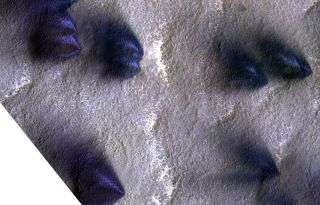
Dark fans and bright fans on Mars. Image credit: NASA/JPL/University of Arizona

Scrutiny by NASA's newest Mars orbiter is helping scientists learn the stories of some of the weirdest landscapes on Mars, as well as more familiar-looking parts of the Red Planet.

One type of landscape near Mars' south pole is called "cryptic terrain" because it once defied explanation, but new observations bolster and refine recent interpretations of how springtime outbursts of carbon-dioxide gas there sculpt intricate patterns and paint seasonal splotches.

"A lot of Mars looks like Utah, but this is an area that looks nothing like Planet Earth," said Candice Hansen of NASA's Jet Propulsion Laboratory, Pasadena, Calif., deputy principal investigator for the High Resolution Imaging Science Experiment (HiRISE) camera on NASA's Mars Reconnaissance Orbiter.
Mars Orbiter Examines 'Lace' and 'Lizard Skin' Terrain

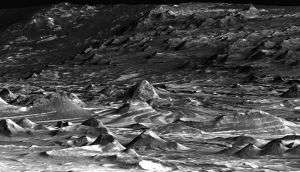
This is a perspective view of a scene within Mars' Candor Chasma. It shows how the surface would appear to a person standing on top of one of the many hills in the region and facing southeast. Image credit: NASA/JPL/University of Arizona

In addition to radially branching patterns called "spiders," which had been detected by an earlier Mars orbiter, other intriguing ground textures in the area appear in the new images. "In some places, the channels form patterns more like lace. In others, the texture is reminiscent of lizard skin," Hansen said.

Results from all six instruments on the Mars Reconnaissance Orbiter, which reached Mars last year, are described in dozens of presentations this week by planetary scientists in San Francisco at the fall meeting of the American Geophysical Union.

By taking stereo pictures of a target area from slightly different angles during different orbits, HiRISE can show the surface in three dimensions. Channels found to widen as they run uphill in the cryptic terrain region testify that the channels are cut by a gas, not a liquid.

Earlier evidence for jets of gas active in the region came from fan-shaped blotches appearing seasonally, which scientists interpret as material fallen to the surface downwind of vents where the gas escapes. Some of the fans are dark, others bright. "The dark fans are probably dust, but the exact composition of the brighter fans had remained unknown until now," said Tim Titus of the U.S. Geological Survey's Astrogeology Team, Flagstaff, Ariz.

Observations by the new orbiter's Compact Reconnaissance Imaging Spectrometer for Mars suggest that the bright fans are composed of carbon-dioxide frost. Here's the story researchers now propose: Spring warms the ground under a winter-formed coating of carbon dioxide ice. Thawing at the base of the coating generates carbon-dioxide gas, which carves channels as it pushes its way under the ice to a weak spot where it bursts free. The jet of escaping gas carries dust aloft and also cools so fast from expanding rapidly that a fraction of the carbon dioxide refreezes and falls back to the surface as frost.

The processes creating the cryptic terrain are current events on Mars. Repeated HiRISE observations of the same target area show the downwind fans can form and grow perceptibly in less than five days.

Other new findings from the Mars Reconnaissance Orbiter reveal processes of Martian environments long ago. A team including Chris Okubo of the University of Arizona, Tucson, used stereo HiRISE images to examine layered deposits inside Mars' Candor Chasma, part of Valles Marineris, the largest canyon system in the solar system.

"The high-resolution structural map allowed us to interpret the geological history of the area," Okubo said. "The layers are tilted in a way that tells us they are younger than the canyon." Spectrometer studies of the composition of these deposits had indicated water played a role in their formation, but their age relative to the formation of the canyon had been uncertain. The new findings suggest water was present after the canyon formed.

Source: NASA


print this article email this article download pdf blog this article bookmark this article     Stumble it Digg this share on Facebook retweet share on Reddit add to delicious
Rate this story - 3.6 /5 (29 votes)

Rank Filter

Move the slider to adjust rank threshold, so that you can hide some of the comments.


Display comments: newest first

  • Birdlady - Dec 12, 2007
    • Rank: 1.7 / 5 (3)
    I find the above comment to mirror my feelings.
    NASA has been hiding the truth from us for years
    and years, since they were first organized. I am
    always interested in seeing the pictures, but I
    am seldom surprised by them. Birdlady
  • JohnSawyer - Dec 12, 2007
    • Rank: 3.3 / 5 (4)
    That damn NASA, always hidin' stuff from us. They hold all the cards. And best of all, all I need to prove this is to believe in what people like Richard Hoagland tell us. It's just IMPOSSIBLE for things to look unusual on other planets, without it being definite proof that aliens are involved, or that Jules Verne got there first.
  • MrGrynch - Dec 12, 2007
    • Rank: 1 / 5 (2)
    Many of the unexplainable features found on Mars and other planetary bodies are easily explainable as electrical phenomenon. Victoria Crater will yield many surprises with respect to our current "understanding" of geological processes.

    http://www.thunde...ters.htm
  • MarsArtifactResearch - Dec 12, 2007
    • Rank: 1 / 5 (2)
    Cento57,
    You're damned straight! There most certainly was, and may still be a civilization on Mars. I have on line officially documented 190 artifacts and structures, and other things such as plants and fossils.
    Right now I am dealing with a death threat related somewhat to my research...
  • Magog - Dec 12, 2007
    • Rank: 1.5 / 5 (2)
    Google "Operation Paperclip" to get an idea of how NASA was formed. Also google I.G. Farben and Prescott Bush.
  • out7x - Dec 13, 2007
    • Rank: 2 / 5 (2)
    Read Squires Book. Mars probably had a primeval atmosphere and water that dissipated due to low gravity. Beyond that, unknown.
  • quantum_flux - Dec 16, 2007
    • Rank: not rated yet
    Why would people think that NASA would have to hide information from the public if they found intelligent life!? Finding intelligent life is part of the reason why American taxpayers are so willing to keep on supporting NASA in the first place.

    Also, if we did find some civilized alien race, then NASA would have reverse engineered their technology by now and everyone on Earth would be driving flying saucers to and from work.... they'd be easier to park in a parking spot and mid-air collisions could easily be avoided by magnetic repelling technologies.

    The point is that we haven't found these supposed aliens yet, but maybe with a larger budget we will! So far, the most intelligent species known, next to mankind, is chimpanzies and dolphins.

December 11, 2007 all stories

Comments: 7

3.6 /5 (29 votes)
  • Stumble this up

  • Digg this

  • share this

  • hide
  • Related Stories

  • Surface features on Titan form like Earth's, but with a frigid twist
    created Aug 06, 2009 | popularity not rated yet | comments 0
  • Lunar Reconnaissance Orbiter to Help Astronauts Survive in Infinity
    created Apr 17, 2009 | popularity not rated yet | comments 0
  • HiRISE Sees Signs of an Unearthly Spring on Mars
    created Mar 25, 2009 | popularity not rated yet | comments 0
  • Solar Wind Rips Up Martian Atmosphere
    created Nov 21, 2008 | popularity not rated yet | comments 0
  • Martian weather satellite's first report
    created Oct 13, 2008 | popularity not rated yet | comments 0


  • hide
  • Relevant PhysicsForums posts

  • The shape of our solar system's orbits.
    created Nov 07, 2009
  • Above or Below the Line of Nodes
    created Nov 07, 2009
  • Supernova vs. Nova?
    created Nov 07, 2009
  • Supernova's Gamma Rays and Comets
    created Nov 06, 2009
  • Our Moon
    created Nov 06, 2009
  • Question about a Carl Zeiss lens
    created Nov 05, 2009
  • More from Physics Forums - General Astronomy

Other News

Making Climate Forecasts More Useful to Farmers

Making Climate Forecasts More Useful to Farmers

Space & Earth / Environment

created 24 minutes ago | popularity not rated yet | comments 0

(PhysOrg.com) -- Climate forecasts are becoming more useful to farmers and ranchers, thanks to research by Agricultural Research Service (ARS) scientists and their cooperators.


Antarctica glacier retreat creates new carbon dioxide store

Antarctica glacier retreat creates new carbon dioxide store

Space & Earth / Earth Sciences

created 7 hours ago | popularity 4.3 / 5 (3) | comments 0

Large blooms of tiny marine plants called phytoplankton are flourishing in areas of open water left exposed by the recent and rapid melting of ice shelves and glaciers around the Antarctic Peninsula. This ...


L-R: Chiwetel Ejiofor, Amanda Peet and John Cusack at the premiere of "2012"

NASA on crusade to debunk 2012 apocalypse myths

Space & Earth / Space Exploration

created 2 hours ago | popularity not rated yet | comments 0

The world is not coming to an end on December 21, 2012, the US space agency insisted Monday in a rare campaign to dispel widespread rumors fueled by the Internet and a new Hollywood movie.


NASA satellites make a movie and get rainfall, wind info on Ida

NASA satellites make a movie and get rainfall, wind info on Ida (w/ Video)

Space & Earth / Earth Sciences

created 2 hours ago | popularity not rated yet | comments 0

NASA satellites are amazing examples of technology. The TRMM satellite peers into tropical cyclones and can tell how much rain is falling per hour and where. QuikScat uses microwave technology to measure Ida's ...


NASA's TRMM Satellite sees most of Ida's heaviest rain stayed off coasts

NASA's TRMM Satellite sees most of Ida's heaviest rain stayed off coasts

Space & Earth / Earth Sciences

created 3 hours ago | popularity not rated yet | comments 0

NASA and the Japanese Space Agency's Tropical Rainfall Measuring Mission (TRMM) satellite flew over Ida and captured her rainfall when she passed by Nicaragua, Honduras and Belize this weekend. TRMM data revealed ...