Student identifies enormous new dinosaur
December 12th, 2007 Student identifies enormous new dinosaur

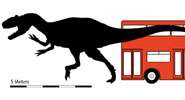
Carcharodontosaurus iguidensis racing a London bus. Photo by Simon Powell

The remains of one of the largest meat-eating dinosaurs ever found have recently been recognized as representing a new species by a student working at the University of Bristol.

The new species is one of the largest carnivorous dinosaurs ever to have lived. Carcharodontosaurus iguidensis was probably 13-14 metres long, making it taller than a double-decker bus. It had a skull about 1.75 metres long and its teeth were the size of bananas.

Steve Brusatte, an MSc student the University of Bristol who identified the theropod said: “The first remains of Carcharodontosaurus were found in the 1920s, but they only consisted of two teeth which have since been lost. Other bits of Carcharodontosaurus were found in Egypt and described in the 1930s, but these were destroyed when Munich was bombed in 1944. Since then a skull of Carcharodontosaurus saharicus turned up in the Moroccan Sahara, and was described a decade ago. So as you can see, evidence for this dinosaur is very rare.”

The new fossils come from a different part of Africa, the Republic of Niger, and show a number of differences from the Moroccan material, allowing Brusatte to name it as a new species: Carcharodontosaurus iguidensis.

The fossils include several pieces of the skull – parts of the snout, lower jaw, and braincase – as well as part of the neck. They are described in the current issue of the Journal of Vertebrate Paleontology, published today.

This new discovery shows that a number of huge theropods – bipedal, carnivorous dinosaurs – were living in Africa 95 million years ago. Two other mega carnivores are known to have inhabited the same Saharan ecosystem at this time: Spinosaurus – a sail-backed creature which may have grown up to 18 metres in length, and the slightly smaller Abelisaurid theropods that were characterized by stocky hind limbs and extensive ornamentation of the skull bones. They only grew to about nine metres high.

Brusatte added: “The Cretaceous world of 95 million years ago was a time of some of the highest sea levels and warmest climates in Earth history. It seems that shallow seas divided Morocco and Niger, promoting evolutionary separation of the species living in the two regions.

“This has implications for the world today in which temperatures and sea level are rising. It is precisely by studying these sorts of ecosystems that we can hope to understand how our modern world may change.”

The fossils were found in Niger in 1997 on an expedition led by Paul Sereno from the Universtiy of Chicago, a co-author on the paper.

Source: University of Bristol


print this article email this article download pdf blog this article bookmark this article     Digg this Stumble it share on Facebook share on Reddit add to delicious save to Yahoo! bookmarks
4.4/5 after 22 votes


December 12th, 2007 all stories
Other Sciences / Archaeology & Fossils

Comments: 0
Rank: 4.4/5 after 22 votes

  • Stumble this up

  • Digg this

  • Share it:
  • share on Facebook
  • share on MySpace
  • share on Slashdot
  • rss-newsfeed
  • share on Google
  • share on Reddit
  • add to delicious
  • save to Yahoo! bookmarks
  • share on Windows Live
  • Add to Mixx!
Rating: 4.4/5 after 22 votes

  • Related Stories

  • 2,000 Theropod teeth
    created Nov 03, 2005 | popularity not rated yet | comments 0

Tags


  • Physicists Demonstrate Quantum Memory with Matter Qubits
    Physicists Demonstrate Quantum Memory with Matter Qubits
    Physics / General Physics
    created Jul 03, 2009 | popularity 4.4 / 5 (17) | comments 1
  • 'Holey' Nanosheets for Wastewater Dye Removal
    Nanotechnology / Nanomaterials
    created Jul 01, 2009 | popularity 5 / 5 (5) | comments 1
  • Jellyfish Robot Swims Like its Biological Counterpart
    Jellyfish Robot Swims Like its Biological Counterpart
    Electronics / Robotics
    created Jun 26, 2009 | popularity 4.4 / 5 (8) | comments 1
  • Could Maxwell's Demon Exist in Nanoscale Systems?
    Could Maxwell's Demon Exist in Nanoscale Systems?
    Physics / General Physics
    created Jun 24, 2009 | popularity 4.4 / 5 (18) | comments 29
  • Living Safely with Robots, Beyond Asimov's Laws
    Living Safely with Robots, Beyond Asimov's Laws
    Electronics / Robotics
    created Jun 22, 2009 | popularity 4.6 / 5 (52) | comments 40
  • Other News

    Creation Museum president Ken A. Ham

    Paleontologists brought to tears, laughter by Creation Museum

    Other Sciences / Other

    created Jun 30, 2009 | popularity 4.2 / 5 (42) | comments 121

    For a group of paleontologists, a tour of the Creation Museum seemed like a great tongue-in-cheek way to cap off a serious conference.


    Mummified dinosaur skin yields up new secrets

    Mummified dinosaur skin yields up new secrets

    Other Sciences / Archaeology & Fossils

    created Jul 01, 2009 | popularity 4.7 / 5 (15) | comments 10

    (PhysOrg.com) -- Scientists from The University of Manchester have identified preserved organic molecules in the skin of a dinosaur that died around 66-million years ago.


    Liberal? Conservative? Stanford study says mental nudge can make voters flip-flop

    Liberal? Conservative? Stanford study says mental nudge can make voters flip-flop

    Other Sciences / Social Sciences

    created Jul 02, 2009 | popularity 3.8 / 5 (5) | comments 4

    (PhysOrg.com) -- No doubt you’ve worked hard for your success. But chances are you’ve also had some help and lucky breaks along the way.


    Probing Question: How do Ponzi Schemes work?

    Other Sciences / Economics

    created Jul 02, 2009 | popularity 5 / 5 (2) | comments 2

    Imagine the shock, the horror, and the sheer panic that would come with learning that the financial plan you’d sunk your life savings into was a sham, the financial experts you trusted were crooks, and all your money was ...


    Tourists enjoy a "Pineapple Tour" in Costa Rica

    Costa Rica tops happiness, 'green living' poll

    Other Sciences / Social Sciences

    created Jul 04, 2009 | popularity 3 / 5 (3) | comments 0

    Costa Rica is the happiest place on earth, and one of the most environmentally friendly, according to a new survey by a British non-governmental group.