Taiwan Scientists Discover Gold Nanoparticles Stabilize Organic Memory
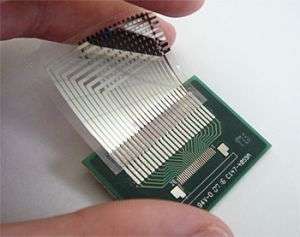
December 12th, 2007 by Mary Anne Simpson New Gold Plastic Memory

New Flexible Organic Memory. Credit: Industrial Technology Research Inst.

Taiwan scientists and engineers have invented a nonvolatile organic memory device. The device uses gold nanoparticles mixed with a polymer that is wedged between two aluminum electrodes.

The scientists of the National Chung Hsing University of Taiwan claim break through technology in developing a new low cost memory array 16-byte device. The collaborative efforts of University scientists and the Industrial Technology Research Institute were able to produce an organic memory device that is non-volatile.

Heretofore, engineers have endeavored to create a non volatile memory devices comprised of plastics and other carbon based chemicals. The flexible carbon organic memory is critical in the manufacturing of RFID, Smart Cards, and flexible displays for mobile phones.

The main problem engineers and scientist have encountered is the organic memory devices tend to break down in air and under stress of many read-write cycles. The breakthrough technology memory device utilizes gold nanoparticles mixed into a polymer named PCm that is wedged between two aluminum electrodes. The structure in a dormant state produces little current. However, if the voltage is pushed 2 volts, the current jumps 10,000 fold.

According to Cellular-News, the co-inventor of the process and assistant professor of electrical engineering at NCHU, Zingway Pei says that adding the gold nanoparticles made the organic memory stable and aided it in endurance of up to 1,000 switches. Pei and his colleagues theorize that the prior to reaching the threshold a small amount of electrons virtually hop from one gold nanoparticle to another. Some electrons get trapped and provide a conductive path to make the device functional . In the process smaller voltages will carry the higher current and it will begin storing current. The stored current can be wiped away by simply applying a negative voltage.

The new device can retain data for up to 10 days even if it is exposed to open air. Professor Pei believes the stability will improve and retention time should reach 30 days. The United States provided 9.1 million dollars to ITRI in March, 2007 to set up the first flexible electronics laboratory.

Other research groups are actively involved in projects involving organic nonvolatile memory devices. Some labs are exploring the use of other nanoparticles like carbon-60 that is embedded in the plastic. Others are researching the utility of plastic serving as a part of the organic transistor structure.

The new flexible organic memory device was discussed at the 2007 IEEE International Electron Devices Meeting in Washington D.C. The conference began on December 10 and will conclude December 12. According to Yu-Tzu Chiu of Spectrum On Line, the Taiwanese team consisting of NCHU and the Industrial Technology Research Institute plans to create smart cards that incorporate the new memory device. The device will be on show December 17-18 at the International Symposium for Flexible Electronics and Displays in Taiwan.


print this article email this article download pdf blog this article bookmark this article     Digg this Stumble it share on Facebook share on Reddit add to delicious save to Yahoo! bookmarks
3.9/5 after 33 votes


December 12th, 2007 all stories
Nanotechnology / Nanomaterials

Comments: 0
Rank: 3.9/5 after 33 votes

  • Stumble this up

  • Digg this

  • Share it:
  • share on Facebook
  • share on MySpace
  • share on Slashdot
  • rss-newsfeed
  • share on Google
  • share on Reddit
  • add to delicious
  • save to Yahoo! bookmarks
  • share on Windows Live
  • Add to Mixx!
Rating: 3.9/5 after 33 votes

  • Related Stories

  • Speedier flexible electronics possible with new fabrication process
    created Mar 16, 2009 | popularity not rated yet | comments 0
  • Creating a memory device out of paper
    created Nov 26, 2008 | popularity not rated yet | comments 0
  • Spinning into the future of data storage
    created Nov 24, 2008 | popularity not rated yet | comments 0
  • Toward Plastic Spin Transistors
    created Aug 17, 2008 | popularity not rated yet | comments 0
  • Multitasking nanotechnology
    created Jul 10, 2008 | popularity not rated yet | comments 0

Tags


  • Physicists Demonstrate Quantum Memory with Matter Qubits
    Physicists Demonstrate Quantum Memory with Matter Qubits
    Physics / General Physics
    created Jul 03, 2009 | popularity 4.4 / 5 (16) | comments 1
  • 'Holey' Nanosheets for Wastewater Dye Removal
    Nanotechnology / Nanomaterials
    created Jul 01, 2009 | popularity 5 / 5 (5) | comments 1
  • Jellyfish Robot Swims Like its Biological Counterpart
    Jellyfish Robot Swims Like its Biological Counterpart
    Electronics / Robotics
    created Jun 26, 2009 | popularity 4.4 / 5 (7) | comments 1
  • Could Maxwell's Demon Exist in Nanoscale Systems?
    Could Maxwell's Demon Exist in Nanoscale Systems?
    Physics / General Physics
    created Jun 24, 2009 | popularity 4.4 / 5 (18) | comments 29
  • Living Safely with Robots, Beyond Asimov's Laws
    Living Safely with Robots, Beyond Asimov's Laws
    Electronics / Robotics
    created Jun 22, 2009 | popularity 4.6 / 5 (52) | comments 40
  • Other News

    A 'quantum of sol' -- how nanotechnology could hold the key to a solar-powered future

    A 'quantum of sol' -- how nanotechnology could hold the key to a solar-powered future

    Nanotechnology / Nanomaterials

    created Jun 30, 2009 | popularity 3.7 / 5 (12) | comments 16

    (PhysOrg.com) -- A new generation of 'nano-structured' millimetre-sized solar cells that could convert the sun's energy to electricity more than twice as efficiently as current technology, is the subject of ...


    Australian researchers are set to begin human trials of a tiny nano-cell that acts as a "Trojan horse" against cancer

    Hi-tech 'Trojan horse' can kill cancer cells: researchers

    Nanotechnology / Bio & Medicine

    created Jun 29, 2009 | popularity 4.6 / 5 (11) | comments 7

    Australian researchers are set to begin human trials of a tiny nano-cell that acts as a "Trojan horse" against cancer cells, a breakthrough they say may curb the need for debilitating chemotherapy.


    Harnessing Nanoparticles To Track Cancer Cell Changes

    Nanotechnology / Bio & Medicine

    created Jul 03, 2009 | popularity not rated yet | comments 1

    The more dots there are, the more accurate a picture you get when you connect them. Cancer researchers adopting that philosophy have developed a new imaging technology that could give scientists the ability to simultaneously ...


    'Holey' Nanosheets for Wastewater Dye Removal

    Nanotechnology / Nanomaterials

    created Jul 01, 2009 | popularity 5 / 5 (5) | comments 1

    (PhysOrg.com) -- Researchers have discovered that extremely thin sheets of nickel oxide with hexagonally shaped holes can absorb hazardous dyes from wastewater nearly as well as the best traditional methods, but are recyclable. ...


    New statistical technique improves precision of nanotechnology data

    New statistical technique improves precision of nanotechnology data

    Nanotechnology / Nanophysics

    created Jul 01, 2009 | popularity 3 / 5 (2) | comments 0

    A new statistical analysis technique that identifies and removes systematic bias, noise and equipment-based artifacts from experimental data could lead to more precise and reliable measurement of nanomaterials ...