Fuel cells help make noisy, hot generators a thing of the past
December 12, 2007
Fuel cells help make noisy, hot generators a thing of the past

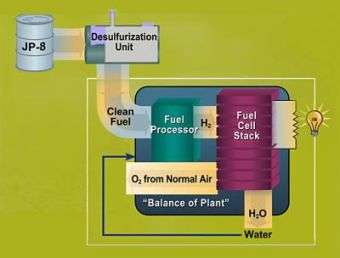
The process of converting JP-8 into hydrogen for use in the on-board fuel cell. Credit: Pacific Northwest National Laboratory

Two core technologies developed at the Department of Energy's Pacific Northwest National Laboratory - a fuel desulfurization system and a fuel reforming system - were instrumental in the demonstration of an electric power system operating on JP-8, a fuel commonly used in military operations.

Portable fuel cell power units are quieter, more efficient and have lower emissions than standard diesel generators, but are challenged when used with JP-8 fuel because of its sulfur content. The fuel desulfurization and reforming systems developed at PNNL reduce the sulfur content of JP-8 and generate a hydrogen stream compatible with an integrated fuel cell.

"Running a noisy, hot generator in a war zone is inefficient and can give away your position," said Dale King, project manager at PNNL. "Not running it can leave you without power for communications and other critical systems."

Although currently under development for military use, the desulfurization and reforming technologies can be used with different liquid fuels to provide portable power almost anywhere that small size and high performance are important. Researchers at PNNL are also extending the desulfurization technology for use with diesel fuel.

The fuel cell-centric auxiliary power unit is modular and can be reconfigured for a wide range of uses. Researchers envision the technology being used to supply auxiliary power and heat for long-haul commercial trucks, which would replace the need to run less efficient internal combustion engines while the vehicle is stopped. Battelle, which operates PNNL for DOE, operated a prototype system demonstrating these technologies during the three-day 2007 Fuel Cell Seminar this fall. During the demonstration, an integrated 5-kilowatt electric power system successfully powered area lights and a commercial refrigerator.

A unique catalytic hydrodesulfurization process developed by PNNL removes sulfur from the JP-8 fuel using syngas as the co-reactant in place of hydrogen. Gas phase operation of the process allows for a significant increase in throughput and decrease in operating pressure compared with conventional technology. The process doesn't require consumables or periodic regeneration. The system was developed with funding from the U.S. Army Tank Automotive Research, Development and Engineering Center.

Fuel cells combine hydrogen and oxygen to produce electrical energy with water and heat as by-products. The process is clean, quiet and highly efficient - potentially up to three times more efficient than internal combustion engines. Envisioned benefits include reduced emissions, increased reliability, multi-fuel capability, durability and ease of maintenance.

Source: Pacific Northwest National Laboratory

4.3 /5 (12 votes)  

Filter


Move the slider to adjust rank threshold, so that you can hide some of the comments.


Display comments: newest first

vivcollins
Dec 12, 2007

Rank: not rated yet
Now lets see them fit it in to a predator B.
Rank 4.3 /5 (12 votes)
Tags

Relevant PhysicsForums posts
  • Empirical data regarding shower heads and water
    created7 hours ago
  • feed hold button on CNC lathe
    createdFeb 09, 2012
  • RFAC in Fortran
    createdFeb 09, 2012
  • dynamics 2/32
    createdFeb 08, 2012
  • dynamics
    createdFeb 08, 2012
  • Vibration Absorbtion Problem
    createdFeb 08, 2012
  • More from Physics Forums - General Engineering

More news stories

New error-correcting codes guarantee the fastest possible rate of data transmission

Error-correcting codes are one of the triumphs of the digital age. They’re a way of encoding information so that it can be transmitted across a communication channel — such as an optical fiber o ...

Technology / Computer Sciences

created 1 hour ago | popularity 5 / 5 (2) | comments 0 | with audio podcast

Advanced power-grid model finds low-cost, low-carbon future in West

(PhysOrg.com) -- The least expensive way for the Western U.S. to reduce greenhouse gas emissions enough to help prevent the worst consequences of global warming is to replace coal with renewable and other ...

Technology / Energy & Green Tech

created 40 minutes ago | popularity 5 / 5 (1) | comments 1 | with audio podcast

Small modular reactor design could be a 'SUPERSTAR'

(PhysOrg.com) -- Though most of today's nuclear reactors are cooled by water, we've long known that there are alternatives; in fact, the world's first nuclear-powered electricity in 1951 came from a reactor ...

Technology / Energy & Green Tech

created 33 minutes ago | popularity 5 / 5 (2) | comments 0 | with audio podcast

Engineering images bring life to submerged city

(PhysOrg.com) -- Photo-realistic 3D mapping and digital reconstruction of an ancient underwater city in Greece have earned a team from the University of Sydney's Faculty of Engineering and Information Technologies ...

Technology / Engineering

created 5 minutes ago | popularity not rated yet | comments 0

New power source discovered

(PhysOrg.com) -- Researchers at the Massachusetts Institute of Technology (MIT) and RMIT University have made a breakthrough in energy storage and power generation.

Technology / Energy & Green Tech

created 5 minutes ago | popularity not rated yet | comments 0


A frank discussion of the power law and linking correlation to causation

(PhysOrg.com) -- Michael Stumpf a mathematics professor at Imperial College in London, and Mason Porter a lecturer at Oxford have teamed together to write and publish a perspective piece in Science regarding the in ...

Mars Science Laboratory computer issue resolved

(PhysOrg.com) -- Engineers have found the root cause of a computer reset that occurred two months ago on NASA's Mars Science Laboratory and have determined how to correct it.

Clam fields found at deep, low-temperature Mariana vents

(PhysOrg.com) -- Scientists have marveled at the unusual life forms thriving at high temperature hydrothermal vents of the deep ocean.

Seeing colors in music, tasting flavors in shapes may happen in life's early months

Famed violinist Itzhak Perlman sees a deep forest green whenever he plays a B-flat on his Stradivarius' G string. The A on the E string is red.

High school students test best with 7 hours' rest

(Medical Xpress) -- Whether or not you know any high school students that actually get nine hours of sleep each night, that’s what federal guidelines currently prescribe.

The question of life in the ancient world

There’s a general feeling that we don’t get the Greeks – ancient or modern. Many, including heads of state like Angela Merkel, visibly shake their head in exasperation, rightly or wrongly, at ...