Global climate change: The impact of El Nino on Galapagos marine iguanas
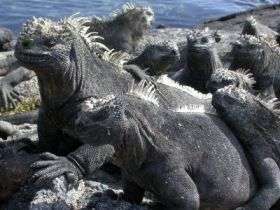
A before-and-after study led by Yale biologists, of the effects of 1997 El Niño on the genetic diversity of marine iguanas on the Galápagos Islands, emphasizes the importance of studying populations over time and the need to determine which environmental and biological factors make specific populations more vulnerable than others.
According to the authors, recurring El Niño events provide an ideal system to study the impact of human-mediated climate change on ecosystems worldwide, by allowing observation of changes in populations associated with individual events.
“Since global warming is expected to cause an increase in the strength and frequency of El Niño events, it is important to evaluate the impact of El Niño on natural populations and their capacity to respond to environmental stresses,” said Gisella Caccone, senior research scientist in ecology and evolutionary biology at Yale, and senior author of the paper published this week in the Public Library of Science (PLoS) One.
In this study, the researchers investigated the effect of sea surface warming associated with the single, intense El Niño event of 1997 to 1998 on genetic diversity in Galápagos marine iguana populations. They found that populations within the same species responded very differently.
Collaboration between German scientists who fortuitously collected and archived samples between 1991 and 1993 and Yale researchers who sampled the iguanas in 2004 enabled these unique before-and after comparisons. More than 800 samples from 11 Galápagos marine iguana populations were evaluated.
The researchers looked for changes in levels of genetic variation in nuclear microsatellite DNA and mitochondrial DNA markers of samples collected before and after this El Nino event. Changes in microsatellite frequency are sensitive enough to detect low population sizes before there is a significant loss of diversity in a population, whereas mitochondrial markers only show losses of diversity.
Caccone said that although some populations had mortality rates of up to 90%, only one population from a single island showed strong evidence of a “genetic bottleneck,” suggesting that the El Niño-induced disturbance affected populations very differently even within the same species.
“Our study points out that there was a low population size on the island of Marchena during the same period in which there was serious volcanic activity as well as the El Nino,” said Yale graduate student Scott Glaberman, a principal author of the study. “Since both of these forces could have acted on the population, it shows the importance of knowing the major forces influencing survival and reproduction to best interpret the results of genetic tests.
“The most striking result of our study is that although marine iguanas on some islands had a rather high mortality due to El Niño, the genetic consequences were mostly absent,” said author Sebastian Steinfartz a postdoctoral fellow. “This unique study shows that natural populations may be able to balance even severe short term climatic disturbances, and that such fluctuations will not necessarily have long-term negative consequences on the population structure.”
“Basic surveys and ecology of organisms are not the most glamorous aspects of research, but if used together with the exciting genetic approach in our study, they make for a very powerful approach,” said Glaberman.
“This underscores the importance of having baseline studies for any population of interest, and the value of archiving samples for the use of future research,” Caccone said. “It sets the basis for future research to determine which environmental and biological factors make specific populations more vulnerable than others.”
Source: Yale University


