NIST imaging system maps nanomechanical properties
December 12, 2007 NIST imaging system maps nanomechanical properties

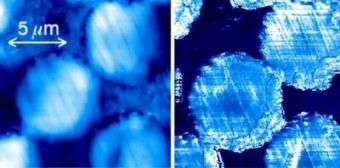
An atomic force microscope normally reveals the topography of a composite material (l.) NIST's new apparatus adds software and electronics to map nanomechanical properties (r.) The NIST system reveals that the glass fibers are stiffer than the surrounding polymer matrix but sometimes soften at their cores. Credit: DC Hurley/NIST

The National Institute of Standards and Technology has developed an imaging system that quickly maps the mechanical properties of materials—how stiff or stretchy they are, for example—at scales on the order of billionths of a meter. The new tool can be a cost-effective way to design and characterize mixed nanoscale materials such as composites or thin-film structures.

The NIST nanomechanical mapper uses custom software and electronics to process data acquired by a conventional atomic force microscope (AFM), transforming the microscope’s normal topographical maps of surfaces into precise two-dimensional representations of mechanical properties near the surface.

The images enable scientists to see variations in elasticity, adhesion or friction, which may vary in different materials even after they are mixed together. The NIST system, described fully for the first time in a new paper, can make an image in minutes whereas competing systems might take an entire day.

The images are based on measurements and interpretations of changes in frequency as a vibrating AFM tip scans a surface. Such measurements have commonly been made at stationary positions, but until now 2D imaging at many points across a sample has been too slow to be practical.

The NIST DSP-RTS system (for digital signal processor-based resonance tracking system) has the special feature of locking onto and tracking changes in frequency as the tip moves over a surface. Mechanical properties of a sample are deduced from calculations based on measurements of the vibrational frequencies of the AFM tip in the air and changes in frequency when the tip contacts the material surface.

NIST materials researchers have used the system to map elastic properties of thin films with finer spatial resolution than is possible with other tools. The DSP-RTS can produce a 256 × 256 pixel image with micrometer-scale dimensions in 20 to 25 minutes. The new system also is modular and offers greater flexibility than competing approaches. Adding capability to map additional materials properties can be as simple as updating the software.

Citation: A.B. Kos and D.C. Hurley. Nanomechanical mapping with resonance tracking scanned probe microscope. Measurement Science and Technology 19 (2008) 015504.

Source: National Institute of Standards and Technology


print this article email this article download pdf blog this article bookmark this article     Stumble it Digg this share on Facebook retweet share on Reddit add to delicious
Rate this story - 5 /5 (2 votes)


December 12, 2007 all stories

Comments: 0

5 /5 (2 votes)
  • Stumble this up

  • Digg this

  • share this

  • hide
  • Related Stories


  • hide
  • Relevant PhysicsForums posts

  • Why we dont use Magnet Motors?
    created 5 hours ago
  • e=mc^2
    created 6 hours ago
  • About electromagnetic waves
    created 6 hours ago
  • Blinding White Universe
    created 7 hours ago
  • More from Physics Forums - General Physics

Other News

carbon fiber

Ultra-Long Carbon Nanotubes Could Serve as Future Transmission Lines

Nanotechnology / Nanomaterials

created Nov 10, 2009 | popularity 4.9 / 5 (23) | comments 13

(PhysOrg.com) -- When it comes to carbon nanotubes, the majority of research so far has focused on small-scale applications. But now, a team of researchers from Rice University has created carbon nanotubes ...


Researchers turn algae into high-temperature hydrogen source

Researchers turn algae into high-temperature hydrogen source

Nanotechnology / Nanophysics

created Nov 12, 2009 | popularity 3.6 / 5 (7) | comments 5

In the quest to make hydrogen as a clean alternative fuel source, researchers have been stymied about how to create usable hydrogen that is clean and sustainable without relying on an intensive, high-energy ...


Argonne 'homegrown' hybrid solar cell aims for low-cost power

Argonne 'homegrown' hybrid solar cell aims for low-cost power

Nanotechnology / Nanomaterials

created Nov 10, 2009 | popularity 4.2 / 5 (11) | comments 3

(PhysOrg.com) -- Scientists at the U.S. Department of Energy’s (DOE) Argonne National Laboratory have refined a technique to manufacture solar cells by creating tubes of semiconducting material and then "growing" ...


Engineers image nanostructure of a solid acid catalyst and boost its catalytic activity

Nanotechnology / Nanomaterials

created Nov 09, 2009 | popularity 5 / 5 (3) | comments 2

The catalytic processes that facilitate the production of many chemicals and fuels could become much more environmentally friendly thanks to a breakthrough achieved by researchers from Lehigh and Rice Universities.


Research helps overcome barrier for organic electronics

Research helps overcome barrier for organic electronics

Nanotechnology / Nanomaterials

created Nov 10, 2009 | popularity 4.9 / 5 (9) | comments 0

(PhysOrg.com) -- Electronic devices can't work well unless all of the transistors, or switches, within them allow electrical current to flow easily when they are turned on. A team of engineers has determined ...