Without its insulating ice cap, Arctic surface waters warm to as much as 5 C above average
December 12, 2007
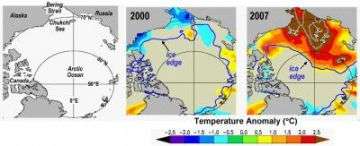
A comparison of 2000 and 2007 shows how the ice edge has retreated as the ice cap has shrunk and how surface waters have warmed compared to the 100-year average. For example, parts of the Bering Strait and Chukchi Sea were 3 and 3.5 degrees warmer than the historical average. The spot that was 5 degrees above average was found at the center of the 4 degree area of water north of the Chukchi Sea. Credit: Applied Physics Laboratory/UW
Record-breaking amounts of ice-free water have deprived the Arctic of more of its natural "sunscreen" than ever in recent summers. The effect is so pronounced that sea surface temperatures rose to 5 C above average in one place this year, a high never before observed, says the oceanographer who has compiled the first-ever look at average sea surface temperatures for the region.
Such superwarming of surface waters can affect how thick ice grows back in the winter, as well as its ability to withstand melting the next summer, according to Michael Steele, an oceanographer with the University of Washington's Applied Physics Laboratory. Indeed, since September, the end of summer in the Arctic, winter freeze-up in some areas is two months later than usual.
The extra ocean warming also might be contributing to some changes on land, such as previously unseen plant growth in the coastal Arctic tundra, if heat coming off the ocean during freeze-up is making its way over land, says Steele, who is speaking Wednesday at the American Geophysical Union meeting in San Francisco.
He is lead author of "Arctic Ocean surface warming trends over the past 100 years," accepted for publication in AGU's Geophysical Research Letters. Co-authors are physicist Wendy Ermold and research scientist Jinlun Zhang, both of the UW Applied Physics Laboratory. The work is funded by the National Science Foundation.
"Warming is particularly pronounced since 1995, and especially since 2000," the authors write. The spot where waters were 5 C above average was in the region just north of the Chakchi Sea. The historical average temperature there is -1 C – remember that the salt in ocean water keeps it liquid at temperatures that would cause fresh water to freeze. This year water in that area warmed to 4 C, for a 5-degree change from the average.
That general area, the part of the ocean north of Alaska and Eastern Siberia that includes the Bering Strait and Chukchi Sea, experienced the greatest summer warming. Temperatures for that region were generally 3.5 C warmer than historical averages and 1.5 C warmer than the historical maximum.
Such widespread warming in those areas and elsewhere in the Arctic is probably the result of having increasing amounts of open water in the summer that readily absorb the sun's rays, Steele says. Hard, white ice, on the other hand, can work as a kind of sunscreen for the waters below, reflecting rather than absorbing sunlight. The warming also may be partly caused by increasing amounts of warmer water coming from the Pacific Ocean, something scientists have noted in recent years.
The Arctic was primed for more open water since the early 1990s as the sea-ice cover has thinned, due to a warming atmosphere and more frequent strong winds sweeping ice out of the Arctic Ocean via Fram Strait into the Atlantic Ocean where the ice melts. The wind effect was particularly strong in the summer of 2007.
Now the situation could be self-perpetuating, Steele says. For example, he calculates that having more heat in surface waters in recent years means 23 to 30 inches less ice will grow in the winter than formed in 1965. Since sea ice typically grows about 80 inches in a winter, that is a significant fraction of ice that's going missing, he says.
Then too, higher sea surface temperatures can delay the start of freeze-up because the extra heat must be discharged from the upper ocean before ice can form. "The effect on net winter growth would probably be negligible for a delay of several weeks, but could be substantial for delays of several months," the authors write.
Source: University of Washington
-
Antarctic lake could reveal evolution, new life: scientists
Feb 09, 2012 |
not rated yet |
0
-
Study shows global glaciers, ice caps, shedding billions of tons of mass annually
Feb 08, 2012 |
4.4 / 5 (8) |
12
-
Russia 'drills into' Antarctic subglacial lake
Feb 06, 2012 |
4.8 / 5 (11) |
13
-
CU-Boulder-led team to assess decline of Arctic sea ice in Alaska's Beaufort Sea
Jan 26, 2012 |
5 / 5 (1) |
2
-
New study shows correlation between summer Arctic sea ice cover and winter weather in Central Europe
Feb 01, 2012 |
4.8 / 5 (5) |
0
-
Engineers build first sub-10-nm carbon nanotube transistor
Feb 01, 2012 |
4.9 / 5 (31) |
30
-
Something old, something new: Evolution and the structural divergence of duplicate genes
Jan 31, 2012 |
4.6 / 5 (7) |
1
-
The hidden nanoworld of ice crystals: Revealing the dynamic behavior of quasi-liquid layers
Jan 30, 2012 |
5 / 5 (3) |
1
-
Stock market network reveals investor clustering
Jan 27, 2012 |
3.9 / 5 (23) |
8
-
Of microchemistry and molecules: Electronic microfluidic device synthesizes biocompatible probes
Jan 26, 2012 |
5 / 5 (1) |
0
-
Discrepancy between oxygen and carbon-dioxide levels
Feb 09, 2012
-
where gems are found in the world
Feb 09, 2012
-
Wind Waves in Reservoir ~ Wind run-up and Wind set-up
Feb 08, 2012
-
Balance of oxygen in the atmosphere
Feb 01, 2012
-
The case for a methanol-based economy
Jan 30, 2012
-
Weather in a rotating cylinder
Jan 25, 2012
- More from Physics Forums - Earth
More news stories
Humans may have helped the decline of African rainforests 3000 years ago
(PhysOrg.com) -- Large areas of rainforests in Central Africa mysteriously disappeared over three thousand years ago, to be replaced by savannas. The prevailing theory has been that the cause was a change ...
Could Venus be shifting gear?
(PhysOrg.com) -- ESAs Venus Express spacecraft has discovered that our cloud-covered neighbour spins a little slower than previously measured. Peering through the dense atmosphere in the infrared, the ...
Space & Earth / Space Exploration
18 hours ago |
5 / 5 (7) |
8
|
NASA budget will axe Mars deal with Europe: scientists
US President Barack Obama's budget proposal to be submitted next week for 2013 will cut NASA's budget by 20 percent and eliminate a major partnership with Europe on Mars exploration, scientists said Thursday.
Space & Earth / Space Exploration
21 hours ago |
5 / 5 (2) |
18
Two new moons for Jupiter
Advances in technology have lead to the discovery of new planets outside of our Solar System, and now even new moons in our own backyard.
Space & Earth / Space Exploration
18 hours ago |
4 / 5 (1) |
7
Mars Science Laboratory computer issue resolved
(PhysOrg.com) -- Engineers have found the root cause of a computer reset that occurred two months ago on NASA's Mars Science Laboratory and have determined how to correct it.
Space & Earth / Space Exploration
19 hours ago |
4.7 / 5 (6) |
3
|
Anonymous knocks CIA website offline (Update)
The website of the Central Intelligence Agency was inaccessible on Friday after the hacker group Anonymous claimed to have knocked it offline.
New error-correcting codes guarantee the fastest possible rate of data transmission
Error-correcting codes are one of the triumphs of the digital age. Theyre a way of encoding information so that it can be transmitted across a communication channel such as an optical fiber o ...
Google users warned of threat to smartphone wallets
Users of Google smartphone wallets were being warned on Friday that there is a way to crack pass codes intended to thwart thieves from going on illicit shopping sprees.
New power source discovered
(PhysOrg.com) -- Researchers at the Massachusetts Institute of Technology (MIT) and RMIT University have made a breakthrough in energy storage and power generation.
Small modular reactor design could be a 'SUPERSTAR'
(PhysOrg.com) -- Though most of today's nuclear reactors are cooled by water, we've long known that there are alternatives; in fact, the world's first nuclear-powered electricity in 1951 came from a reactor ...
The power of estrogen -- male snakes attract other males
A new study has shown that boosting the estrogen levels of male garter snakes causes them to secrete the same pheromones that females use to attract suitors, and turned the males into just about the sexiest ...