'Yes, Virginia, physics can be fun!'
Since the release of a 1983 report commissioned by the federal government, Americans have been aware of a significant decrease in the number of US students pursuing studies and careers in the sciences and engineering. As a result of this deficiency, the United States has become increasingly dependent upon foreign-born scientists and researchers to drive technological progress.
According to The New York Times, the National Academies released a report in 2005 confirming this trend and highlighting the seriousness of the problem in terms of “threatening America’s strategic and economic security.” Why do many young Americans have little enthusiasm for science and what can be done to pique their interest? Nobel Laureate Dr. Robert Richardson says that, “Science and math need to be made more interesting to our students…they say it’s boring and hard. And while math and science are hard, they don’t have to be boring.”
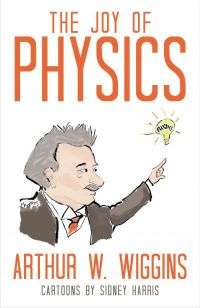
Physics professor Arthur W. Wiggins agrees and insists that physics can be made enjoyable for anyone with even the slightest curiosity about how the universe works. In order to spread his enthusiasm for the subject, he wrote The Joy of Physics (Prometheus Books $26.95), a fun-filled, hands-on, and truly educational tour of this all-important science. Dr. James Trefil, Professor of Physics at George Mason University, says, “’Joy’ and ‘Physics’ aren’t two words that are often associated with one another. Arthur Wiggins’s book, though, is just plain fun.”
What makes the study of physics so worthwhile? Wiggins says that, despite its reputation for difficulty, physics has an enormously ambitious goal, which appeals to people’s innate curiosity: to understand the workings of the entire universe, from the smallest quarks to the largest galaxies. Learning and comprehending as much as we can about the inner and outer workings of the universe is what evokes the joy of physics.
Taking a hands-on approach, he invites the reader to share his excitement. Easy, practical experiments pepper the book and connect the ideas of physics with the reality of the universe. The yo-yo, flying disc, shake flashlight, laser pointer, LED, and even a microwave experiment with an edible result add to the fun. Understanding and enjoyment go hand in hand as the whole enterprise of physics is explored, explained, and illustrated with clear, recognizable examples and with good humor. Explanations of motion, energy, sound, electricity, and magnetism lead to intriguing discussions of such groundbreaking ideas as relativity, quarks, string theory, and dark energy.
Publisher's Weekly says that The Joy of Physics, “makes genuine fun out of rigorous science…Wiggins’s friendly, stress-free approach will teach readers how to measure, observe, and calculate, and he enriches his study with short history lessons and biographies of physics pioneers...With the exception of chapters on nuclear and astrophysics, each chapter contains quick-and-easy experiments…Clever cartoons by Sydney Harris and quotes from such worthies as Jeff Foxworthy provide laugh-out-loud moments, while the very human travails of pioneers like Tesla and Bernoulli remind us that life (and science) is seldom easy, even for geniuses. A welcome volume, Wiggins’s gentle but thorough text could do much to quell perennial student bellyaching over introductory physics courses.”
Professor Wiggins aptly concludes, “Physics plays a key role in the future of our civilization. We cannot afford a large disconnect between physics and the rest of the culture…physicists have an obligation to help people understand how the universe works. And people, as thinking members of this universe, have a responsibility to work toward an understanding of physics…How better to approach understanding than through joy?” This book is a great step toward exposing new generations of people to the wonders of the universe and promoting excitement for science, something that is sure to benefit us all.
Source: Prometheus Books


